Interest: calculate a transparent model and trace economic effects
By UK GCSE Business · independent study · myAudience
Original myAudience educational illustration. Image: illustration, not a documentary photograph. · myAudience educational illustration; no affiliation with any awarding body.
Interest: calculate a transparent model and trace economic effects
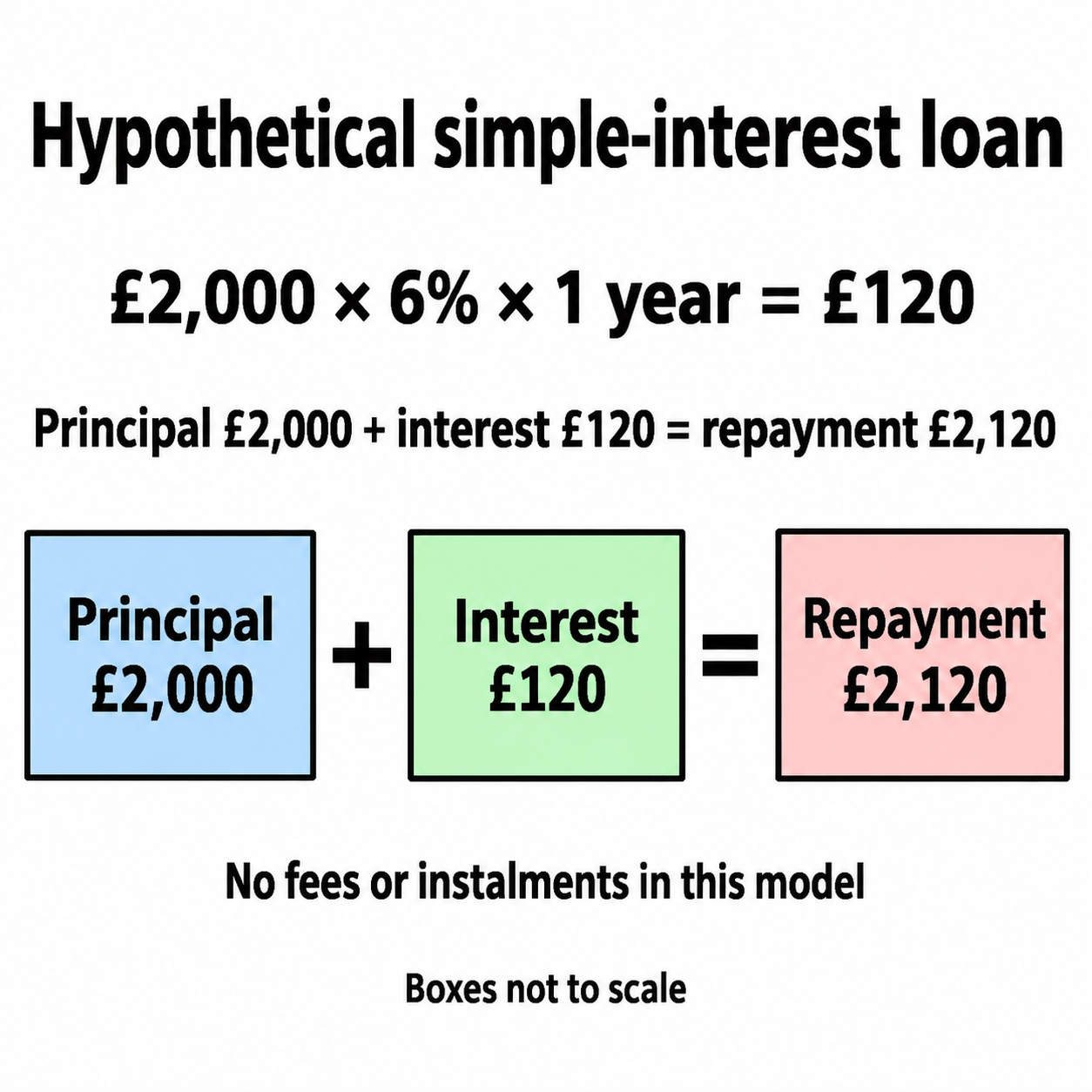
Interest is a cost of borrowing or a return to lending and saving. For a stated simple-interest model, interest = principal × annual rate as a decimal × time in years. A 6% rate means 0.06; six months means 0.5 year. This calculation holds principal constant and excludes compounding, repayments and fees. It is an illustrative calculation extension, not a promise about actual credit terms. The symbolic boxes in the image show principal plus interest equals repayment; their sizes do not encode monetary scale.
A rate rise can increase payments on variable-rate debt, leaving less cash for investment. Fixed-rate borrowing may not change immediately. Higher borrowing costs can also reduce customers’ discretionary spending; essential repairs may react differently from luxury purchases. Savers can gain interest income, so effects differ across households and businesses. Employment changes affect available labour, recruitment costs and customer incomes, while spending changes affect demand. Trace a mechanism to this business rather than asserting that every business loses from higher interest. Bank of England educational guidance on interest transmission was checked on 4 October 2026; no current Bank Rate or inflation statistic is asserted.
Distinguish an interest-rate change in percentage points from a percentage change in the rate. A rise from 6% to 8% is two percentage points but a one-third increase in the rate. Do not infer that all costs rise by one third: only the relevant interest element does under the assumptions. Transfer criterion: show units and conversion, calculate a sensitivity, then develop a second channel through customer demand or suppliers with a reasoned caveat. A model answer is not financial advice and does not guarantee borrowing access.
The simple-interest illustration holds the principal constant until final repayment and excludes fees. Under those assumptions, multiplying principal by annual rate and years gives the stated cost. A loan repaid gradually has a changing outstanding balance; compounding or charges can also change the schedule. Do not use the simple calculation as a universal quotation or silently apply an annual rate to six months as though a full year had elapsed.
A change from 6% to 8% is two percentage points. Dividing the difference by the original 6% gives roughly a one-third increase in the rate, not a one-third increase in every business cost. Exposure depends on the debt terms and amount. A fixed rate may protect an existing payment for a specified period, while new borrowing or refinancing can face different conditions.
Interest can reach an enterprise through customers as well as its own borrowing. Higher credit costs may discourage some expensive discretionary purchases, and an increased return to saving can change spending incentives. These are plausible channels, not universal predictions: customer income, financing choices and the product's appeal also matter. The Bank of England explainer supports the mechanism; its dated discussion is not evidence of today's rate or this workshop's actual demand.
Evaluated model for the original workshop question. The workshop's existing debt has a fixed rate for two years, so a rise in rates need not immediately increase the payments on that debt. We should check the precise agreement rather than assume every borrowing cost changes at once. One possible effect is on new finance: a further loan or refinancing after the fixed period may be more expensive. That can reduce the cash available from an investment and make repayment harder if expected demand is not achieved. The simple worked example illustrates direction under its own assumptions: £2,000 for a year costs £120 at 6% and £160 at 8%, an extra £40. Those rates are hypothetical and are not a quotation for the workshop or evidence of current policy. A second effect is indirect. Customers buying expensive leisure accessories may use credit or decide between spending and saving. Higher borrowing costs can discourage some purchases, reducing the workshop's sales and contributions even while its existing debt payment remains unchanged. The channel is plausible, but the question does not establish that all customers borrow or respond identically.
I would prepare separate demand and finance scenarios rather than announce a certain fall in profit. Customer enquiries, cancellations and sales trends could indicate whether demand is weakening; written offers and the expiry date of the fixed arrangement would clarify direct exposure. A cautious response is to preserve a cash reserve and reconsider discretionary expansion if the new payment schedule relies on optimistic sales. However, postponing an investment has an opportunity cost. A machine that lowers waste or enables a valued product might strengthen competitiveness precisely when customers become selective, and delaying it could leave the workshop behind rivals. The decision should therefore compare the investment's evidenced operational benefit with its financing and demand risks, rather than treat a rate rise as an automatic instruction to stop investing. A smaller staged commitment might reduce exposure if feasible. Evidence of resilient customers paying without credit and a strong cost-saving project could justify proceeding despite higher new rates. Evidence of uncertain demand and unaffordable repayment would favour postponement. My recommendation is conditional: protect near-term cash, distinguish the two-year protection on old debt from future borrowing, and use dated, relevant evidence before changing the plan. This addresses both channels without importing a current rate, assuming universal customer behaviour or claiming that fixed debt removes every economic risk.
Worked example: Hypothetical £2,000 loan for one year at simple interest 6%, with all principal repaid at the end and no fees. Compare 8%; then calculate six months at 6%.
At 6%, interest = £2,000 × 0.06 × 1 = £120; repayment £2,120, matching the image.
At 8%, interest = £160; repayment £2,160. Extra annual cash cost = £40.
Six months at 6% gives £2,000 × 0.06 × 0.5 = £60; repayment £2,060.
The 6% to 8% move is +2 percentage points and approximately +33.3% in the rate. A real loan with declining principal or fees needs a different schedule.
Answer: The model yields £120, £160 and £60 interest respectively. The rates are hypothetical, not current policy or lender quotes.
Check your understanding: A hypothetical workshop has fixed-rate debt for two years but sells expensive leisure accessories. Analyse two possible effects of a rate rise and recommend a cautious response.
Answer: Its existing fixed debt may be unaffected immediately, but new finance can be dearer and credit-funded customer demand may weaken. Test demand and cash scenarios, preserve a reserve and compare postponing discretionary investment with its competitive cost.
Why: A strong response separates direct financing exposure from indirect demand exposure, states the timing and avoids a universal prediction. Current rates are deliberately absent; any policy-rate claim in a later revision requires a dated primary-source check.