Investment appraisal: average return is evidence, not a decision
By UK GCSE Business · independent study · myAudience
Original myAudience educational illustration. Image: illustration, not a documentary photograph. · myAudience educational illustration; no affiliation with any awarding body.
Investment appraisal: average return is evidence, not a decision
Investment in machinery, buildings or vehicles commits money now for future benefits. Average rate of return (ARR) compares average annual profit from a project with its initial investment: average annual profit ÷ initial investment × 100. If supplied figures are net cash returns before recovering the investment and there is no residual value, subtract initial investment from total returns, then divide by years to find average annual profit. If the question already supplies annual profits, do not subtract the investment again. State which definition the data uses.
ARR provides a percentage comparison across project sizes, but an average hides timing and uncertainty. Two projects can have the same ARR while one brings receipts later, creating a bigger funding strain. A higher percentage project may yield less total profit than a larger project. Reliability, worker training, service access and environmental impacts can change the judgement. The interest image reinforces that finance costs exist alongside investment returns; its 6% hypothetical simple-interest rate is not an ARR or an appropriate universal minimum return.
Use forecasts consistently and do not silently add an assumed resale value, tax saving or real company return. Depreciation and more advanced appraisal are outside this first model. Sensitivity testing shows how a decision depends on expected returns. Transfer criterion: interpret a stated return measure, compare percentage and absolute gains, explain timing and a qualitative trade-off, then give a conditional investment decision with a relevant evidence request.
The denominator in ARR is initial investment, not sales revenue or the remaining bank balance. Its numerator is average annual profit under the stated project definition. If the starting information is net operating cash returns before recovery of the machine's purchase cost, subtract that cost once to obtain total project profit, then average across the stated life. If annual profit is supplied directly, subtracting the initial investment again would wrongly reduce it twice. In the illustration, trace capital recovery once before averaging profit over four years. The operating cash-return row is deliberately before capital recovery; it is not already the annual-profit row.
ARR compares a return rate, whereas absolute annual profit measures an amount. The larger investment can earn more pounds while yielding a lower percentage. Neither ranking automatically overrides a funding constraint. ARR also averages across years and does not itself locate receipt dates: the same average can mask a long wait before cash arrives. A promise of guaranteed interest is different from a forecast project profit and should not be substituted.
The worked illustration stipulates four years, zero residual value and cash returns before capital recovery. Changing these assumptions changes the calculation. Its sensitivity case shows why a precise percentage can still rest on uncertain sales and operating costs. Examine usable capacity, quality, funding and the reliability of returns; the option with the highest estimated percentage may be unable to deliver the enterprise's required output or service.
Evaluated model for the original cash-constrained investment question. The first option produces £500 average annual profit on a £5,000 initial cost, so ARR is £500 ÷ £5,000 × 100 = 10%. The second produces £1,200 on £15,000, giving £1,200 ÷ £15,000 × 100 = 8%. Since average annual profit is already given, the purchase cost must not be subtracted from it again. The first option has the higher percentage return and requires £10,000 less initial funding. For a cash-constrained enterprise, that lower commitment is a strong reason to prefer it provisionally: it may be achievable without sacrificing funds needed for wages, materials and other obligations. However, the second option earns £700 more average annual profit in absolute terms. Rejecting it solely because 8% is below 10% would ignore a potentially valuable increase in the amount earned. The figures describe forecasts, not guaranteed cash receipts or a savings interest rate, and neither option is automatically affordable just because its ARR is positive.
I would ask how much verified funding the enterprise has, when returns arrive and whether the smaller option provides sufficient capacity and quality. The question gives no project life, receipt schedule or residual value, so total lifetime profit and a financing cost cannot be calculated honestly. If the £5,000 option can meet demand and preserve an operating reserve while the larger one cannot be funded reliably, the smaller option is the more defensible choice. Yet insufficient capacity could lead to lost orders, or weaker quality could cause complaints that undermine the forecast. The larger option might then be preferable if evidence shows enough extra demand and suitable finance without threatening cash continuity. Borrowing to obtain it adds obligations that the quoted project-profit figures may not include; those terms need a revised appraisal rather than an assumed free £10,000. I would also test lower sales or higher operating costs to see whether the expected gains remain credible. My recommendation is therefore the first option under the stated cash constraint, subject to confirming its operational suitability and receipt timing. Verified affordable finance and strong evidence of demand beyond the smaller option's capacity could reverse that recommendation. A sound judgement uses both percentage efficiency and absolute gain, relates them to the enterprise's constraint, and names the missing evidence rather than presenting the larger number or the higher rate as a universal rule.
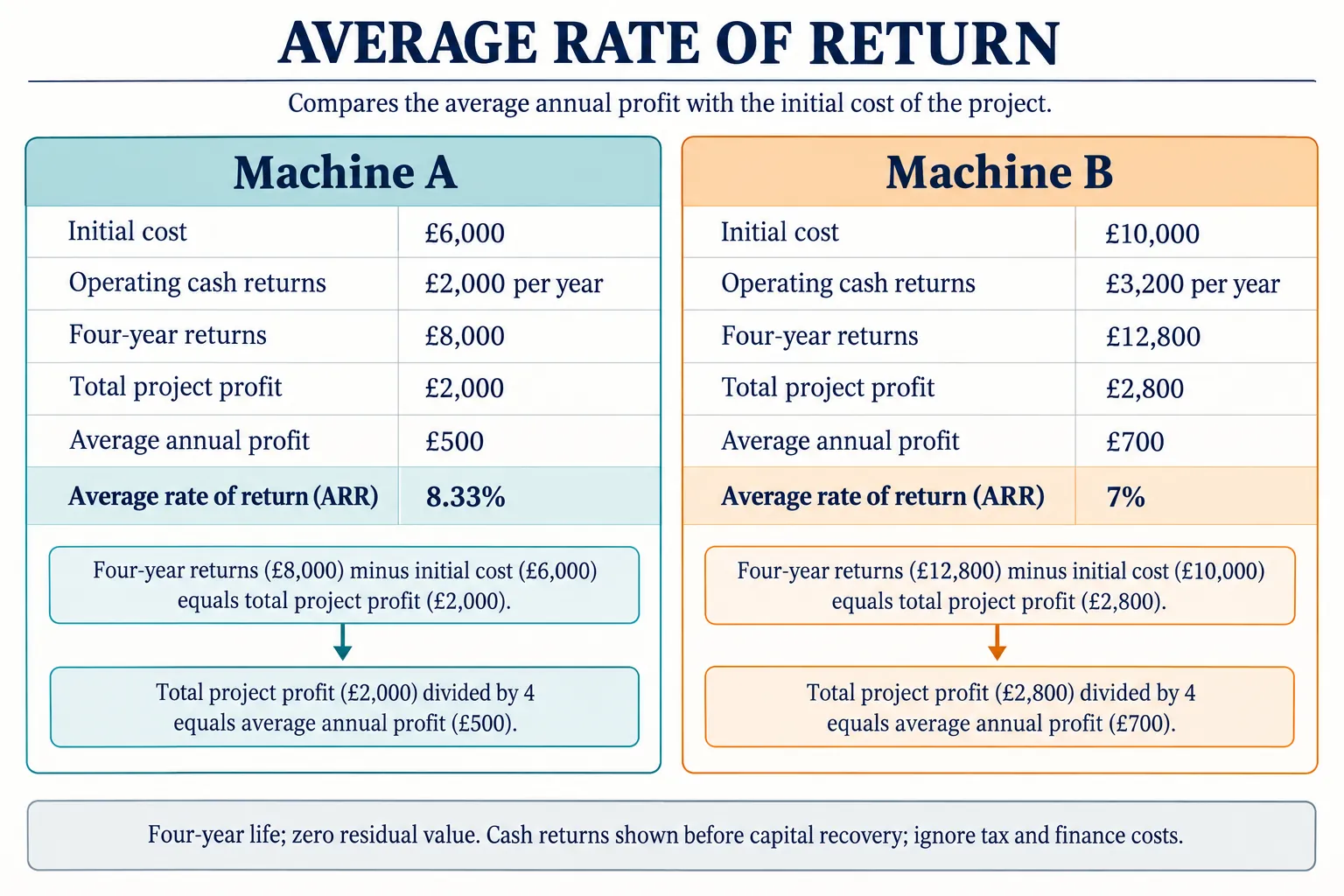
Worked example: Hypothetical machine A costs £6,000 and yields net operating cash returns of £2,000 annually for four years, before recovering its cost. No residual value. B costs £10,000 and returns £3,200 annually for four years. Ignore tax and finance costs. Compare ARR.
A total returns = £8,000; total project profit = £8,000 − £6,000 = £2,000; average annual profit = £500.
A ARR = £500 ÷ £6,000 × 100 ≈ 8.33%.
B returns £12,800; total profit £2,800; average annual profit £700; ARR = £700 ÷ £10,000 × 100 = 7%.
A has higher ARR but B higher total profit. If A’s annual returns are only £1,600, total profit £400, annual average £100 and ARR ≈ 1.67%; the forecast matters.
Answer: A has the higher forecast ARR, B the larger absolute profit. Neither is automatically preferable without capacity, finance and reliability evidence.
Check your understanding: A hypothetical investment gives £500 average annual profit on £5,000 initial cost. Another gives £1,200 on £15,000. Which is better for a cash-constrained enterprise?
Answer: ARR is 10% versus 8%. The smaller option has a higher percentage and lower funding need, so may fit the constraint, but verify receipt timing, adequate capacity and quality before choosing it.
Why: The decision should explain why the cash constraint is relevant, acknowledge the larger absolute annual gain and identify what could reverse the recommendation. ARR is an estimate of accounting/project return under the stated definition, not guaranteed interest or cash availability.