Production: choose job or flow by demand, variety and capacity
By UK GCSE Business · independent study · myAudience
Original myAudience educational illustration. Image: illustration, not a documentary photograph. · myAudience educational illustration; no affiliation with any awarding body.
Production: choose job or flow by demand, variety and capacity
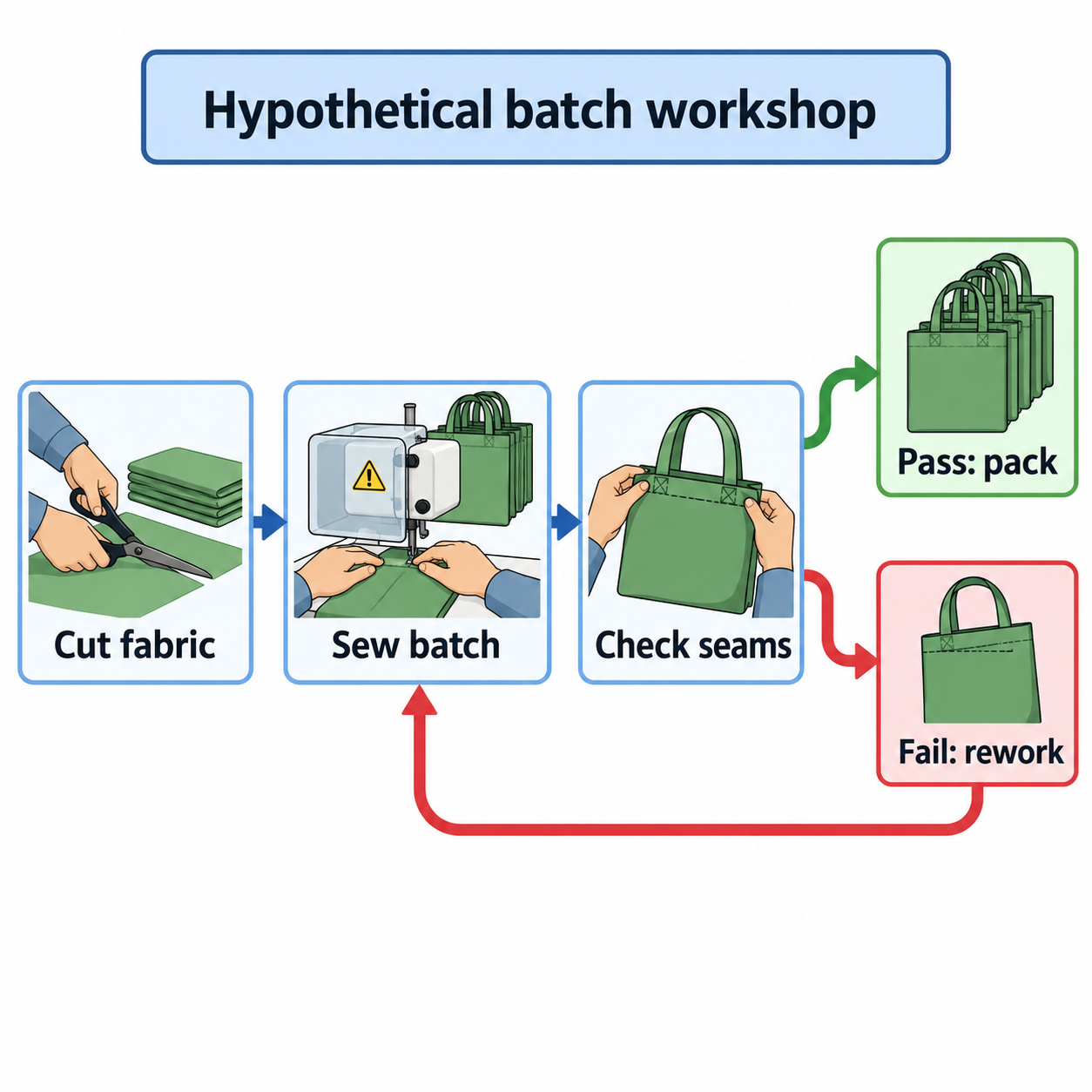
Job production completes an individual customised task, such as a repair tailored to one bicycle. It can support variety and skilled work but takes time and makes standardisation difficult. Flow production passes standardised products through sequenced stages repeatedly, suited to sustained high-volume demand. It can reduce unit costs through specialisation and equipment, yet entails setup cost, less flexibility and disruption if a critical stage stops. These are the two assessed methods here. Batch production, shown by the bag-workshop image, is a labelled comparison extension: a group is processed before equipment or tasks change for another group.
Efficiency means using resources well to achieve useful output, not simply running workers faster. Average unit cost = total cost ÷ units produced, with a defined period and comparable quality. Labour productivity compares output with labour input, but is an extension measure here rather than a substitute for safe quality. Lean production aims to remove waste, such as defects, waiting and unnecessary movement. A bottleneck limits the whole process: increasing cutting speed does little if sewing is the slowest stage. Finance must fund equipment, marketing must establish demand and human resources must support training.
The image’s check/rework loop shows why counting gross production can overstate useful output. Flow may be suitable for identical large orders while job production suits varied repairs; one business can use different methods for different activities. Lower unit cost is valuable only if output can be sold and quality maintained. Transfer criterion: compare methods using variety, volume and constraints; calculate a like-for-like cost; then recommend a method with a demand condition and a people or quality safeguard.
Worked example: Hypothetical standard bags: job method costs £2,400 for 200 saleable bags; a flow line costs £5,000 for 500 saleable bags. A firm has firm orders for 220 bags and no reliable further demand. Compare unit costs and decision relevance.
Job unit cost = £2,400 ÷ 200 = £12; flow unit cost = £5,000 ÷ 500 = £10 at the stated outputs.
The lower flow average assumes 500 saleable bags. At only 220 demanded, the firm cannot count 500 sales or assume the £10 cost persists.
Job’s stated capacity of 200 falls short of 220, so investigate feasible extra capacity or a different schedule rather than assuming it fulfils the order.
Recommend a staged capacity plan after quotes and demand checks; a flow commitment needs credible demand, financing and training. Neither initial cost average alone settles the decision.
Answer: The arithmetic favours flow at its stated scale, but the firm lacks demonstrated demand for that scale and needs a feasible 220-unit plan.
Check your understanding: A hypothetical production process can cut 100 pieces/hour, sew 60 and inspect 80. Analyse whether buying a faster cutter increases finished output.
Answer: With one unit needed at each stage and no other constraints, sewing limits output to 60/hour. A faster cutter creates more work waiting unless sewing capacity improves. Investigate training or balanced capacity while retaining inspection quality.
Why: A bottleneck is a whole-system constraint. A good answer states the units and assumptions and connects a machine purchase to the intended output. Process improvements must not remove safety checks or turn unsold work in progress into claimed revenue.