Procurement and stock: compare delivered value and resilience
By UK GCSE Business · independent study · myAudience
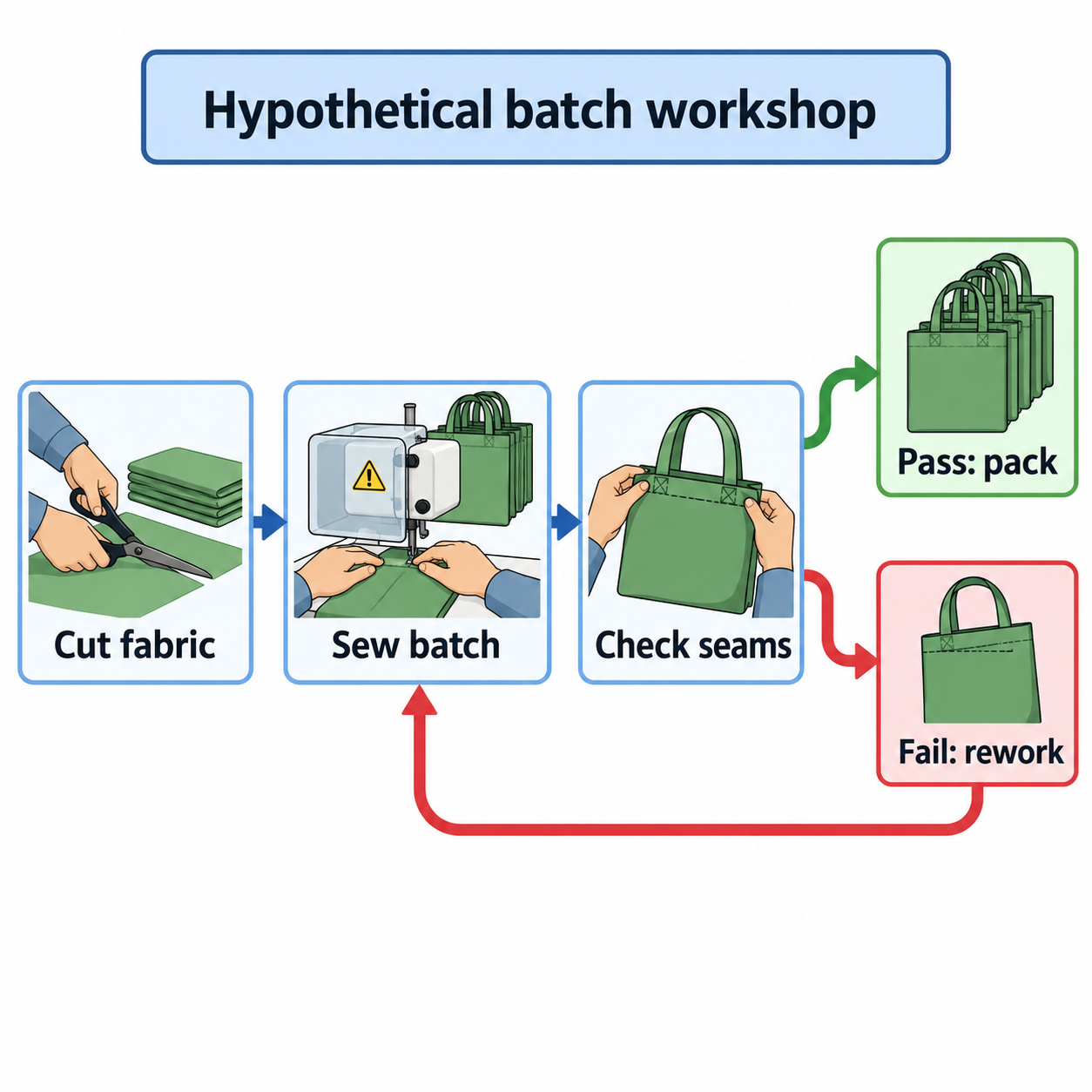
Original myAudience educational illustration. Image: illustration, not a documentary photograph. · myAudience educational illustration; no affiliation with any awarding body.
Procurement and stock: compare delivered value and resilience
Procurement obtains goods and services; logistics manages their movement and storage. A supply chain connects suppliers, producers and customers, so a delay upstream can interrupt sales downstream. Compare delivered value using price, quality and reliability, not the invoice price alone. Purchasing economies of scale can lower unit prices, yet a large order ties up cash and risks unused stock. The workshop image starts with fabric and ends with checked bags: choosing weak fabric can create waste and rework at later stages.
Just in time (JIT) aims to receive stock close to use, reducing holding costs and waste. It relies on reliable suppliers and transport and can require frequent deliveries that lose bulk discounts. Just in case (JIC) holds buffer stock against disruption or demand surprises, at the cost of cash, space, deterioration and possible waste. JIT is not synonymous with having absolutely zero inventory; JIC is not an excuse for unlimited stock. This specification does not require stock-control charts. Teach the trade-off using a specific disruption and capacity case instead.
In a hypothetical UK bag importer sourcing from an Indian worker-owned workshop, assess agreed pay and hours, safe conditions, realistic lead times and worker voice rather than making assumptions from geography. The ILO child-labour guidance checked on 4 October 2026 supports attention to harmful conditions; no claim about this imagined supplier is factual. Trace environmental trade-offs too: frequent deliveries can increase transport effects, but stock that spoils also wastes resources. Transfer criterion: quantify a comparable cost, examine disruption and ethical conditions, and justify a stock policy with a trigger for review.
Worked example: Hypothetical 100 fabric units: supplier A charges £5 each plus £40 delivery; 5 units are unusable and cannot be replaced or refunded. Supplier B charges £5.50 each with free delivery and all 100 usable. Compare delivered cost per usable unit; demand requires 100.
A total delivered cost = 100 × £5 + £40 = £540; usable units 95; cost per usable unit = £540 ÷ 95 ≈ £5.68.
B costs £550 for 100 usable units; cost per usable unit £5.50.
A has a lower invoice total but a higher usable-unit cost and a five-unit shortage. Buying replacements adds further cost and delay not yet quoted.
Prefer B if quality and reliability assumptions hold and conditions are responsible. A stronger supply contract or evidence of different defect rates could change the comparison.
Answer: B offers better usable-unit value and fulfils the need under these hypothetical assumptions; invoice price alone gives the wrong signal.
Check your understanding: A hypothetical repair service uses rare parts with uncertain delivery, limited cash and little storage. Recommend pure JIT, large JIC stocks or a selective buffer.
Answer: A selective buffer of critical, frequently needed parts can protect service while limiting cash tied up. Use JIT for reliable, less critical items. Assess delay cost, shelf life and actual demand before deciding buffer quantities.
Why: The judgement balances resilience against holding costs instead of labelling one system universally best. It develops a business-specific reason, checks feasibility and recognises suppliers and customers as people affected by the policy.