2. Global water stores: denominators and residence times
By UK A Level Geography · independent study · myAudience
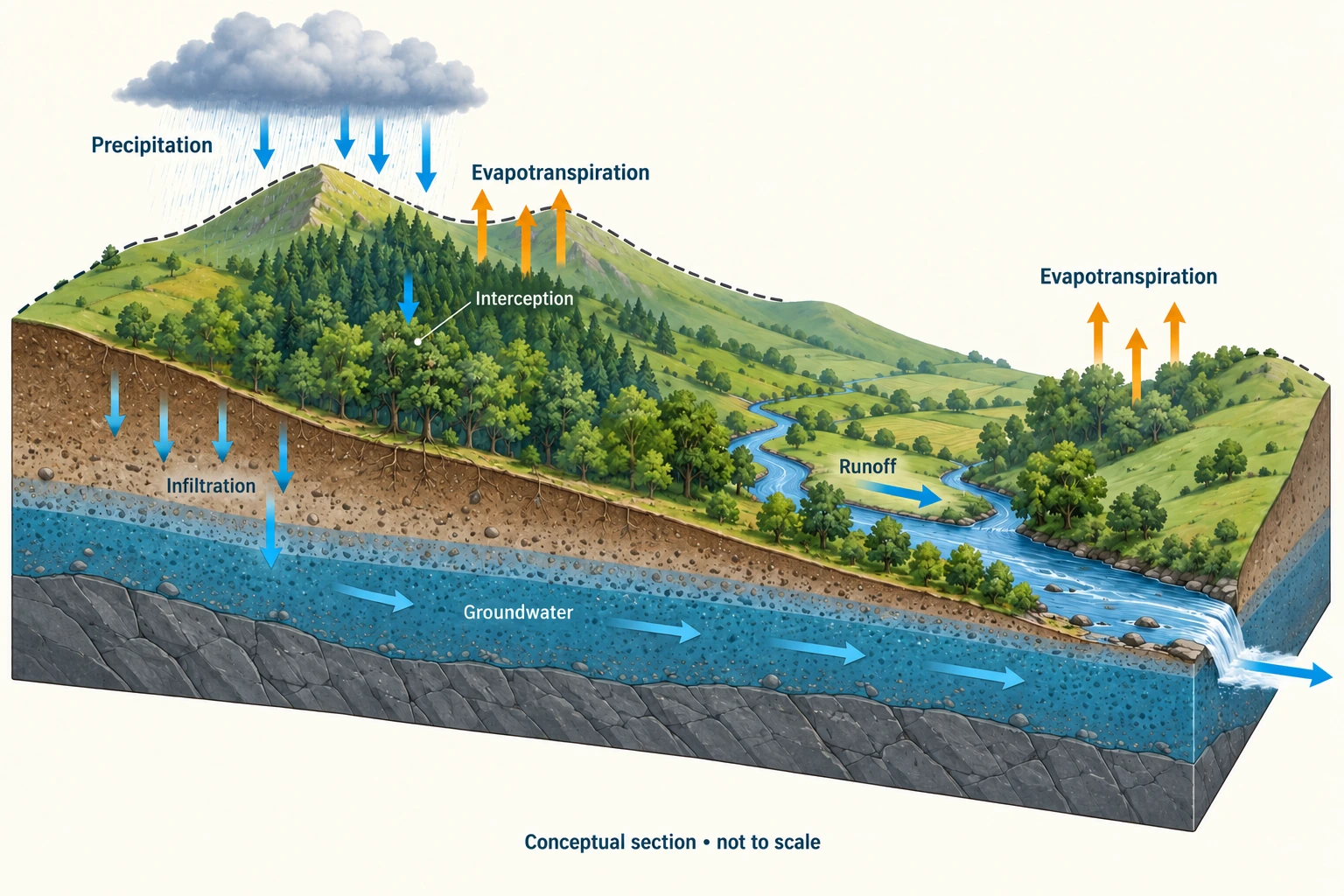
Image: illustration, not a documentary photograph. · Original generated teaching artwork; provenance retained. No, government or research-body endorsement.
2. Global water stores: denominators and residence times
Water availability depends on where water is stored, its quality and how rapidly it is renewed. The hydrosphere includes oceans and other water bodies; the cryosphere includes frozen water; groundwater lies within the lithosphere; atmospheric water includes vapour and condensed droplets or ice. These geographical categories overlap in everyday terminology, so use a table's definitions rather than adding all category headings blindly. Fresh groundwater is a subset of total groundwater. Summing both would count the same water twice. A large saline ocean store is not directly equivalent to an accessible freshwater supply.
USGS publishes a reference distribution attributed to Shiklomanov's chapter in Gleick's 1993 Water in Crisis. Its ocean value is 1,338,000,000 km³; total water is 1,386,000,000 km³; fresh groundwater is 10,530,000 km³; ice caps, glaciers and permanent snow total 24,064,000 km³. These are historical global inventory estimates, accessed 4 October 2026, not measurements made in 2026. Rounding and definitions matter. The table's 30.1% fresh-groundwater figure has total freshwater as its denominator, whereas 0.76% uses all water. Both can describe the same store without contradiction.
Residence time is often approximated by store divided by a representative outflow rate. Its units are time: km³ divided by km³ per year gives years. This is a characteristic turnover estimate under assumptions of a sufficiently stationary store and defined exchange. It is not the age of every molecule, a forecast of when an aquifer will empty, or proof that recharge can replace abstraction. Mixtures of fast fractures and slowly moving pore water can have very different travel times. If the outflow estimate covers only one pathway, the calculated turnover is for that pathway, not necessarily the whole store.
The small atmospheric store can have rapid turnover while ice sheets and some groundwater stores renew much more slowly. That distinction explains why rain can change rapidly without exhausting the global ocean. Melting converts ice into liquid; it transfers existing water rather than creating water. Ocean evaporation removes water but leaves most dissolved salts behind; condensation and precipitation return it in different places. At basin scale these transfers connect atmospheric circulation with local relief and land cover. At global scale the basin plate remains only an analogy: it omits ocean circulation and most frozen stores.
Uncertainty is not removed by precise arithmetic. Dividing rounded reference values produces extra decimal places without extra knowledge. A useful answer retains enough precision to distinguish orders of magnitude and labels the date and source of the estimates. Distinguish a percentage-point change from a percentage change: a share rising from 20% to 25% rises five percentage points, or 25% relative to its original share. Neither statement by itself tells you whether the absolute amount grew, because the denominator may have changed.
An extended argument about water scarcity should connect store size to replenishment, location, infrastructure, affordability and quality. A country with abundant annual runoff can still have dry-season shortages or contaminated supply. Conversely, storage and demand management can make a modest flow more reliable. This is a conditional argument about access rather than a deterministic claim that climate fixes economic outcomes. Use supply observations and information about users to test it. Do not use the fictional turnover calculation below as a factual estimate for a named aquifer.
Worked example: Using the USGS reference values above, calculate the ocean share and fresh-groundwater share of total water. Then analyse a separate fictional aquifer with a 12 km³ store and a 0.30 km³/year outflow. A drought reduces the store to 11 km³ and outflow to 0.20 km³/year: does the longer turnover mean improved security?
Evaluated extension (original task): Evaluate whether larger stock and longer turnover imply greater water security.
Ocean share = 1,338,000,000 / 1,386,000,000 × 100 = 96.54% to two decimals.
Fresh groundwater / total water × 100 = 10,530,000 / 1,386,000,000 × 100 = 0.7597%, about 0.76%.
Fictional turnover changes from 12 / 0.30 = 40 years to 11 / 0.20 = 55 years.
The store and transfer both declined. A longer quotient therefore does not demonstrate more renewable supply.
A larger water stock or longer calculated turnover is not sufficient evidence of greater water security. Security concerns accessible water of suitable quality arriving when users and ecosystems require it. The historical USGS distribution table illustrates the denominator problem: ocean volume divided by total water gives approximately 96.54%, whereas fresh groundwater divided by total water gives approximately 0.76%. These are not percentages of the same freshwater subset. Groundwater's fresh and saline entries are components of total groundwater, so adding all three would double-count them. The inventory is a dated estimate, not a measurement of today's locally available supply.
The supplied turnover example makes the distinction sharper. A store of 12 km³ with 0.30 km³ of outflow per year has a simple stock-to-throughput quotient of 40 years. A smaller store of 11 km³ with 0.20 km³ of outflow per year produces 55 years. Turnover becomes longer despite a lower stock and slower modeled outflow. A claimant who interprets 55 years as an improved guarantee reverses the significance of the declining flux. Under a 10% stock increase and 25% throughput increase, the quotient changes by 1.10/1.25=0.88, a 12% decrease. This ratio is not an age assigned to every water molecule or a sustainable withdrawal rate.
Physical access and timing further weaken a ranking based on global volume. Saline ocean water cannot be treated as interchangeable with freshwater without considering treatment, energy, infrastructure and environmental consequences. Ice is a store but may be distant from demand; extracting slowly replenished groundwater can temporarily increase supply while reducing later availability. Seasonal rainfall and storage capacity determine whether an apparently abundant annual resource can meet dry-period demand. Pollution can restrict usable supply without much change in total volume. These mechanisms show why a stock inventory and a turnover calculation answer different questions from a local assessment of security.
I would therefore compare accessible storage, reliable replenishment, demand, quality and ecological requirements on matching spatial and temporal scales. A larger stock can improve buffering if it is usable, replenished and fairly accessible; a longer quotient can warn of slower replacement instead of greater security. Useful corroboration would include repeated groundwater levels, seasonal flow observations, recharge uncertainty and evidence of who controls access. Where data establish adequate reliable supply without progressive depletion or harmful diversion, the security argument is stronger. Without those conditions, the defensible conclusion is about relative inventory or modeled turnover only, not a guaranteed duration of safe supply.
Answer: The historical inventory shares are approximately 96.54% and 0.76%. The fictional turnover rises from 40 to 55 years while available storage falls; renewal and demand evidence are needed before judging security.
Check your understanding: Transfer: a model store increases 10% while outflow increases 25%. Find the relative change in its turnover time and explain why this is not a percentage-point calculation.
Answer: New turnover / old turnover = 1.10 / 1.25 = 0.88, so turnover falls 12%. This compares a quantity in years with its initial value, not two percentage shares. The change could reflect faster exchange rather than improved long-term security.
Why: The denominator responds too. Ratios can move against their numerators. Inventory estimates, turnover models and observed availability answer different questions and must not be substituted for each other.