4. Basin water balance with a missing transfer
By UK A Level Geography · independent study · myAudience
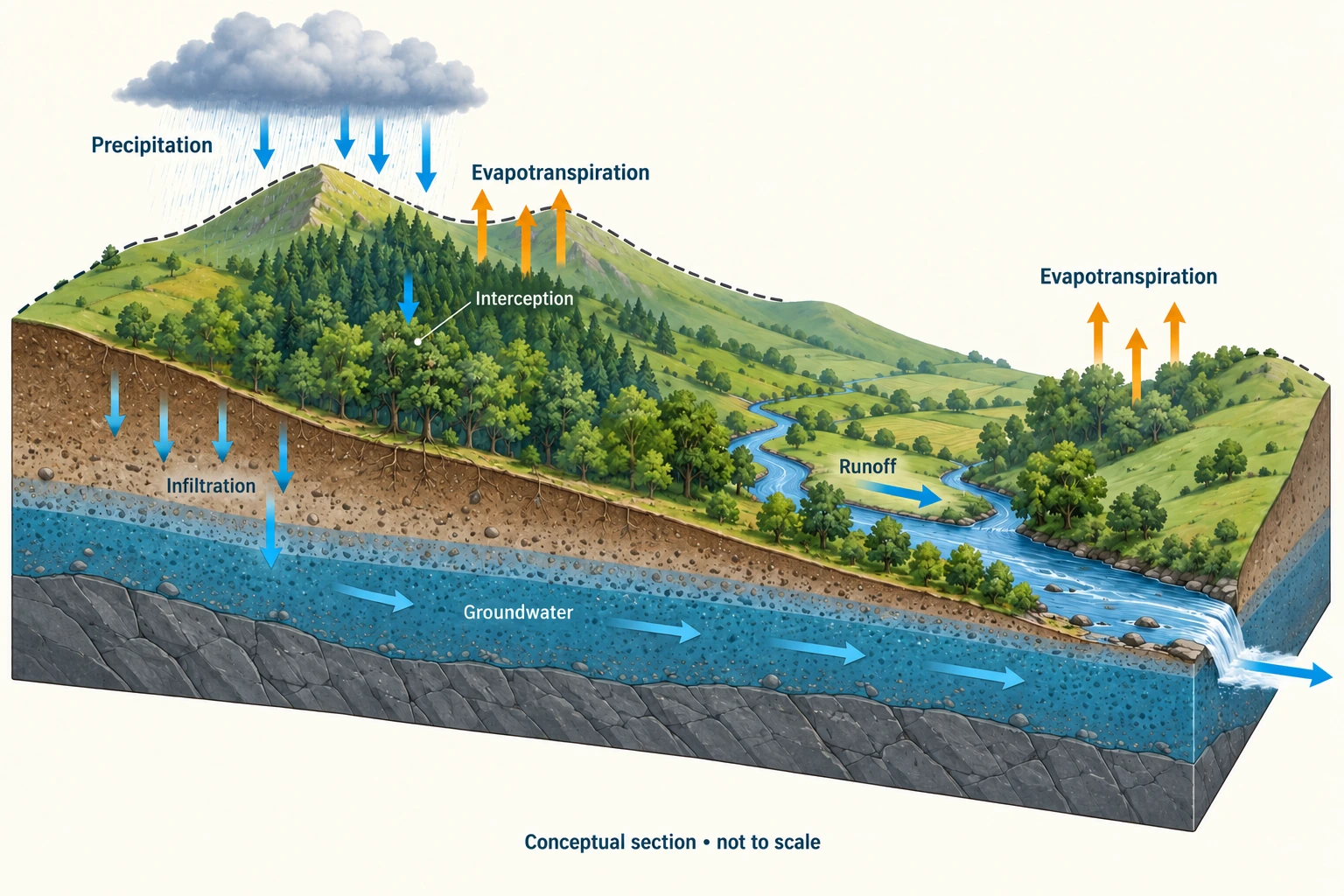
Image: illustration, not a documentary photograph. · Original generated teaching artwork; provenance retained. No, government or research-body endorsement.
4. Basin water balance with a missing transfer
A catchment balance is an accounting statement for a place and time. A common simplified form is P = Q + ET + ΔS, with all terms expressed as depths over the basin or as volumes. P is precipitation, Q is outlet runoff, ET is actual evapotranspiration and ΔS is storage change. If groundwater crosses the boundary, imported water enters, or abstraction exports water, add those terms explicitly. A city can import piped water from outside its surface catchment. Omitting that transfer and forcing the residual into storage produces an internally tidy but physically misleading answer.
Depth units make differently sized basins comparable, but convert correctly. One millimetre over one square kilometre is 1,000 cubic metres. A flow measured at one instant in cubic metres per second must be integrated over the interval before it can be compared with accumulated rainfall. If you assume the flow is constant, label that assumption. Rain measured over a calendar day cannot be compared without adjustment with a river total accumulated from noon to noon during a rapidly changing storm. Differences in clock and spatial support are sources of structural error, not mere calculator rounding.
Storage comprises canopy interception, surface depressions, soil moisture, groundwater and channel water. These compartments exchange internally. Rain first intercepted by leaves may evaporate; throughfall and stemflow can reach the soil; infiltrating water may become soil moisture and then percolate toward groundwater. Quick runoff and delayed baseflow can leave during different intervals. The same molecule must not be counted as both an external infiltration loss and later outlet runoff. The basin plate omits a named stemflow arrow; follow that transfer verbally from canopy down the trunk into soil rather than treating every arrow as an exhaustive budget.
A seasonal residual can be plausible without being proven. Positive ΔS after wet months could indicate replenishment; negative ΔS in summer could reflect drawdown. To establish which compartment changes, seek soil moisture, groundwater level and reservoir observations. Soil saturation can increase flood susceptibility even before a river rises. Abstraction may reduce ecological flow, and a balanced annual total may conceal a harmful summer shortage. Evaluation therefore asks whether amount, timing and quality meet the needs of different users, rather than equating annual balance with sustainability.
Uncertainty should accompany the residual. If uncertain terms are supplied as bounded errors, an interval calculation takes the smallest input and largest output for the lowest residual, and the largest input and smallest output for the highest. This is a conservative range, not automatically a 95% confidence interval. If you instead combine independent standard uncertainties by root-sum-square, say so and justify independence; rainfall and ET model errors may be correlated. More precise arithmetic cannot repair an omitted pipe import or biased rain gauge.
The original fictional example is deliberately nonroutine because adding the missing abstraction changes the interpretation of recharge. A useful argument first derives the balance, then challenges its assumptions, then names the observation that could overturn the inference. It should distinguish a conclusion that is numerically robust to measurement bounds from a conclusion vulnerable to structural omissions. No term in the example is an observation of an actual named basin, and no fictional result can close the local-catchment case-study requirement.
Worked example: Fictional 25 km² basin, one month: P = 120 ± 6 mm, ET = 35 ± 4 mm, Q = 60 ± 3 mm. Records reveal a further 10 ± 2 mm equivalent of exported pumping. Assume no imports or boundary groundwater. Calculate ΔS, its bounded range and volume. Explain the effect of initially omitting pumping.
Evaluated extension (original task): Evaluate whether the residual uniquely identifies water-storage gain.
Without pumping the apparent ΔS is 120 − 35 − 60 = 25 mm; with pumping it is 15 mm.
Lowest residual = 114 − 39 − 63 − 12 = 0 mm. Highest = 126 − 31 − 57 − 8 = 30 mm.
Volume change = 15 × 25 × 1,000 = 375,000 m³. Conservative range = 0 to 750,000 m³.
The nominal positive residual is consistent with zero at the supplied bounds; it cannot establish recharge of a particular compartment.
The central residual indicates storage gain only if the measured terms and boundary are appropriate. With precipitation 120 mm, evapotranspiration 35 mm, runoff 60 mm and pumping 10 mm, the account gives 15 mm. Across 25 km², 0.015 m multiplied by 25 million square metres gives 375,000 m³. This is an accumulated volume, not a discharge rate. Omitting the pumping term produces 25 mm, overstating gain by 250,000 m³. Pumping is an output only where it leaves the declared accounting system; water transferred into another included store must instead be treated consistently as an internal movement. The boundary therefore controls the balance's physical interpretation.
The supplied uncertainty bounds weaken any claim that a positive central value uniquely proves gain. Choosing the lowest input and largest outputs gives 114−39−63−12=0 mm; reversing those choices gives 126−31−57−8=30 mm. The corresponding volume envelope is 0–750,000 m³. This is a conservative arithmetic range under explicitly chosen independent admissible endpoints, not a confidence interval or a probability distribution. If errors are dependent or the extreme combinations cannot occur together, the envelope may be overly wide. It remains incorrect to call 375,000 m³ a precisely established observed accumulation when the measurements have such limitations.
A residual can represent actual storage change, measurement error, or an omitted transfer. For example, an unrecorded 5 mm import changes the central balance to 20 mm; measuring that import independently would alter the expected store change rather than violate conservation. Errors in evapotranspiration estimation can be systematic, so merely repeating the same method may leave the bias intact. Comparing independently measured soil moisture, groundwater levels and surface storage would help distinguish these explanations. Any comparison needs consistent dates and area, because a delayed groundwater response or a changed observation interval can make apparently conflicting measurements refer to different quantities.
I would report the 15 mm central residual together with its stated 0–30 mm hard-bound envelope and assumptions. The result supports a possible gain but, because zero is included, does not uniquely establish a positive change. If independent storage observations match the account over repeated intervals and significant transfers are measured, the interpretation becomes stronger. If they do not, I would investigate missing flows and measurement methods before attributing the discrepancy to an environmental process. Management decisions should also examine whether particular stores, users or ecological flows worsen despite a basin-wide gain; a reconciled budget is necessary evidence, not a complete sustainability judgment.
Answer: Nominal storage gain is 15 mm or 375,000 m³. Its conservative range includes zero. Omitting pumping overstates nominal gain by 10 mm (250,000 m³), even though both nominal balances appear positive.
Check your understanding: Transfer: an analyst adds infiltration of 20 mm to the outputs in this whole-basin balance. What goes wrong? If an unrecorded import of 5 mm exists instead, what is the corrected nominal ΔS?
Answer: Infiltration normally moves water between internal basin compartments, so adding it as an external output double counts. A genuine cross-boundary import enters the inputs: ΔS becomes 20 mm. Check the boundary and whether the import later appears in measured outlet flow.
Why: Correct boundary accounting precedes statistical error propagation. A residual sign does not locate a store; the distinction between an internal pathway and an external transfer is essential.