5. Infiltration, antecedent conditions and runoff thresholds
By UK A Level Geography · independent study · myAudience
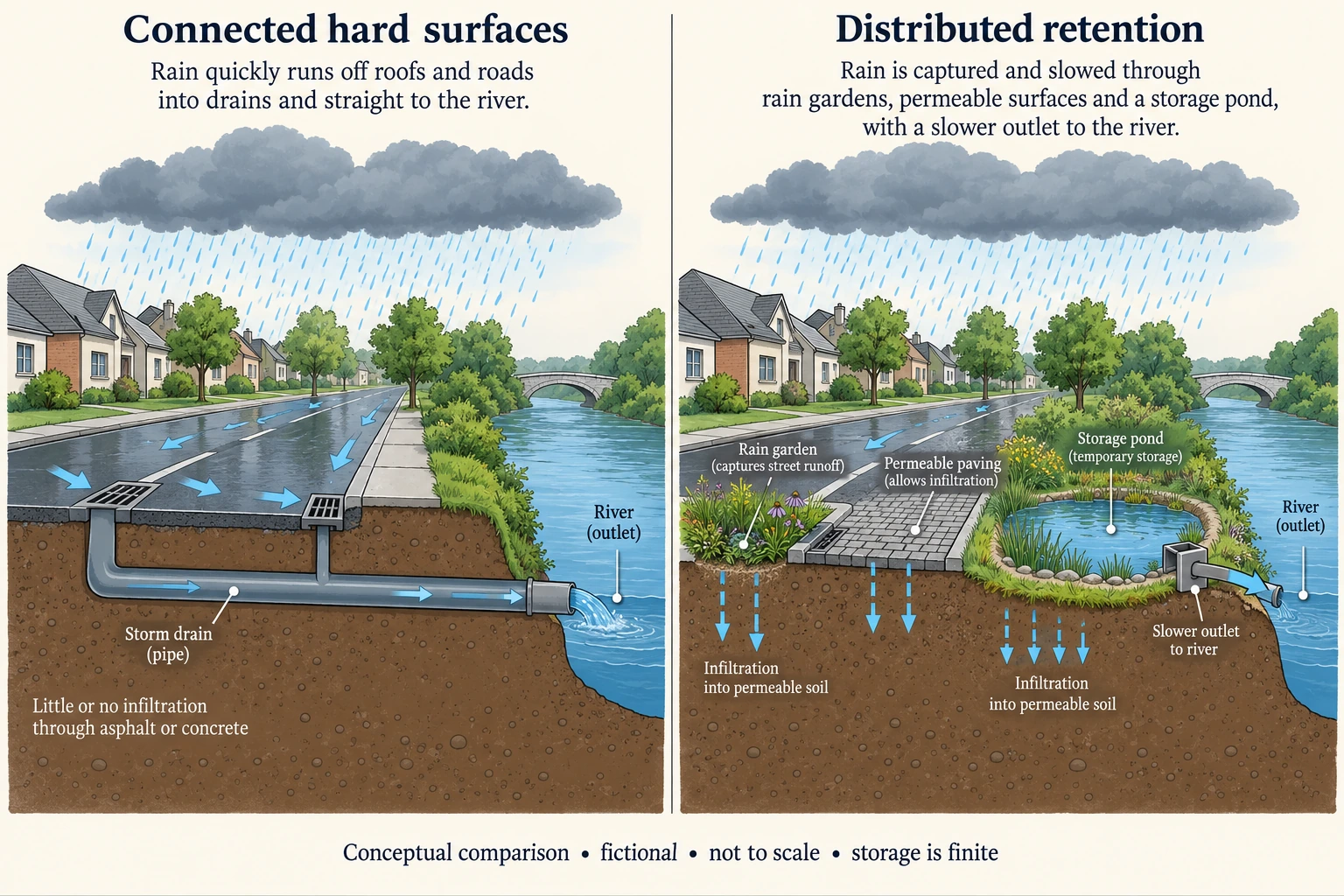
Image: illustration, not a documentary photograph. · Original generated teaching artwork; provenance retained. No, government or research-body endorsement.
5. Infiltration, antecedent conditions and runoff thresholds
Infiltration is entry through the soil surface; percolation is movement downward within soil or rock. Infiltration capacity is a rate, commonly mm per hour. Rainfall intensity can exceed that rate and generate infiltration-excess overland flow. Saturation-excess runoff instead occurs when the soil store has filled so that further input cannot be accommodated. Both mechanisms can operate in one basin, with different spatial patterns and timing. A wet hollow and a compacted track need not respond through the same pathway even when exposed to the same rain.
Antecedent moisture changes the space available for new water. A permeable dry soil can receive considerable rainfall; a similar soil near saturation may generate rapid excess. Vegetation intercepts rain and supports transpiration, but its effects depend on season, root structure, soil and storm intensity. Interception storage is finite, so it cannot absorb an indefinitely long storm. Compaction can reduce infiltration capacity. Connected hard surfaces can route rain quickly into drains and channels, shortening travel times. Percentage paved area alone is inadequate if much of that area drains into gardens rather than directly into a river.
A threshold model simplifies these processes into a capacity and a finite store. It can be useful for comparing mechanisms, but an hourly model cannot resolve five-minute intensity peaks. A basin mean can hide connected saturated patches. A fixed infiltration capacity assumes away changing surface conditions. The worked example allows drainage during each hour; hence a full store at the beginning does not necessarily imply zero infiltration throughout that hour. Declare operation order explicitly or the same numbers can generate different model outputs without any arithmetic mistake.
The urban plate contrasts directly connected hard surfaces with distributed retention. Both panels have outlets. Stored water must eventually infiltrate, evaporate, be reused or leave through an outlet; it does not disappear because the peak is delayed. Retention capacity and maintenance determine whether overflow occurs. The plate is schematic, not a before-and-after observation of a real project. Read its arrows to propose testable mechanisms rather than using the illustration as evidence that an intervention has already reduced flood damage.
Land use is one cause among several. A faster hydrograph after development may reflect new drainage connections, but it may also reflect a wetter initial soil or a more intense storm. A fair comparison controls those conditions or models their influence and uncertainty. Increased infiltration may benefit recharge but transfer contaminants into groundwater. Drainage improvements may protect one street while increasing downstream peaks. A geographical evaluation tracks where and when effects occur and who bears them; it cannot stop at a single desirable indicator.
Original model outputs below are a conservation exercise, not calibrated runoff predictions. Distinguish rainfall, admission into soil, drainage leaving the soil and surface excess. A stronger explanation identifies which constraint is active in each hour and tests a counterfactual initial condition. The model is intentionally too simple to provide safety advice or design a real drainage scheme. Field assessment would require verified soil properties, rainfall distributions, groundwater, infrastructure and appropriate professional methods.
Worked example: Fictional three-hour soil model: capacity 10 mm/hour, total soil-store limit 20 mm, initial store 15 mm; rain is 8, 18, 6 mm. Each hour first drain up to 3 mm from the existing store, then admit the minimum of rain, infiltration capacity and free space. Surface excess is rain minus admission. Repeat from initial storage 5 mm.
Evaluated extension (original task): Evaluate whether doubling infiltration capacity necessarily halves surface runoff.
Wet start: after drainage hour 1 has 12 mm; admit 8, end 20, excess 0. Hour 2 drains to 17; admit 3, end 20, excess 15. Hour 3 drains to 17; admit 3, end 20, excess 3.
Wet-start totals: rain 32, surface excess 18, soil drainage 9, store gain 5 mm. Check 32 = 18 + 9 + 5.
Dry start: hour 1 drains 5 to 2, admits 8, ends 10; hour 2 drains to 7, admits 10, ends 17, excess 8; hour 3 drains to 14, admits 6, ends 20.
Dry-start totals: surface excess 8, drainage 9, storage gain 15. Check 32 = 8 + 9 + 15.
Doubling infiltration capacity does not necessarily halve runoff, because the controlling constraint may be storage rather than entry rate. In the stated bucket model, drainage occurs before each rainfall pulse, admission is limited by rainfall, infiltration capacity and remaining storage, and any unadmitted rain becomes excess. Starting at 15 mm with a 20 mm limit, 3 mm drainage and rainfall 8, 18, 6 mm, the final store remains 20 mm and excess totals 18 mm. Starting at 5 mm produces only 8 mm excess, despite the same rainfall and entry capacity. Antecedent conditions therefore change the outcome without any change in the nominal soil permeability.
The wet-store counterfactual is particularly important. Raising capacity from 10 mm to 20 mm per pulse still produces 18 mm excess, because free space after drainage is 8 mm in hour one and only 3 mm in hours two and three. More capacity cannot admit water into a full store under this rule. In the dry case, hour-two admission rises from 10 to 13 mm. Excess shifts from 8 mm in hour two to 5 and 3 mm in hours two and three, retaining 8 mm total. Both calculations satisfy the same conservation identity: initial store plus 32 mm rain equals final store, 9 mm drainage and excess. A proposed improvement should be tested against that identity and the ordering rule, rather than obtained by applying a guessed percentage reduction to runoff.
The conceptual urban plate shows plausible alternative pathways: permeable paving can admit water, rain gardens can retain runoff and a pond can temporarily store it before release. It does not supply their capacities or prove that all incoming water is captured. Real performance also depends on soil structure, maintenance, water-table position, storm intensity and connections to drains. The finite bucket omits spatial redistribution and changing hydraulic gradients. It can reveal why a slogan is logically insufficient, but cannot certify a real retrofit or replace measured infiltration and storage data. Different drainage timing would also require recalculating the sequence rather than retaining the same result.
I would reject a general claim of halved runoff from doubled capacity. I would prefer an intervention matched to the identified limiting mechanism: increasing usable retention or changing connectivity may help where a wet store dominates, while improving entry capacity may help an unsaturated, rate-limited surface. Field measurements before and after the intervention, comparable storms and maintenance evidence would test that conditional argument. Benefits should be assessed downstream and over the full event, because delayed release can retain volume while changing peak timing. The defensible conclusion is that capacity, initial state and storage must be evaluated together; the model supports that reasoning, not a guaranteed flood-reduction percentage.
Answer: The wet start generates 18 mm surface excess; the dry start 8 mm. In hour 2 the wet case is limited by free storage, the dry case by infiltration rate. Identical rain and nominal capacity therefore do not ensure identical runoff.
Check your understanding: Transfer: double infiltration capacity to 20 mm/hour but keep the wet initial condition and all other rules. Does surface excess decline? Explain what evidence is needed to choose a real intervention.
Answer: It stays 18 mm because free storage limits admission in hours 2 and 3. In this model raising surface capacity alone cannot solve a storage constraint. In a real basin, measure saturation, drainage and pathway connections before deciding between infiltration improvements and added temporary storage.
Why: Testing the active constraint distinguishes saturation excess from infiltration excess. The counterfactual rejects a universal claim that permeability improvements always reduce storm runoff.