9. Carbon stores and fluxes: a forest can change sign
By UK A Level Geography · independent study · myAudience
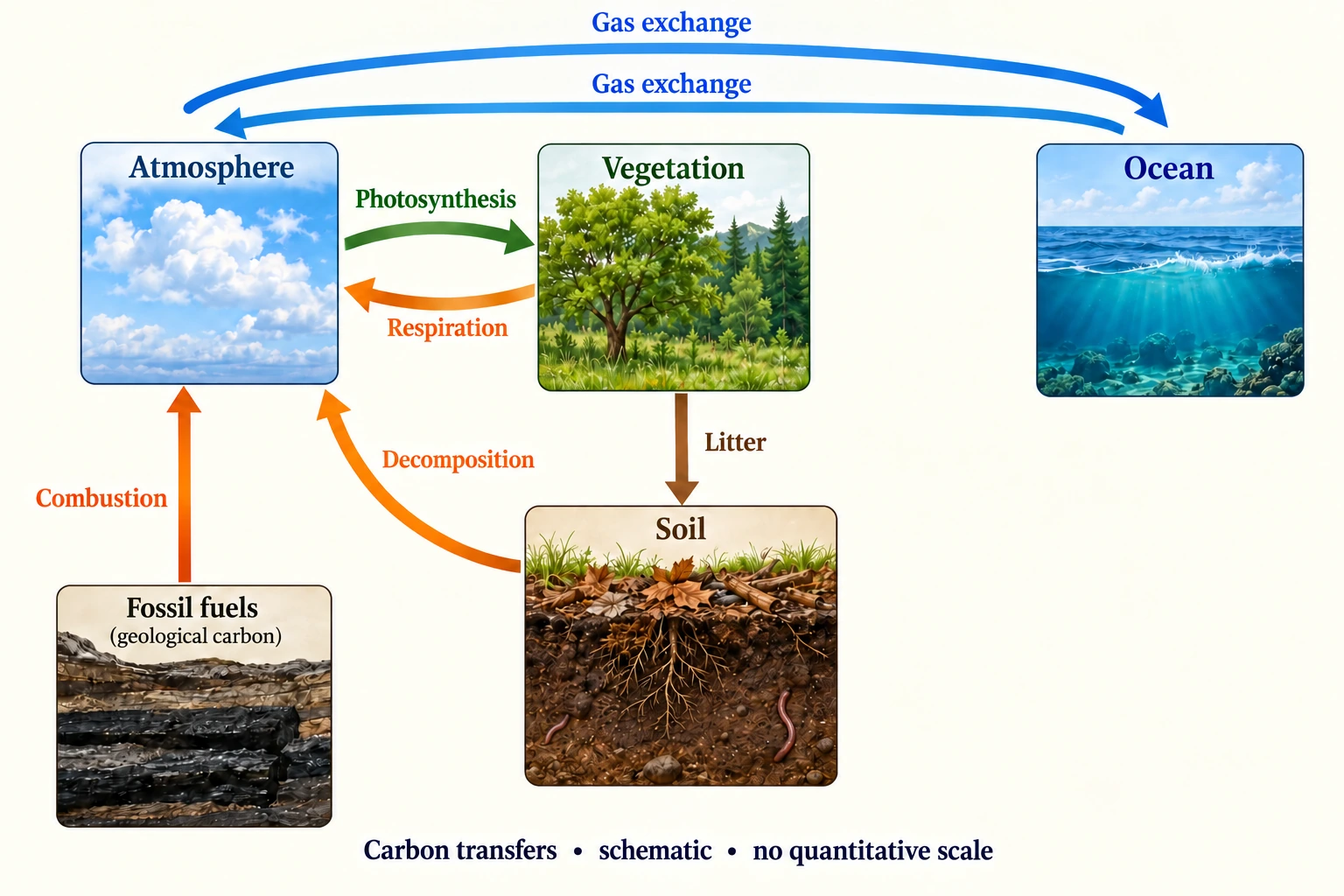
Image: illustration, not a documentary photograph. · Original generated teaching artwork; provenance retained. No, government or research-body endorsement.
9. Carbon stores and fluxes: a forest can change sign
Carbon is conserved through transfers among atmosphere, living organisms, soil, ocean and geological stores. A carbon amount is not the same as a carbon dioxide amount: CO2 includes oxygen as well as carbon. In mass accounting, multiply carbon mass by 44/12 to express the mass of equivalent CO2. A gigatonne of carbon, GtC, is 10⁹ tonnes of carbon. PgC uses petagrams and has the same mass magnitude. These conversions do not make methane and CO2 interchangeable greenhouse gases; their radiative effects and lifetimes require additional concepts beyond this simple material budget.
Photosynthesis transfers atmospheric carbon into organic material using energy; plants also respire, returning carbon to the atmosphere. Gross primary production (GPP) is the photosynthetic uptake; net primary production (NPP) subtracts plant respiration. Heterotrophic respiration from decomposers returns some organic carbon as CO2. An ecosystem may have positive NPP yet be a net carbon source if decomposition, combustion or exported carbon outweigh the net input. Define the boundary: a forest stand, an ecosystem including soils and organisms, or a whole region with timber movements. A large stock does not guarantee a current sink.
Litter transfers carbon from vegetation into a detrital or soil store. Within an ecosystem boundary it cancels from the total balance, just as infiltration cancels from a whole-basin water balance. Timber removed across the boundary is an ecosystem output even if some carbon remains in long-lived products elsewhere. A harvested stand can lose carbon without all of it immediately becoming atmospheric CO2. Distinguish stock loss, emission to atmosphere and transfer into products. The corrected carbon plate connects gas exchange directly between atmosphere and ocean; it must not imply that ocean exchange passes through terrestrial vegetation.
Ocean uptake involves air–sea exchange, dissolved carbon chemistry, circulation and biological processes. Surface uptake does not mean every carbon atom immediately enters deep storage. Sedimentation and burial can isolate carbon on much longer timescales; weathering connects rocks, dissolved material and oceans. Geological carbon is often much larger and slower cycling than living vegetation, while permafrost stores can become vulnerable to thaw. A list of stores should be accompanied by their timescales, forms and measurement basis. This introductory cohort does not yet quantify every required global carbon store or teach all weathering reactions.
IPCC AR 6 Working Group I Chapter 5 (2021), accessed 4 October 2026, assesses increased photosynthetic uptake with higher CO2 while explaining constraints from nutrients, water, warming and land use. This is a synthesis of evidence and models, not a prediction that every forest will accumulate carbon. Differences between plots can arise from age, species, soils, climate or disturbance. To test whether a management change increased sequestration, compare total ecosystem changes over a meaningful period and include soil and exported products rather than selecting only tree growth.
The original two-compartment model makes internal transfers explicit. It assumes consistent annual totals, omits dissolved exports and represents disturbance as an annual pulse. Its outputs are scenarios, not observed rates for any forest. The plate has no quantitative arrow scale; use the supplied numbers for conservation. A strong extended argument explains why protecting carbon-rich systems and reducing fossil inputs can complement each other, then examines permanence, land demand and water constraints. It should not claim that planting any trees can automatically cancel any amount of continuing fossil combustion.
Worked example: Fictional ecosystem model in tC/ha/year: initial vegetation 150 tC/ha and soil 90. GPP 18, plant respiration 8, litter 4, harvest export 3, soil decomposition to atmosphere 6. Then add a fire pulse removing 8 tC/ha from vegetation to atmosphere. Compute each store change and total, both before and after fire.
Evaluated extension (original task): Evaluate whether loss of ecosystem carbon is numerically identical to atmospheric emission.
Vegetation change before fire = 18 − 8 − 4 − 3 = +3 tC/ha/year; soil change = 4 − 6 = −2.
Total before fire = +1; internal litter cancels. NPP = 18 − 8 = 10, which is larger than the total net accumulation.
With fire, vegetation change becomes −5 and total becomes −7. Final vegetation = 145, soil = 88, total = 233 tC/ha.
Across the ecosystem boundary: input 18, outputs 8 + 3 + 6 + 8 = 25. Net −7 agrees with summed store changes. Atmospheric net exchange is 18 uptake minus (8+6+8) returns = −4; remaining 3 is harvest export.
A decline in ecosystem carbon stock is not necessarily identical to immediate atmospheric emission. The supplied annual account illustrates why destinations and boundaries matter. Before fire, vegetation gains 18−8−4−3=3 tC/ha, while soil loses 2 tC/ha because 4 enters as litter and 6 returns to the atmosphere. The combined gain is 1 tC/ha. Litter cancels across the combined vegetation–soil boundary: subtracting it again would falsely create an extra loss. Net primary production is 10 tC/ha/year, but that is not the whole ecosystem's retained carbon once decomposition and exports are considered.
Adding the 8 tC/ha fire pulse changes vegetation's net balance to−5 and the combined balance to−7, leaving 145 in vegetation and 88 in soil. Across the ecosystem boundary, photosynthesis adds 18 while respiration, decomposition, fire and harvest remove 25. Only 22 of those outputs go to the atmosphere, so their net atmospheric release after subtracting uptake is 4 tC/ha. The other 3 is exported timber. Converting all 7 to immediate CO2 would misclassify that destination. For the declared net atmospheric exchange, 4×44/12 gives 14.67 tCO2/ha, using the carbon-to-carbon-dioxide mass ratio rather than treating the two units as interchangeable.
Expanding the boundary to include a product store with no other flows clarifies the issue. If the exported 3 tC/ha enters that store without decay during the interval, the expanded system loses 4 rather than 7 tC/ha. Both results can be correct for their stated boundaries. Later timber decay would create a later atmospheric output, not justify backdating an invented same-year emission. Real accounting also needs the fate and timing of harvested material, uncertainties in uptake and soil loss, and whether displaced processes lie outside the system. The carbon plate depicts pathways only; its box sizes and arrow widths do not measure those quantities.
I would report the−7 tC/ha ecosystem change together with 4 tC/ha net atmospheric release and 3 tC/ha product export, rather than one unqualified emissions figure. An assessment of longer-term climate significance should follow product storage and regrowth over time and avoid assuming that every retained store is permanent. Independent inventories and flux measurements can test the model terms, while a consistent boundary prevents double counting. The general inference is that conservation constrains the destinations, but does not tell us which destination occurred without evidence. A stock loss can indicate deterioration while its timing and atmospheric contribution remain separate questions.
Answer: The ecosystem changes from a +1 sink in this annual model to a −7 tC/ha store loss with fire. Of that loss, 4 tC/ha is net atmospheric release and 3 is exported timber; do not call all seven immediate CO2 emissions.
Check your understanding: Transfer: harvest is retained in a product store within a newly expanded boundary. With fire unchanged, what is the expanded total change? Convert the net atmospheric release to tCO2/ha.
Answer: If all 3 tC/ha of exported timber enters a product store and none decays during the interval, expanded storage change is −4 tC/ha. The net atmospheric release is 4×44/12 = 14.67 tCO2/ha. Later product decay would be a later output, not an invented same-year emission.
Why: The different answers arise from a boundary change and distinct destinations, not a failure of conservation. Net production, net ecosystem exchange and stock accumulation must remain separate.