16. Urban adaptation: an evidence-based extended judgment
By UK A Level Geography · independent study · myAudience
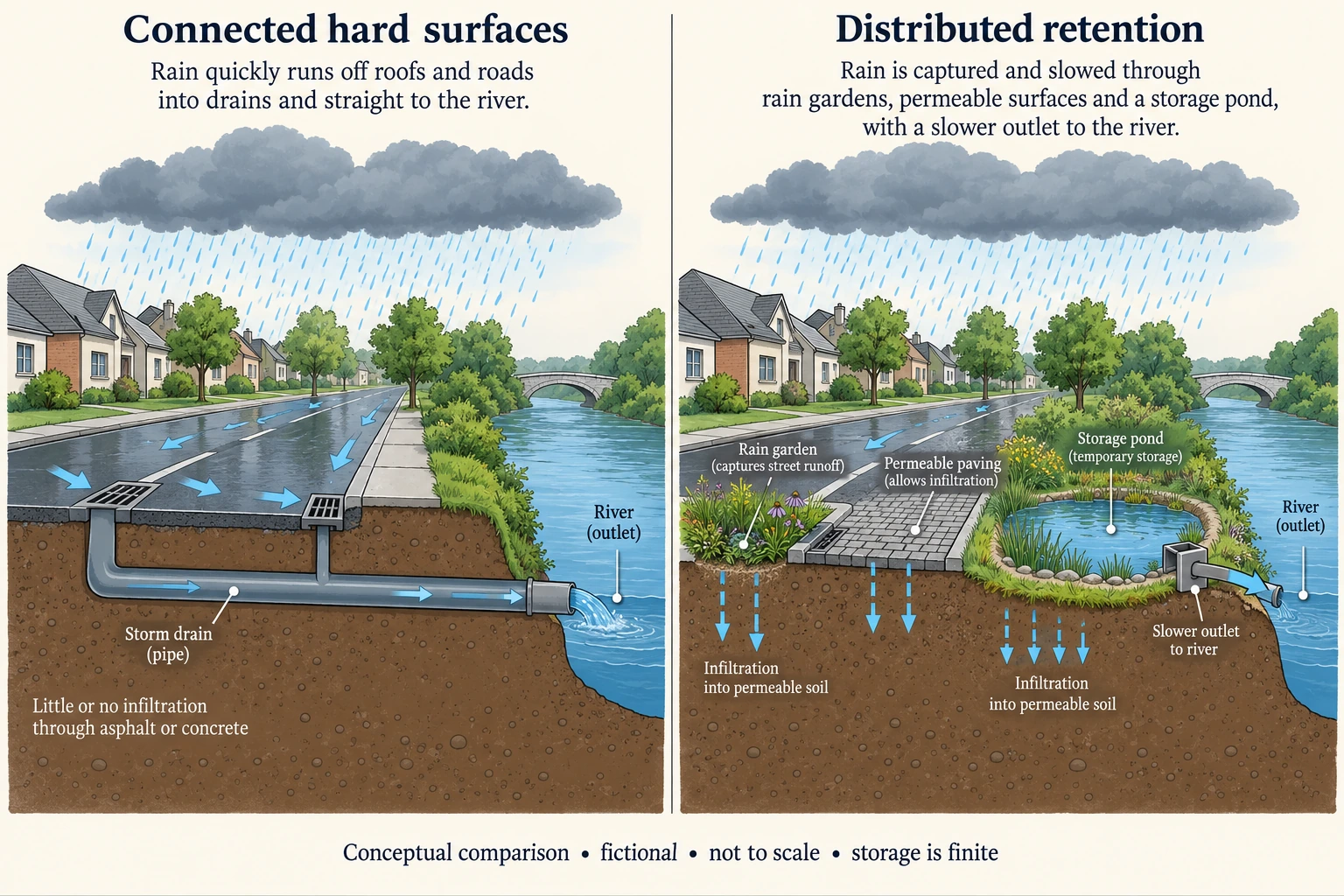
Image: illustration, not a documentary photograph. · Original generated teaching artwork; provenance retained. No, government or research-body endorsement.
16. Urban adaptation: an evidence-based extended judgment
Urban adaptation connects physical pathways with institutions, resources and lived experience. Impermeable surfaces and direct drain connections can accelerate runoff; temporary storage, infiltration and river restoration can redistribute or reduce event flows. Their performance depends on soils, groundwater, available space, capacity and maintenance. A flooded street is an outcome of hazard, exposure and vulnerability, not merely rain. Two households exposed to the same depth may differ in mobility, tenancy, income, insurance and ability to recover. An aggregate reduction in monetary loss can conceal unequal protection.
The World Bank's Urban Development overview, accessed 4 October 2026, states that cities generate 80% of global GDP and identifies infrastructure, housing, finance, congestion, pollution and sprawl as central concerns. The headline GDP share does not give a common observation year or method on the overview, so it cannot supply a country-level trend or a causal return on investment. Its active portfolio as of 2026 is described as over 200 projects amounting to over US$40 billion: those are institutional programme totals, not experimentally measured benefits. This primary economic perspective motivates inquiry but does not prove that every urban investment improves all residents' welfare. A fuller urban course must compare contrasting cities with dated geographic and economic observations; that is not achieved by the fictional allocation below.
The urban plate makes a controlled conceptual comparison under similar rain: left-hand runoff enters a connected drain, while right-hand rain gardens, permeable paving and a storage pond provide alternative pathways. The words 'slower outlet' state a intended mechanism, not a measured flow rate. Actual equality of rainfall and actual delay need observations. Both outlets remain, and finite capacity means overflow is possible. For policy evaluation, measure peak, volume, water quality and downstream timing as well as household outcomes. Treat maintenance as a continuing process rather than a one-time construction success.
Place meaning also matters. A restored river can be welcomed as a public space or experienced as a source of displacement if improvements raise rents and existing residents lose access. Interviews, community documents and mapped service access can reveal effects missed by asset-value totals. Qualitative evidence must be sampled and interpreted critically: who spoke, who was absent, what question was asked and whether representation distorted their meaning. Original classroom model answers are examples of reasoning, never a student's independent NEA submission, genuine interview testimony or a guarantee of assessment marks.
For an extended argument, state a criterion, trace mechanisms, use evidence with dates and scopes, compare alternatives and make a qualified judgment. A 20-mark-length task requires sustained reasoning rather than a list of measures, but no model response here promises an mark. Cost–benefit arithmetic can clarify tradeoffs; it cannot decide ethical priorities automatically. Expected annual losses depend on uncertain hazard distributions and asset valuations. Include whose losses are monetised, whom a scheme excludes and whether the result survives plausible changes in maintenance or storm conditions.
The integrated model below compares two original fictional options over the same horizon without discounting, explicitly as a simplified decision problem. It draws on conservation, threshold and counterfactual lessons without pretending to be a real city study. A longer defensible response would add discount rates, capacity across events, distributional information, consultation and an adaptation pathway. Required globalisation, changing-places studies, urban case depth, fieldwork and independent investigation remain outside this 16-lesson written foundation. Reading completion records exposure to teaching, not qualification completion or mastery.
Worked example: Original fictional city allocation: baseline expected annual flood loss=£4 million. Over 20 years, option A costs£10 m capital plus£0.5 m/year maintenance and reduces expected loss 40%. Option B costs£8 m capital plus£0.2 m/year and reduces loss 30%. Ignore discounting and assume unchanged hazard. A protects high-value central property; B reaches twice as many low-income households (fictional design facts). Compare net monetised benefit, then test B if its reduction falls to 20%.
Evaluated extension (original task): Evaluate which urban drainage package should be preferred under the stated evidence.
Baseline 20-year loss=£80 m. A avoids£32 m; cost=£10 m+£10 m=£20 m; net benefit=£12 m.
B avoids£24 m; cost=£8 m+£4 m=£12 m; net benefit=£12 m. Benefit/cost ratios are 1.6 and 2.0 respectively.
At 20% reduction B avoids£16 m, net benefit£4 m and ratio 1.333. Equal original net benefit is sensitive to effectiveness.
The monetary comparison does not value every social effect or prove which households will actually benefit. Distribution, verified effectiveness, downstream effects and maintenance evidence are needed.
I would provisionally favour option B where its stated wider reach to low-income households is verified, but the preference is conditional rather than universal. Under the fictional fixed-hazard, undiscounted 20-year model, baseline expected losses total£80 million. OptionA avoids£32 million and costs£20 million including maintenance, giving£12 million net benefit. OptionB avoids£24 million and costs£12 million, also giving£12 million net benefit. B's benefit–cost ratio 2.0 exceeds A's 1.6, but the same net benefit shows that ratio and total surplus rank different quantities. Neither alone captures every social or environmental consequence.
B's advantage is vulnerable to the effectiveness assumption. At a 20% rather than 30% loss reduction, it avoids£16 million, so net benefit falls to£4 million and the ratio to 1.333. This sensitivity is more decision-relevant than presenting the base case as a guarantee. The model deliberately ignores discounting, assumes unchanged hazard and treats the reduction and maintenance cost as stable; real comparison would need timing, uncertainty and lifecycle evidence. A's central high-value property protection and B's broader stated household reach are design facts within the scenario, not observed beneficiaries or proof that one group has greater social need.
Distributed retention has plausible mechanisms: it can add temporary storage, enable infiltration and delay runoff. Yet saturation limits infiltration, finite storage can fill and delayed flows may coincide downstream. Forest Research's 2015 Pickering estimate supports benefit from combined land management and major storage for a particular event; it cannot supply a universal urban effectiveness figure. The paired plate illustrates routes and outlets without measuring a peak reduction. Local soils, usable space, maintenance responsibilities and overflow routes should be examined. Resident evidence can reveal access, disruption and tenure-related consequences that aggregate monetary losses fail to represent.
My conditional recommendation would combine monitored retention with measures appropriate to local exceedance and exposure, rather than claim that one design is always most sustainable. B is preferable if reliable effectiveness, equitable household benefits and affordable maintenance support its assumed performance; evidence of poorer performance or harmful downstream timing could reverse that choice. A may be justified for critical infrastructure even when a ratio is lower, provided displacement and distribution are addressed. Sustainability requires durable physical benefit, environmental consequences and fair participation. The model supports transparent comparison and sensitivity; it does not replace contrasting located city cases, field observations or a complete evaluation of every urban drainage alternative.
Answer: Under the base assumptions both yield£12 m net benefit; B has the higher benefit/cost ratio and wider stated low-income reach. Under weakened B performance its net benefit falls to£4 m. Those conditional results support comparison, not an automatic policy verdict.
Check your understanding: Extended transfer: "Distributed retention is the most sustainable response to urban flood risk." Write a reasoned judgment using this cohort’s mechanisms, the Pickering evidence and the allocation scenario; distinguish observation, source estimate and model.
Answer: Distributed retention is a strong component where soil and space allow it: it can delay runoff, support infiltration and distribute benefits. However, capacity can be exhausted and infiltration constrained by saturation; delayed flows can still coincide downstream. Forest Research’s event-specific 2015 Pickering estimate supports benefits from combined land management and storage, not a universal urban effect. In the fictional 20-year allocation, B’s£12 m net benefit matches A’s at assumed 30% effectiveness and reaches more low-income households, but drops to£4 m at 20%. I would favour a monitored combination with equitable access and overflow planning, pending local soils, hydrographs, maintenance and resident evidence. Sustainability depends on durable and fairly distributed outcomes, so no single measure is universally best.
Why: The judgment connects causal mechanisms, a dated research estimate, original model sensitivity and social criteria. It states a position while identifying conditions that could change it. It does not substitute for located cases, personal fieldwork, a complete exam answer set or formal marking.