Courtship as testimony: Othello 1.3
By UK A Level English Literature · independent study · myAudience
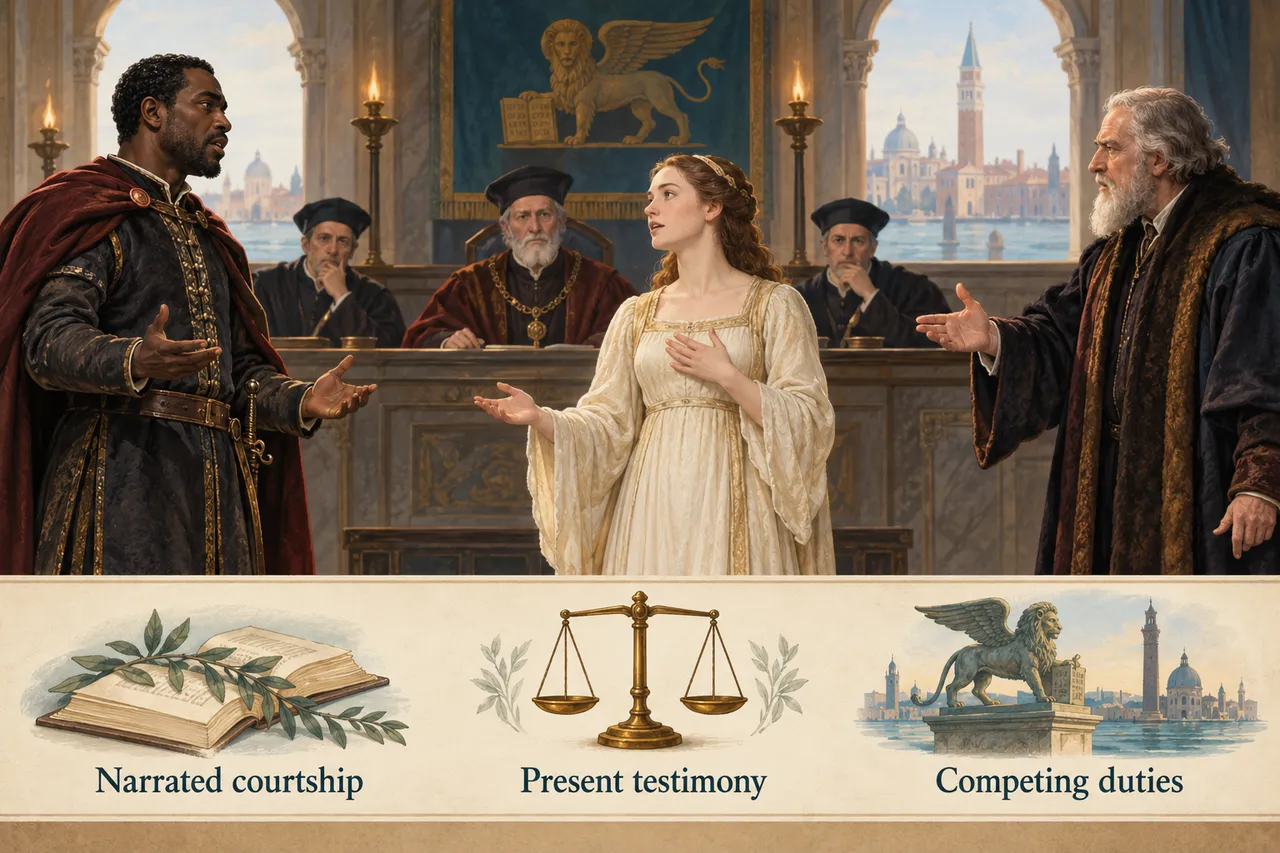
Original myAudience educational illustration. Image: illustration, not a documentary photograph. · myAudience educational illustration; no affiliation with any awarding body.
Courtship as testimony: Othello 1.3
A love story changes when it is told before people who have power to judge it. In Othello1.3, the marriage is already a fact, but its meaning is disputed. Brabantio presents it as an offence requiring explanation; Othello presents a relationship formed through listening and feeling. The scene therefore gives us two questions rather than one: what happened between the lovers, and whose description will be accepted? Begin by locating the hearing within the military emergency. The state needs Othello’s service, yet a private accusation interrupts its business. Personal choice and public authority share the same dramatic space.
Othello answers the accusation by narrating the courtship. His account describes Brabantio’s invitations, his own stories of danger, Desdemona’s interest and her response to what she heard. We hear the relationship retrospectively through one participant. That does not make the account false, but it does make it selected and purposeful. A defence before the senators differs from an intimate conversation between the lovers. Notice how the story distributes activity: Desdemona listens, returns and prompts; Othello notices and expands his account. Neither is presented simply as an object upon whom an unexplained force operates. Their connection grows through an exchange that the speech itself attempts to recreate.
The narrative’s emotional movement matters more than an isolated label such as imagery. Othello moves through danger and suffering towards an explanation of mutual attachment. What initially sounds like a military life becomes a story about another person’s response to that life. His description of her pity supports a reading of sympathetic love. A different reader might question how far each lover understands the other beyond an admired story. These readings need not cancel one another. The scene can establish sincere attachment while also revealing the particular narrative through which that attachment has been formed and through which Othello wishes others to understand it.
Desdemona’s arrival changes the available evidence. Until she speaks, the audience at the hearing has heard men describe her choice. Her answer is not a second version of every detail in Othello’s narrative; it is a reasoned account of allegiance. She acknowledges what her father has provided, then invokes her mother’s decision to prefer a husband to a father. The analogy turns a familiar family relation into an argument for her own marriage. She does not abandon the language of duty. She rearranges its application. A strong interpretation explains that operation instead of assigning the speech the single label obedient or rebellious.
Her argument therefore combines constraint with initiative. Father and husband remain positions described through hierarchical vocabulary, yet she chooses which relationship now takes precedence. This does not make her a modern campaigner speaking outside her situation. Nor does the vocabulary prove that she has no agency at all. The interesting pressure is that her argument must become intelligible to the people judging her. Shakespeare stages an individual decision through a language that already carries social expectations. When writing about context, start with these actual terms and relationships. Do not use an unsupported claim that every woman or every audience in the period held precisely the same beliefs.
Brabantio’s response exposes a competing way of understanding the marriage. His language continues to imagine the daughter as something he can give or would have kept. Desdemona’s reasoning and her father’s disappointment coexist on stage; neither disappears because the hearing moves on. Meanwhile, the duke must return to state affairs. The practical acceptance of the marriage is not identical to a philosophical declaration of equality. It is useful to separate three outcomes: Desdemona has been heard, the accusation has not prevented the marriage from standing, and the surrounding forms of authority remain in place. Treating those outcomes as the same would make the scene less complex than it is.
The wider play puts this moment under pressure. Later, Desdemona’s explanations are repeatedly displaced by another man’s account of what she supposedly means and does. That development should not erase the force of her earlier speech, but it prevents us from claiming that one successful hearing secures permanent control over her story. The contrast is dramatic: the audience has already witnessed her capacity to state a choice, so later refusals to hear her become more disturbing. A passage-to-whole argument should identify that change in conditions. It should not simply append a plot summary or assume the ending proves the earlier love was never sincere.
Use the illustration as a map of voices, not as a historical record of a Venetian chamber. Its three speaking positions separate Othello’s narrated courtship, Desdemona’s present testimony and Brabantio’s competing duties. Ask what each speaker can establish and what remains an inference. Then build a judgement that includes both agency and its limits: love is an independent choice in this scene, but that choice is defended inside structures that do not become equal merely because the lovers persuade their listeners. This is an interpretation supported by the dramatic sequence, not the only permitted response. An alternative must answer the same evidence with equally precise reasoning.
Worked example: How far does1.3 present love as an act of independent choice?
The hearing in1.3 presents love as a meaningful act of choice, but it does not place the lovers beyond social authority. The marriage must be explained to people who can question its legitimacy. Shakespeare makes that tension audible by moving from a father’s accusation to the participants’ own accounts. A successful answer should therefore distinguish the ability to choose from complete freedom to determine how a choice is recognised.
Othello’s courtship narrative supports independence by making attachment the result of listening and response. Desdemona repeatedly seeks his story; his account does not merely describe a command that she follows. Yet the narrative is also a defence shaped for the senators. Its coherence is rhetorically useful. We should recognise its claim to sincerity without treating a speech by one participant as an unselected record of every stage of their relationship.
Desdemona’s own argument strengthens the case for choice. She reasons from her mother’s marriage to her present allegiance, turning a familiar precedent towards a decision her father dislikes. The analogy gives her speech an active function: she interprets duty instead of simply receiving it. Nevertheless, father and husband remain figures within a hierarchical vocabulary. Her agency works through that vocabulary rather than abolishing it.
Brabantio’s disappointment qualifies any account of complete liberation. His language of giving and keeping persists after she has spoken, suggesting that paternal claims do not vanish when challenged. The duke’s need to resume military business also makes the resolution practical. Accepting the marriage is not the same as announcing that the social relations surrounding it have ceased to matter.
Later scenes reveal the fragility of Desdemona’s opportunity to be heard. Her actual explanations lose authority as Othello accepts Iago’s interpretation of them. This contrast does not prove that the earlier choice was unreal. Instead, it shows how a recognised voice can subsequently be displaced. The audience’s memory of1.3 makes that displacement a loss rather than an inevitable condition assumed from the beginning.
Thus independence is both present and limited. The lovers are more than passive subjects of an external arrangement, and Desdemona supplies her own reasons. But the scene locates that agency within competing accounts and unequal forms of authority. The strongest judgement holds those facts together: love enables a choice to be articulated, while the play questions whether the power to articulate it will remain secure.
Answer: Choice is meaningful but situated within competing duties and unequal authority.
Check your understanding: Why is Desdemona’s duty analogy more complex than simple obedience?
Answer: She accepts the vocabulary of duty but uses her mother’s precedent to justify choosing her husband; continuity in language enables a changed allegiance.
Why: A correct answer identifies both the inherited constraint and her argumentative action, with scene evidence.