How implication becomes proof: Othello 3.3
By UK A Level English Literature · independent study · myAudience
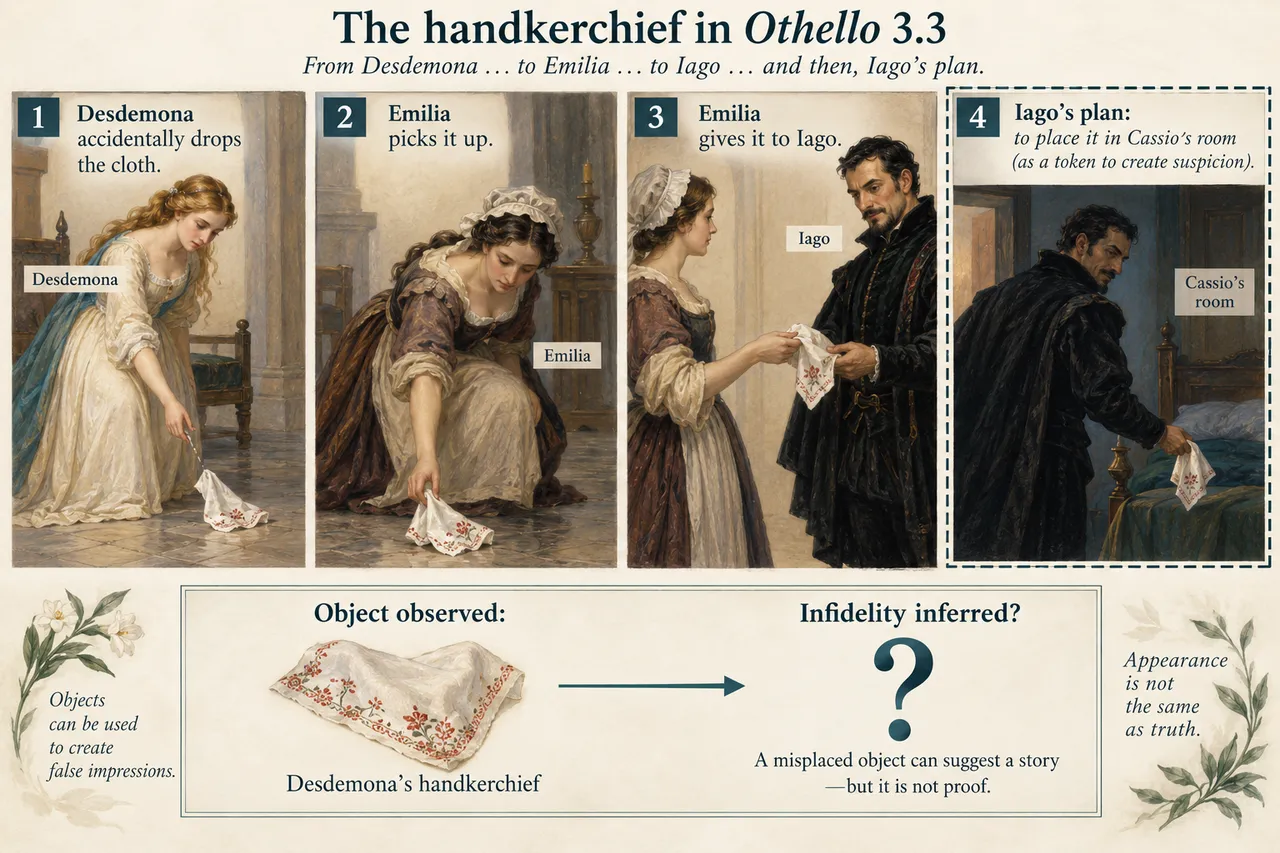
Original myAudience educational illustration. Image: illustration, not a documentary photograph. · myAudience educational illustration; no affiliation with any awarding body.
How implication becomes proof: Othello 3.3
The central problem of Othello3.3 is not that there is no evidence anywhere. It is that observations, reports and insinuations are made to support a claim they do not establish. Desdemona speaks for Cassio’s reinstatement; Cassio leaves as Othello approaches; a handkerchief changes hands. Those events are real within the dramatic action. The allegation of an affair is not thereby real. Start by writing two columns: what the audience actually witnesses, and what Othello is encouraged to infer. Keeping these columns apart allows you to explain manipulation through a mechanism rather than through the vague assertion that Iago is clever.
Iago’s manner helps create the authority of his suggestions. He appears to hold back, repeats or responds incompletely, and lets Othello ask for the explanation that the conversation seems to require. Apparent reluctance can make a statement seem less interested than an immediate accusation would. The listener supplies some of the movement from ambiguity to suspicion. In a close reading, follow the sequence of turns: what prompts the next question, what remains unsaid, and what conclusion the listener begins to voice. A dramatic dialogue distributes reasoning between speakers. It is not simply a speech in which one villain announces a fully formed lie to a passive victim.
His warnings about jealousy are therefore double-edged. On the surface, a warning seems protective: it names a danger that a loyal adviser might wish to prevent. Within the scene’s sequence, however, it also makes that danger imaginable and gives Othello a vocabulary in which to interpret himself. The audience has access to Iago’s hostile intentions, so a caution can sound very different to us than to its recipient. This is dramatic irony with consequences. Naming irony is only a beginning; the analysis must explain how unequal knowledge changes our understanding of the same utterance and increases our awareness of the trap being constructed.
The handkerchief provides a particularly clear test of the distinction between observation and inference. Desdemona offers it when Othello feels unwell, and it falls. Emilia takes it and gives it to Iago, who has repeatedly wanted it. Iago then announces his intention to leave it where Cassio can find it. At this point, the announced planting is a plan, not an event we have just seen completed. Later scenes and the final disclosure extend our knowledge of that chain. Do not collapse those phases into a single picture. The illustration’s dashed last panel keeps intention separate from completed action, while the cloth itself remains the same object.
Othello does ask for proof. That detail matters because it resists an account in which he has no standards and never questions anything. The issue is how a demand for proof becomes satisfied by accounts whose connection to the allegation is weak or manufactured. Iago reports a dream and claims that Cassio used the cloth. Even if an object is seen in someone’s possession, possession does not demonstrate how it arrived there or what relationship produced its presence. The audience’s knowledge of possible planting is crucial counter-evidence. The scene teaches an inferential failure without becoming a modern scientific experiment or requiring a diagnosis of a fictional character.
Language also changes as suspicion becomes a framework for judgement. Pay attention to repeated demands, interrupted exchanges and the increasing force of Othello’s commitments. These formal changes must be demonstrated at particular moments; not every broken line proves a psychological collapse, and an edition’s line division should not be mistaken automatically for a pause in performance. A useful argument connects local features to the scene’s movement: uncertainty becomes an urgency to settle what has happened, and settling it becomes a commitment to retaliation. A director could emphasise different degrees of hesitation, but such staging choices are interpretive possibilities rather than facts about every performance.
Explaining persuasion does not remove responsibility. Iago engineers a damaging account; Othello increasingly grants it authority and later acts violently upon it. A reading that says manipulation makes the killing understandable in the sense of tracing causes must not slide into saying it is justified. Equally, condemning the violence does not excuse an essay from explaining the intricate dramatic process that precedes it. Hold action, knowledge and judgement apart long enough to make their connections precise. This creates a stronger alternative to both extremes: Othello as an entirely helpless instrument, or Othello as a figure whose changing beliefs need no explanation.
Test your interpretation with a counterfactual. If Othello had heard Emilia’s actual account of the cloth at this stage, which part of Iago’s argument would fail? The supposed link between possession and sexual betrayal would lose its force, because an alternative route for the object would be available. This does not prove that one conversation would repair every suspicion in the play. It identifies the missing evidence at a particular inferential step. Your essay can then argue that presentation makes fragments appear to form a coherent story, while the audience sees the gaps. Persuasion here is a construction of certainty, not the discovery of a verified affair.
Worked example: Is Othello persuaded by evidence or by the way evidence is presented?
Othello is persuaded less by conclusive evidence than by a narrative that gives ambiguous observations a threatening connection. The scene does not consist only of false events: Cassio leaves, Desdemona advocates for him and the handkerchief is lost. Iago’s achievement is to make those different occurrences appear to explain one another. Their reality does not validate the allegation attached to them.
His apparent hesitation contributes to that effect. A reluctant adviser can seem more trustworthy than an eager accuser, while an incomplete response encourages Othello to seek its concealed meaning. Othello therefore participates in the construction of the suspicion through his own questions. This is more precise than saying Iago controls every thought: the dialogue stages a listener drawing conclusions from a carefully managed absence of explanation.
The cloth exposes the weakness of the resulting certainty. The audience sees it fall, sees Emilia take it and hears Iago announce a plan to place it in Cassio’s room. That chain supplies an alternative to the story of sexual intimacy. Importantly, the planting is initially a stated intention; the essay must not invent a witnessed completion within this moment. The dramatic audience knows enough to doubt the inference before all later disclosures occur.
Othello’s demand for proof might challenge a reading of wholly passive credulity. But the demand does not guarantee a sound criterion for accepting proof. Reports about a dream and the cloth are interpreted through the suspicion already established. The question is not only whether he asks, but whether the offered material can establish the particular claim. Here, an object’s alleged location is made to carry a meaning it cannot independently bear.
The audience’s greater knowledge produces dramatic irony and ethical pressure. We can trace why the reports matter to Othello while also recognising their manufactured connection. Explaining the route towards certainty must not justify the later violence. His decisions remain consequential even when another character has deliberately shaped the information on which he relies.
Presentation therefore turns fragments into apparent proof. Iago manipulates credibility, sequence and missing alternatives, but Othello’s questions and commitments help consolidate the account. The scene’s tragedy depends on that interaction. A strong judgement acknowledges both the skill of the manipulation and the difference between being persuaded that a claim is true and possessing evidence sufficient to make it true.
Answer: Presentation turns incomplete observations into apparent proof; responsibility is not excused.
Check your understanding: Does possessing the handkerchief demonstrate Desdemona’s infidelity?
Answer: No. The audience witnesses an alternative transfer and hears Iago’s stated planting plan; an object’s possession cannot establish the alleged sexual event.
Why: Require the witnessed chain and distinction between observation and interpretation, not a generic bias label.