Women’s voices before the ending: Othello 4.3
By UK A Level English Literature · independent study · myAudience
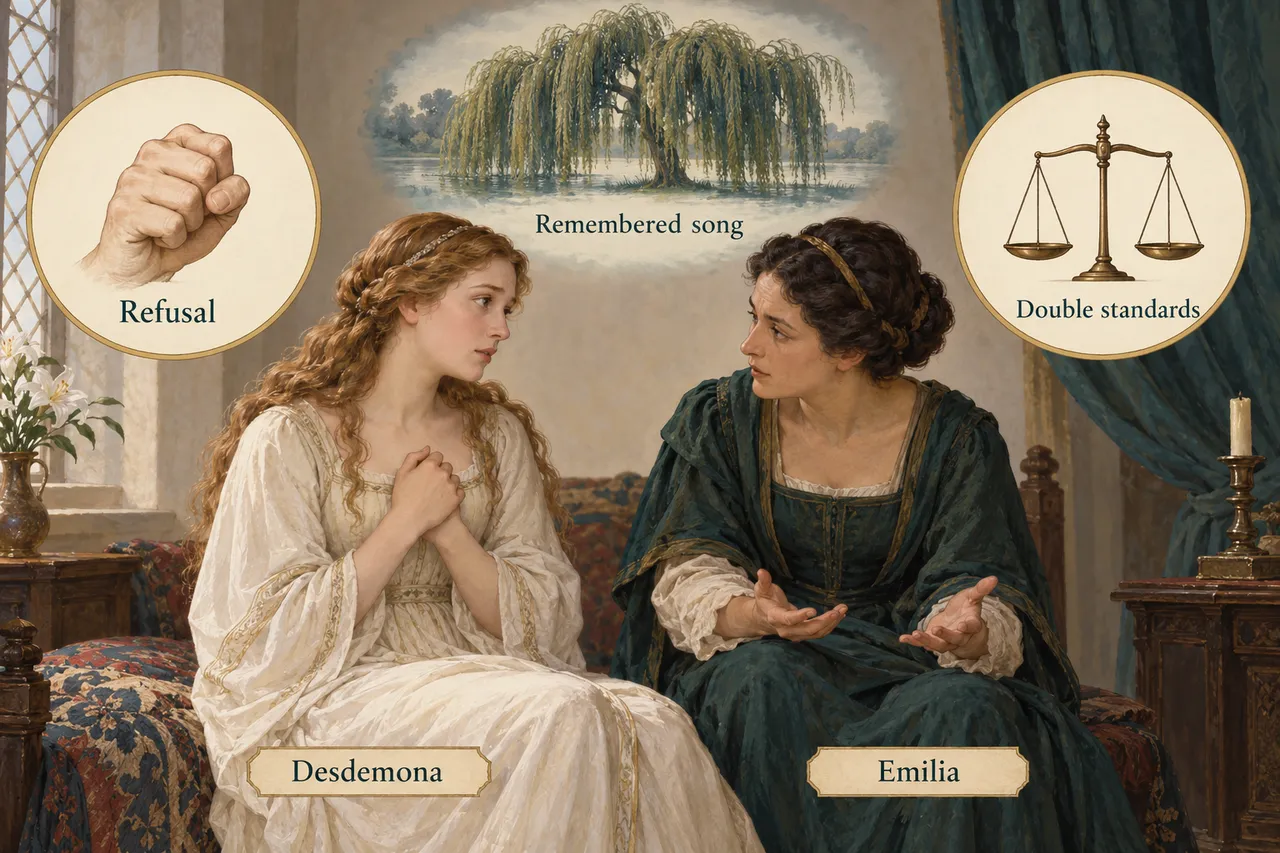
Original myAudience educational illustration. Image: illustration, not a documentary photograph. · myAudience educational illustration; no affiliation with any awarding body.
Women’s voices before the ending: Othello 4.3
Othello4.3 changes the scale of the drama. After public accusations and humiliation, Desdemona and Emilia talk in a more private setting. This does not remove the pressures surrounding them. It lets the audience hear responses to those pressures that a public confrontation might conceal. Read the conversation as an exchange, not as a single speech about what women are like. Desdemona asks questions, recalls a song and imagines possibilities she finds difficult to accept. Emilia answers with another account of desire, conduct and unequal expectations. Their companionship is real, but it does not depend on their holding identical views of love or fidelity.
The remembered Willow song introduces another woman’s story into the scene. Desdemona recalls her mother’s maid Barbary and the song associated with her abandonment. The act of singing gives remembered sorrow a present voice. That is a dramatic connection between experiences, not evidence that Barbary is appearing on stage as a ghost or that every detail of the two relationships is the same. The repetition of a remembered pattern can make the present feel ominous, especially for an audience following the surrounding plot. But avoid replacing analysis with a simple prophecy: the song creates an emotional and structural echo whose significance must be argued from its position in the scene.
Questions then expose the distance between the women’s positions. Desdemona finds the possibility of female infidelity difficult to imagine and refuses the hypothetical exchange even when it is enlarged to the whole world. Emilia responds in a more worldly register, testing what such an exchange would mean. Her reasoning can contain wit, provocation and material calculation at once. A reader who treats every hypothetical answer as a literal confession loses the distinction between arguing a possibility and reporting an action. Follow the conversational conditions carefully. What price is proposed? What assumption is being tested? How does changing the scale alter the apparent force of the question?
Emilia’s later argument shifts from extravagant hypotheticals to husbands’ conduct and the bodily capacities of wives. She lists ways men may neglect, restrict or harm women, then insists that women possess senses and desires as men do. The argument challenges a double standard by making a shared capacity the basis of comparison. Its force is not simply that she names desire. She connects desire with the conditions under which each sex is judged. An essay can explain that reasoning without claiming the speech establishes a universal cause of infidelity or that every husband in the play behaves in exactly the same way. A character’s argument remains situated.
The women’s difference is therefore as important as their shared vulnerability. Desdemona’s refusal can be read as moral constancy, limited experience, resistance to a premise, or a combination supported by particular moments. Emilia’s reasoning can challenge unequal expectations while also revealing the compromises through which she has learned to manage relationships. Neither position should be reduced to intelligence versus stupidity. Desdemona’s earlier public reasoning shows that she can argue; Emilia’s earlier gift of the cloth shows that insight does not make her fully aware of Iago’s purpose. Holding those earlier actions beside the conversation prevents an attractive but flattening division between a wise commentator and an unthinking victim.
Dramatic form gives the debate its texture. A song, a question, a joking answer and an extended argument do different kinds of work. The Folger edition’s shifts in lineation invite close attention to verse and prose, but a formal label alone cannot establish emotional meaning. Explain the relation between a form and the action it enables: repetition can sustain a remembered lament; short exchanges can test assumptions quickly; extended parallels can make an ethical claim accumulate. A performance might emphasise tenderness, exhaustion or sharp disagreement. Describe such possibilities as choices a production could make, rather than asserting that every audience must experience one fixed response.
A contextual reading should remain accountable to the text. The vocabulary of duty, husbands, wives and permitted conduct gives evidence of the unequal relationships the play stages. Contemporary scholarship explores the interaction of gender and power in Othello, but it supplies interpretations to evaluate, not an instruction to attribute one opinion to every early-modern person. Nor is Emilia a direct transcript of Shakespeare’s private beliefs. Drama constructs meanings through the interaction of voices and events. Ask how the scene positions her argument against Desdemona’s replies and against what each woman later does. That method integrates context with dramatic construction instead of adding a detached historical paragraph.
The scene acquires further force through the ending. Emilia eventually speaks against Iago’s account and reveals the cloth’s movement, despite the pressure to remain silent. Her later testimony can be connected to the earlier insistence that women’s experience deserves recognition. Yet that connection does not make her previous choices disappear or turn the play into a straightforward celebration of victory. In the illustration, the remembered song is separate from the two women’s reasoning paths. Use that separation to build a judgement: the scene stages shared pressures through distinct voices, and its power comes partly from allowing disagreement inside companionship. An argument about loyalty should explain that plurality rather than replacing it with a single lesson about women.
Worked example: Does4.3 present a single view of women’s loyalty?
The scene does not present one uniform view of women’s loyalty. Desdemona and Emilia share a private space after public distress, but the conversation reveals differences in the assumptions through which each understands fidelity. Shakespeare makes companionship coexist with disagreement. The scene’s significance therefore lies partly in its refusal to let the experience of being a wife produce a single response to every moral question.
Desdemona’s remembered song gives abandonment a voice that reaches beyond the immediate conversation. Barbary’s story is recalled, not physically re-enacted, and its relationship to Desdemona’s position is an echo rather than an exact equivalence. Her subsequent questions about infidelity preserve a refusal to accept the hypothetical exchange. That refusal may indicate constancy or limited experience, but it should not be treated automatically as an inability to reason.
Emilia tests the question differently. Her responses change with the scale of the proposed reward, making the conversation partly an examination of value and power. A hypothetical willingness is not evidence that she has committed the act. The dialogue invites us to hear wit and challenge in her reasoning rather than convert it into a biographical statement that the play does not establish.
Her argument about women’s senses and desires also challenges the terms on which loyalty is judged. By comparing bodily capacities and identifying husbands’ neglect or restraint, she questions a standard applied unequally. Yet this situated argument does not prove that every case of infidelity has one cause. Its dramatic force comes from giving a character the space to contest assumptions that other scenes have made damagingly powerful.
The wider play complicates any division between an innocent Desdemona and an entirely knowledgeable Emilia. Desdemona has already defended her marriage through an effective analogy; Emilia has given Iago the cloth without understanding his whole plan. Later, Emilia’s testimony opposes his account. These connections let us interpret insight and constraint as changing conditions rather than fixed qualities belonging to one woman alone.
Thus loyalty is debated, not settled through a single authorial declaration. The remembered song, the questions and the contrasting arguments give the scene several ways of understanding love within unequal relations. A convincing response acknowledges their shared vulnerability while preserving the distinctions between their voices. That plurality makes the approaching tragedy more complex than an example intended merely to illustrate a universal rule about female conduct.
Answer: Distinct women’s voices negotiate loyalty differently within shared constraints.
Check your understanding: Why should an essay avoid calling Emilia’s speech Shakespeare’s direct opinion?
Answer: Drama assigns the reasoning to a situated character whose motives, contradictions and later action must be tested; different staged voices remain available.
Why: Credit the distinction between interpreting a dramatic construction and quoting an authorial manifesto.