Who controls the final account? Othello 5.2
By UK A Level English Literature · independent study · myAudience
Original myAudience educational illustration. Image: illustration, not a documentary photograph. · myAudience educational illustration; no affiliation with any awarding body.
Who controls the final account? Othello 5.2
The ending of Othello is also a struggle over how the events will be described. In5.2, explanations arrive too late to undo the violence, yet they still matter to judgement. Desdemona speaks briefly; Emilia challenges the accusation and reveals what she knows; Othello recognises error and attempts to shape the account that others will carry away. Start with the sequence of events before selecting a final speech as your central evidence. An ending can offer a powerful interpretation of a tragedy without making that interpretation the only one the play permits. The audience has witnessed more than any one speaker can choose to include in an account.
Desdemona’s final answer creates a difficult interpretive problem. She does not straightforwardly name Othello as her killer in response to Emilia’s question. That utterance must be read beside the action the audience has just seen and the responses that follow it. It cannot make the witnessed killing cease to be an event. Readers might interpret her words through love, protection, shock or the pressures that have shaped her speech; such possibilities require explanation rather than confident claims about a motive the play does not fully state. Do not convert an ambiguous utterance into consent to violence or a moral instruction that harmed people should protect those who harm them.
Emilia changes the available knowledge. She insists on Desdemona’s innocence, questions the authority of Iago’s account and eventually explains her own part in the cloth’s transfer. Her speech is an act of disclosure within the dramatic action, not merely a chorus commenting from outside it. She has limited knowledge at first and then makes connections as the exchange develops. The difference matters: insight emerges through hearing what others claim and comparing it with what she actually knows. An essay can track that development instead of portraying her as someone who possessed the full solution throughout the play and inexplicably withheld it.
Later testimony corroborates the manufactured chain. Cassio reports finding the cloth in his chamber and relates Iago’s acknowledged placement of it. This gives the audience another reason to distinguish the object from the meaning imposed upon it. The final scene therefore does more than reveal a villain’s secret. It revises the authority of earlier reports and restores access to explanations that suspicion had excluded. That correction has an ethical limit: truthful information arrives after irreversible harm. A strong argument can explain why disclosure changes judgement without treating it as a repair that brings the relationship, or the harmed characters, back to their earlier condition.
Othello’s final self-account seeks a particular balance between blame and remembered service. He asks the people who will write about the events to describe him fairly, then supplies the terms in which he wants to be understood. The relation between request and direction is worth analysing. A speaker who asks for an accurate record also selects descriptions that may influence that record. His account invokes love, error, suffering and service; it does not necessarily give equal weight to every other person’s experience. This is not a reason to dismiss the speech’s emotional force. It is a reason to ask how that force is produced and what it leaves at the edge of attention.
The contrast with1.3 makes the self-narration more significant. Earlier, a retrospective account of courtship helped establish the marriage before a public hearing. Here, another account seeks to determine the remembered meaning of its destruction. In both scenes, the speaker arranges a life into a narrative addressed to judges. But the evidence and the stakes have changed. Desdemona could enter the earlier hearing and supply her own reasons; she cannot participate in the final account in the same way. Connecting the scenes allows a passage-to-whole essay to analyse a repeated dramatic method without claiming the two situations are morally or structurally identical.
Recognition, remorse and responsibility are different claims. Othello’s realisation can give a tragic ending emotional depth, while his responsibility for the killing remains. The fact that Iago deceived him explains part of the causal sequence; it does not establish that the action was justified. Likewise, a performance that invites sympathy does not automatically require exoneration. A director might allow the final speech to dominate the stage, or might keep the other characters’ reactions visibly present. Those alternatives can help test how a reading is produced, but they are imagined staging choices unless supported by a specific documented production. The text does not prescribe one universal emotional response.
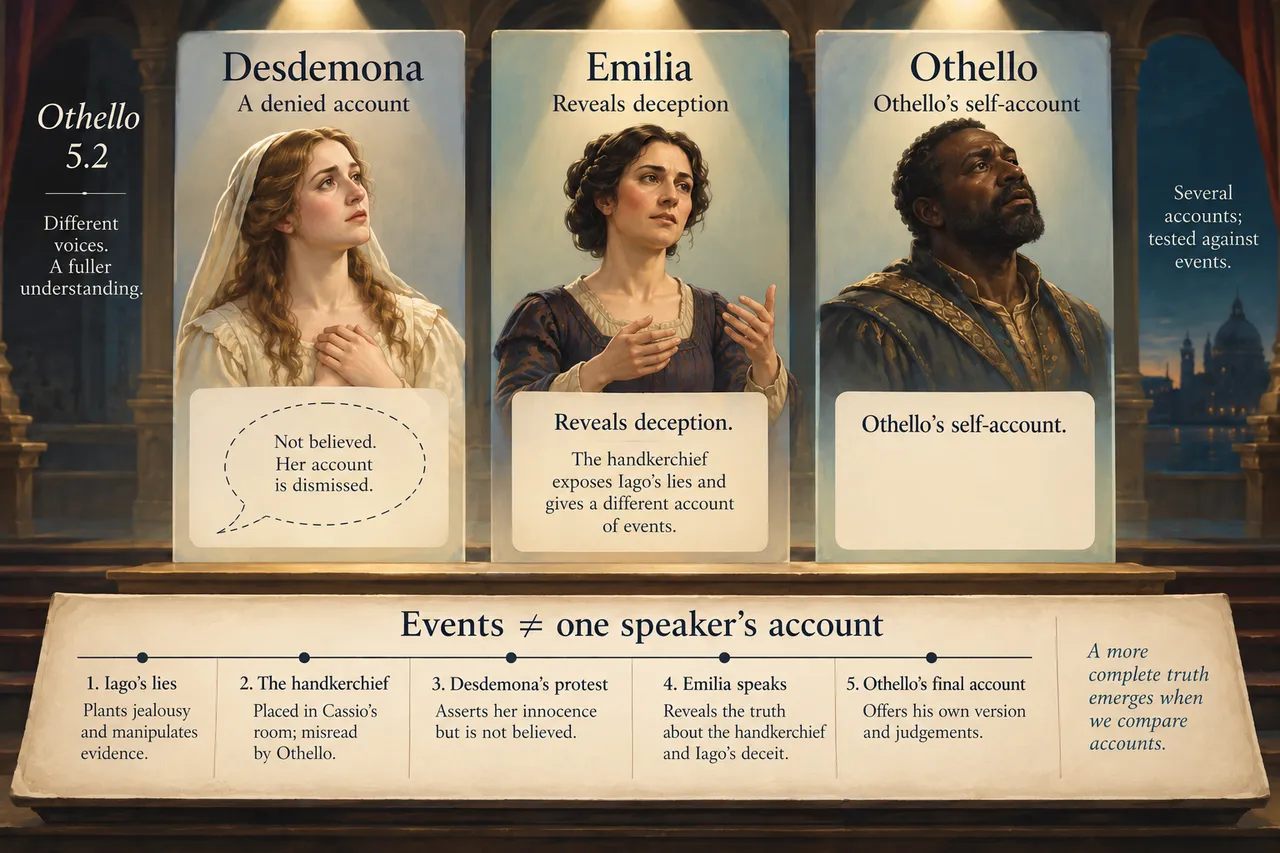
The illustration keeps the ending non-graphic and separates three kinds of account. Desdemona’s denied explanation, Emilia’s disclosure and Othello’s retrospective self-description do not occur as one simultaneous debate; they are a map of competing authority across the scene. Compare each account with the witnessed events and with the later cloth testimony. Your judgement can acknowledge that Othello tries to define his tragedy while explaining why the play does not let that effort erase other voices. An ending is powerful partly because the final speaker cannot fully control what the audience already knows. Interpretative sympathy and an evidence-based ethical judgement can therefore remain in tension rather than being forced into a simple choice.
Worked example: Does the ending allow Othello to define his own tragedy?
Othello attempts to define his tragedy, but the ending does not make his definition the sole authority. His request for a fair record is followed by language that directs how others should describe him. That combination produces a tension between accuracy and self-presentation. We can take his remorse seriously while still asking which events and voices are subordinated by the narrative he offers.
The speech recalls the rhetorical power of1.3. There, Othello arranged experiences into a courtship story for a public hearing; here, he arranges love, error and service into an account intended for later readers. The connection reveals a repeated dramatic method rather than simply a change in mood. Yet Desdemona’s earlier opportunity to state her own choice contrasts with her inability to answer the final self-description in the same circumstances.
Emilia’s testimony resists that narrowing of the record. She challenges the accusation and explains her own knowledge of the cloth. Her understanding develops as she hears the claims being made, so she should not be described as having known the whole plot from the beginning. The scene makes correction an action undertaken under pressure, not information supplied by an infallible commentator outside the tragedy.
Cassio’s later account strengthens the distinction between possession and infidelity. Finding the cloth in his room does not support the meaning previously attached to it, because its deliberate placement supplies a different explanation. This revelation changes the grounds of judgement. It cannot, however, undo the killing. The ending retains the difference between discovering an error and repairing the harm produced by acting upon it.
A sympathetic reading of Othello’s recognition is therefore possible without granting moral acquittal. Iago’s deception contributes to the causal sequence, but Othello’s decisions remain his actions. Desdemona’s final utterance is also insufficient to reverse what the audience witnesses. Any account of her words must acknowledge ambiguity rather than turning them into consent or an instruction to excuse the violence.
The ending gives Othello an emotionally commanding account while surrounding it with competing evidence. Its tragic force depends on that imbalance: an attempt to control remembrance encounters a dramatic record that exceeds the speaker’s selection. Thus he helps define the tragedy but cannot define it alone. A qualified conclusion preserves remorse, manipulation and responsibility without allowing any one of them to cancel the others.
Answer: Othello attempts to frame his tragedy, but competing testimony prevents sole authority.
Check your understanding: What evidence would challenge an essay focused only on Othello’s last speech?
Answer: Emilia’s revelation, Desdemona’s denied accounts and the actual witnessed manipulation prevent the final self-description from becoming the sole authoritative version.
Why: Require multiple located dramatic voices and a reason they change judgement.