Constancy under pressure: Sonnet116
By UK A Level English Literature · independent study · myAudience
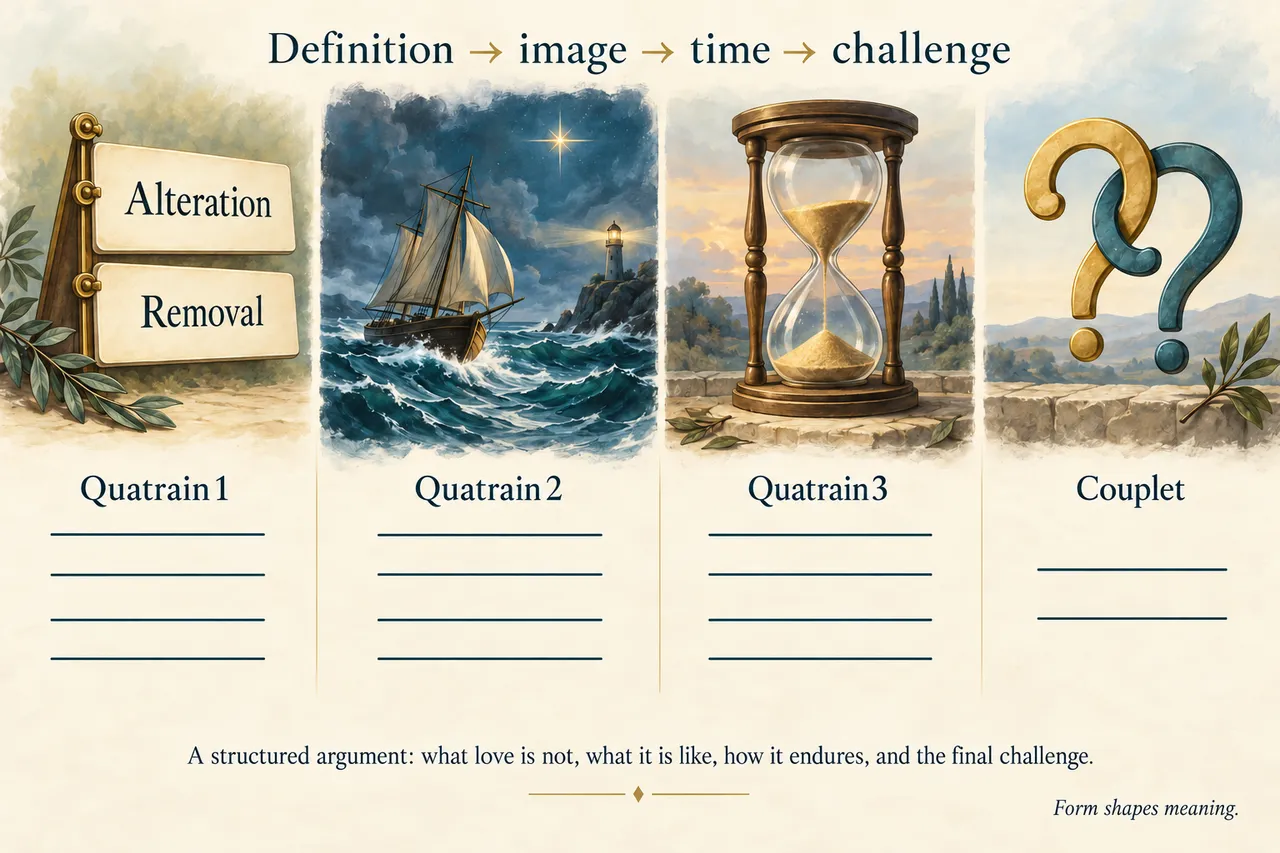
Original myAudience educational illustration. Image: illustration, not a documentary photograph. · myAudience educational illustration; no affiliation with any awarding body.
Constancy under pressure: Sonnet116
Sonnet116 does not begin by telling the story of a particular couple. It begins by defining what love should count as. That makes it an argument as well as a lyric. The speaker distinguishes a union of minds from an attachment that changes when circumstances change, then develops images and a final challenge to support that distinction. Reading the poem as a familiar celebration of commitment is a possible starting point, but familiarity can conceal the work it performs. Ask how its confidence is constructed, what alternatives it excludes and why a reader might accept or question those exclusions. The poem’s speaker is not automatically a transparent record of Shakespeare’s private relationships.
The opening moves through negation. Instead of immediately naming love’s properties, the speaker rules out alteration and removal as conditions under which true love disappears. This is rhetorically effective because it creates a category and places some apparent attachments outside it. A relationship that changes can then be described as never having satisfied the category in the first place. That move does not prove that the definition is wrong, but it shows why the argument is not a neutral observation of all human experience. A close reading should explain the effect of the definition rather than simply endorse it as a universal psychological fact.
The maritime images give the abstract claim a spatial model. A stable reference point can guide a vessel through unstable conditions; the surrounding movement makes its constancy intelligible. The image does not require love to be motionless in every practical sense. Its contrast lies between changing circumstances and a point by which direction can still be judged. Notice also the distinction between measuring a star’s height and knowing its worth. Measurement and value are not interchangeable. The poem can invite confidence in love’s guidance while suggesting that its significance exceeds a simple calculation. This is a figurative argument, not a lesson claiming that a feeling is physically identical to a navigational instrument.
Time introduces another kind of pressure. The poem acknowledges bodily change while denying that the proposed kind of love is governed by the same brief succession of hours and weeks. The distinction between changing bodies and enduring attachment gives the ideal something difficult to withstand. If the poem merely announced permanence without admitting loss or mortality, the assertion would have less resistance against which to define itself. Analyse the temporal movement: the argument extends from immediate alteration to the largest imagined horizon. That expansion makes constancy increasingly ambitious. It also gives a questioning reader grounds to ask whether an ideal is being described or a rule imposed upon experience.
The fourteen-line form organises these developments. The English-sonnet arrangement uses three quatrains followed by a couplet; the rhyme scheme is conventionally represented as ABAB CDCD EFEF GG when spaced by groups, or ABABCDCDEFEFGG continuously. Write the pattern against the actual end words instead of memorising letters without checking them. Pronunciation and historical rhyme can complicate how some pairs sound to a modern reader. Similarly, the poem’s pentameter invites metrical attention, but a reading aloud is not a machine with every syllable receiving identical emphasis. Explain where an argument develops or a sentence crosses a line before attaching an automatic emotional meaning to the formal pattern.
The final couplet changes the relation between speaker and reader. Rather than merely repeating the definition, the speaker sets the truth of his account against the existence of his own writing and of human love. The challenge can sound triumphant: its alternatives appear impossible to accept. Yet that impossibility is itself a rhetorical device. The poem’s existence is not empirical proof of the proposition about love. A sceptical reading may therefore hear a defensive insistence underneath confidence. It should still account for the poem’s coherent ideal and not assume that an arguable definition must be cynical or insincere. Interpretations gain force by meeting resistance, not by collecting convenient features alone.
A brief connection with Othello can make the problem of certainty clearer. Othello’s changing beliefs reveal the destructive effects of an account that becomes resistant to contrary evidence; the sonnet constructs a definition of constancy through a very different form. This does not make the poem equivalent to Iago’s manipulation or imply that devotion is always dangerous. It supplies a question about the authority of claims made in language. Compare the way an assertion is supported, who speaks, and which alternatives remain available. Such a connection serves the A-Level emphasis on texts within wider networks without substituting a passing comparison for the detailed study of either work.
The illustration groups fourteen strokes into4,4,4 and2, then aligns definition, maritime image, time and challenge with the argument’s broad movement. It is a reading aid, not a facsimile of the poem, and the labels simplify transitions that must still be checked against the lines. Use it to reconstruct the sequence from memory, then reopen the actual text to test what the simplification leaves out. A defensible judgement can hold celebration and persuasion together: the speaker offers a powerful ideal of enduring love by building a definition that survives imagined pressures. The task is to explain how that ideal becomes convincing, not to certify that every relationship must conform to it.
Worked example: How does the poem make enduring love persuasive rather than simply describe it?
The poem makes endurance persuasive through an organised argument rather than a simple statement of feeling. Its speaker defines a kind of love, gives that definition a figurative model and then challenges the possibility that it is false. This movement allows conviction to be read both as celebration and as a rhetorical achievement. Neither reading should confuse the speaker’s ideal with independently verified knowledge about every relationship.
Negation gives the opening its force. By excluding alteration and removal from genuine love, the speaker distinguishes a true union from attachments that fail under change. That distinction can reassure a reader seeking constancy. It can also be questioned because it protects the definition by placing contrary examples outside its category. The analysis must identify that operation instead of merely listing negative words.
The maritime imagery makes the distinction imaginable. A guiding point remains usable when the vessel’s circumstances are unstable; the surrounding change helps demonstrate why a stable reference matters. Yet the metaphor is not literal proof. The difference between measurable height and unknown worth further separates calculation from value, letting the poem present love as dependable without reducing its significance to something fully measurable.
The treatment of time increases the pressure on the ideal. Bodily change is acknowledged, while love is placed against a larger horizon than brief intervals. Constancy therefore has to mean more than continuing affection when nothing difficult happens. The third quatrain develops the argument by showing what the definition refuses to surrender to. Its ambition is part of the poem’s power and a legitimate point for alternative interpretation.
The couplet then puts the account at stake through an extreme conditional challenge. It can sound victorious because denying it would require accepting apparently impossible consequences. A questioning reader may nevertheless distinguish persuasive confidence from logical demonstration. That objection does not automatically make the whole poem insincere; the ideal can be sincerely held and rhetorically defended at the same time.
Thus form and argument cooperate. The quatrains develop distinct pressures and models, while the couplet turns their accumulated force towards the reader. The poem does more than describe enduring love: it invites us to accept a particular account of what endurance means. A qualified conclusion recognises the strength of that invitation while preserving the possibility of examining its definitions and the authority through which they are offered.
Answer: A definition, figurative guidance, temporal pressure and a closing challenge make the ideal persuasive.
Check your understanding: Does the nautical imagery prove that love cannot change?
Answer: No. It offers a figurative model of guidance and constancy; an interpretation must explain what this analogy makes imaginable and where literal proof would be inappropriate.
Why: Credit mechanism and epistemic limit, not merely naming metaphor.