When love releases its demand: Remember
By UK A Level English Literature · independent study · myAudience
Original myAudience educational illustration. Image: illustration, not a documentary photograph. · myAudience educational illustration; no affiliation with any awarding body.
When love releases its demand: Remember
Remember begins with a request, but it does not end with the same demand unchanged. The speaker imagines a future in which physical presence and ordinary shared conversation are no longer possible. The repeated appeal for remembrance first seems to secure a continuing bond across that separation. Later, the poem permits forgetting when remembrance would cause unhappiness. That movement makes it useful to ask not only whether love endures, but what love asks of the person who remains. The poem does not identify a particular named addressee or establish the biographical cause of the imagined loss. Begin with the speaking situation supplied by the words rather than filling those gaps from an assumed life story.
The opening imagines absence through familiar contact: hands, turning, daily conversation and plans for the future. Their significance lies in the relation between ordinary intimacy and the anticipated inability to continue it. A spatial image of going away can make death or permanent separation speakable without describing a physical journey that readers could verify. The voice addresses someone who can still be asked to remember, so the imagined future is organised through a present relationship. Explain how those concrete habits support the request. Calling the opening sad identifies a possible response but does not yet show the mechanism by which the poem gives loss a shape.
Repetition creates insistence. The appeal returns as the speaker imagines more of what will disappear, and its recurrence can sound like an attempt to preserve a place in the addressee’s future. This is a useful complication for a reading of uncomplicated selflessness. Before the turn, the speaker does want something from the survivor. A good essay acknowledges that desire rather than skipping to the generous ending. The later adjustment has significance precisely because a demand has been established. If no claim on memory were made, there would be less to relinquish. Sequence therefore changes the meaning of individual words: a repeated request and a later permission do not perform the same act.
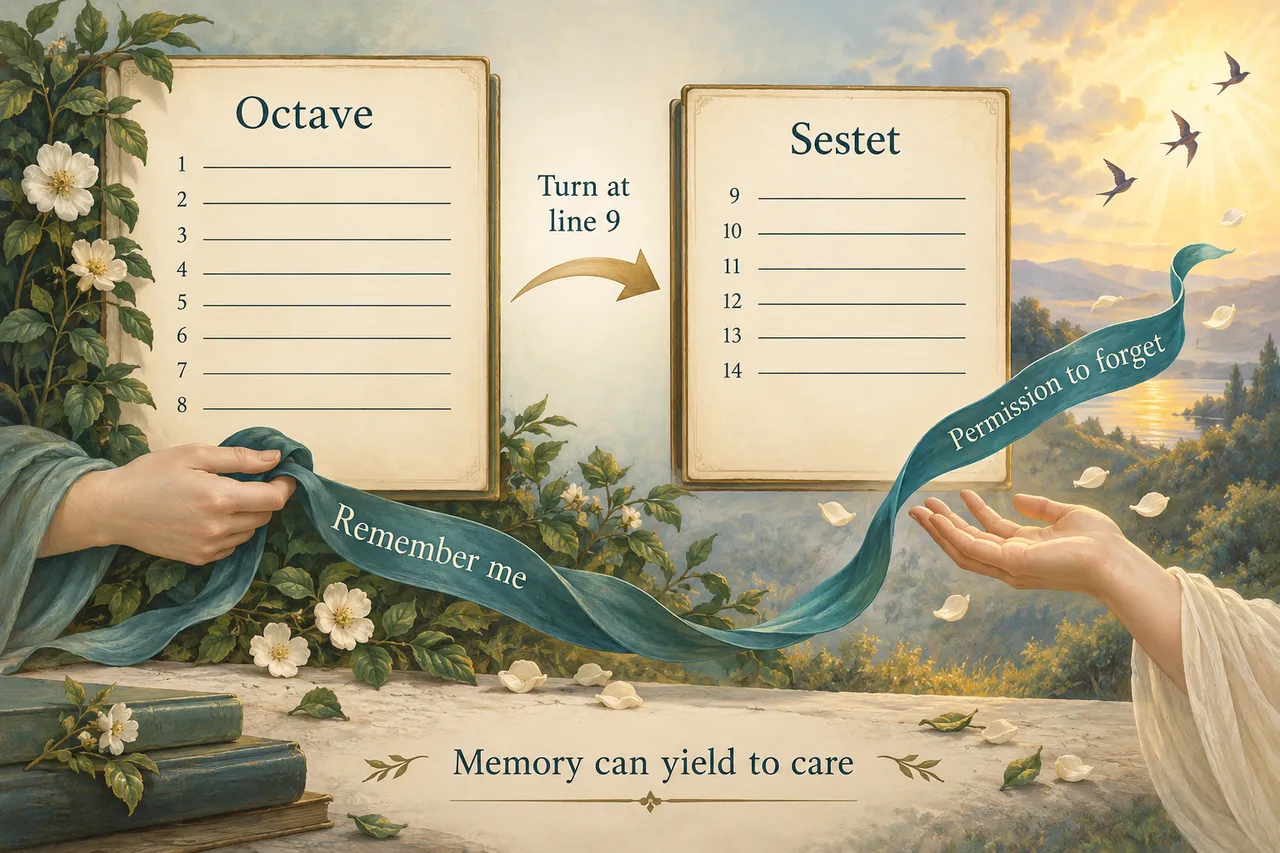
The form makes that revision visible. The poem has an octave of eight lines and a sestet of six, with the ninth line introducing a qualification through the possibility of forgetting. In the Toronto edition, the rhyme scheme is ABBAABBA CDDECE. Check the end words to see how the first eight lines enclose their pattern and how the last six develop a different set of echoes. Form does not dictate one emotion, but the change in argumentative direction corresponds to a recognisable structural division. Naming the volta is insufficient: explain what proposition is altered, what possibility becomes allowable and how the ending follows from that change.
The permission is carefully conditional. Temporary forgetting is imagined, followed by remembrance that should not produce grief. Later, the speaker places the survivor’s happiness above a form of recollection that would make them sad. This need not mean attachment has become worthless. It changes what the attachment requires of another person. A reading of ethical generosity can therefore be grounded in an actual revision of obligation. Another reader may emphasise the continuing wish to be remembered, which the poem never simply expunges. The strongest interpretations retain both desire and concession. They do not turn a poem’s imagined counsel into clinical advice about how every bereaved person ought to feel or behave.
Compare the argument with Sonnet116 through a shared question rather than two disconnected summaries. Both speakers resist the idea that physical change must make love insignificant. Their methods differ. Sonnet116 defines true love through what it will not yield to; Remember adjusts the demand made upon the addressee when continuing remembrance would be painful. The difference is not adequately described as one speaker faithful and the other unfaithful. One poem insists on an enduring category, while the other makes care compatible with a change in memory’s place. A comparison should use each poem’s actual structure and address to explain that distinction.
Their endings also invite different kinds of judgement. Sonnet116 closes through an extreme challenge to the validity of its definition. Remember closes through a preference between possible consequences for the addressee. One can sound like a defence of a proposition; the other weighs what a remembered bond should require. This contrast remains a reading to test against the poems, not an assertion that their authors held complete and opposing philosophies. Neither text needs to stand for an entire century. Relevant context should clarify how language and form are read without replacing the personal voice with a stereotype about Renaissance certainty or Victorian grief.
In the illustration, eight strokes lead towards a turn and six strokes towards a release. The ribbon is a conceptual image of obligation, not an object described in the poem. Its purpose is to help you reconstruct the relationship between insistence and permission. Test that simplification by returning to the conditional language and by considering whether the ending erases or retains the initial wish. Your judgement might say that generosity emerges through a reconsideration of desire rather than an absence of desire. That formulation is more precise than claiming the poem is either selfish or selfless from beginning to end. An evaluated comparison can then explain how two forms of constancy differ in what they ask another person to bear.
Worked example: Compare how Remember and Sonnet116 negotiate change in love.
The poems both preserve the significance of love under change, but they differ in the obligation they place upon it. Sonnet116 defines genuine love as resistant to alteration. Remember begins by requesting remembrance, then permits a change in memory when the survivor’s happiness requires it. A connective interpretation can therefore distinguish an unchanging ideal from an attachment whose expression is reconsidered through care.
In Sonnet116, exclusion is central. The speaker refuses to count an attachment that alters with circumstance as true love, then uses stable guidance within an unstable maritime setting to make that definition intelligible. Time extends the pressure from immediate change to mortality. The poem’s form supports a developing argument, but its confidence remains rhetorical rather than experimental proof about how all people actually love.
Remember initially sounds more demanding than its ending alone might suggest. The appeal returns while the speaker imagines the loss of contact and shared plans. These repetitions establish a wish to remain part of the addressee’s future. An interpretation of generosity must address that wish as counter-evidence. Otherwise it turns the poem into a simple message whose conclusion has already been assumed at the start.
The ninth-line qualification makes forgetting possible. The octave-to-sestet transition is important because it changes the request’s conditions rather than merely changing the rhyme. By the final comparison, happiness without recollection is preferable to sadness maintained through it. This can be read as an ethical revision: the speaker’s desire does not disappear, but it no longer requires the survivor to preserve grief as proof of attachment.
The endings sharpen the contrast. Sonnet116 challenges any attempt to disprove the proposed definition, whereas Remember weighs consequences for its listener. It would be reductive to call the first confident and the second weak. Each speaker makes a strong decision about what love should mean. Their differing forms of address organise those decisions and supply distinct grounds on which readers may accept or question them.
Thus change need not have one meaning across the poems. In one, alteration threatens the category of genuine love; in the other, changed remembrance can fulfil love’s concern for another person. The comparison does not establish that one speaker loves more. It shows how literary arguments about constancy can preserve attachment while disagreeing about the terms on which attachment should continue.
Answer: Constancy can be defended through an unchanging category or through reconsidered obligations.
Check your understanding: Why is the ninth-line turn necessary evidence for a claim of generosity?
Answer: The opening demands remembrance; the turn permits temporary forgetting and leads to the preference for the survivor’s happiness, so generosity is a developed revision, not the whole poem’s starting premise.
Why: A justified answer must track both halves: the repeated opening demand supplies counter-evidence, while the ninth-line turn and final preference explain the ethical revision. Naming a volta alone is insufficient.