Persuasion, regret and the judgement of narrators
By UK A Level English Literature · independent study · myAudience
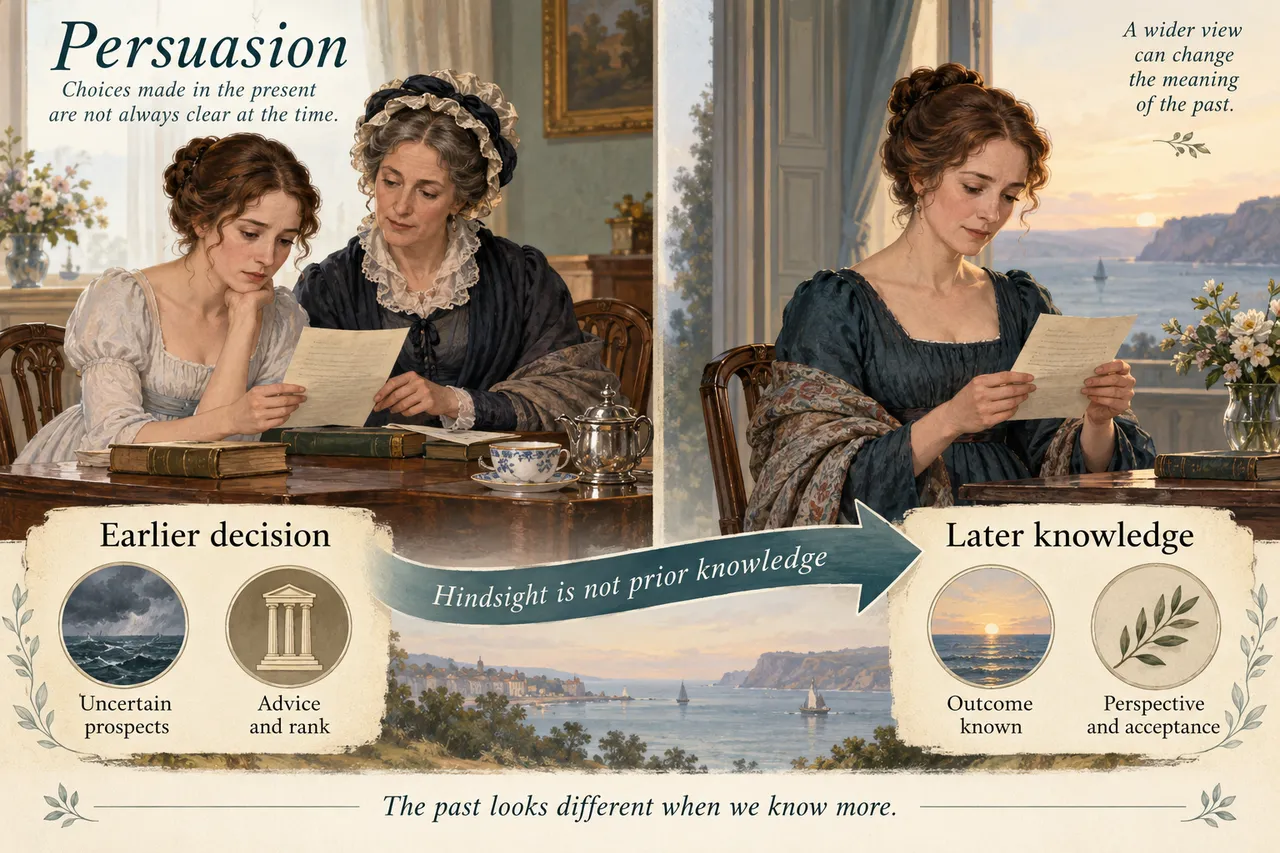
Original myAudience educational illustration. Image: illustration, not a documentary photograph. · myAudience educational illustration; no affiliation with any awarding body.
Persuasion, regret and the judgement of narrators
In Persuasion4, the reader learns about an earlier engagement from a position later in the story. Anne and Wentworth were deeply attached, but advice and family opposition helped bring the engagement to an end. The chapter is therefore a useful lesson in temporal judgement. What the characters could expect at the earlier moment is not identical to what Anne, the narrator or the reader can know afterwards. An essay that says Lady Russell was simply wrong because Wentworth later succeeded skips the very problem the novel makes interesting. Begin by separating the decision, the motives presented for it, its immediate consequences and the subsequent information that changes how it may be evaluated.
The opposition is not given one uniform voice. Sir Walter’s response is associated with rank and the perceived degradation of the alliance. Lady Russell’s objections are presented through both pride and a protective concern for someone she loves. The chapter places those motives together rather than forcing us to choose between care and prejudice. A person can act from care while allowing social assumptions to narrow what seems acceptable. That distinction supports a more precise interpretation than calling all advice malicious. It also prevents a sympathetic account of intention from cancelling the effects of the advice. Motive, judgement and consequence are connected but not identical.
Wentworth’s expectations introduce uncertainty rather than a guaranteed outcome. At the earlier point he has confidence, ability and enthusiasm, but not the fortune or connections that would reassure Lady Russell. His own conviction that success will follow is part of his character and part of the disagreement. It is not the same kind of evidence as the success later reported. The text allows us to see why Anne finds his confidence attractive and why her adviser sees risk in it. Follow the difference between what each person values. The scene of retrospective explanation is richer when competing assessments of the same quality remain visible.
Narrative perspective helps arrange that competition. The paragraph imagining what Anne would be throwing away at nineteen presents an anxious social calculation closely coveringLady Russell’s reasoning. The exclamatory pressure and accumulated possibilities make a judgement feel urgent. Explain those features before naming free indirect discourse or another narrative method. Third-person narration alone is not sufficient evidence of a character’s consciousness entering the prose. Ask whose priorities shape the language and how the narrator frames them. The shift can expose the assumptions within a view while also letting us understand why that view exerts influence on Anne. A method can create proximity without requiring complete endorsement.
Anne’s decision is also more complicated than obedience for her own comfort. The chapter says she believes the broken engagement will benefit Wentworth as well as herself. That belief makes self-denial part of her reasoning. A reader can question the assumptions through which she reaches it, but should not erase the generosity she imagines. Wentworth’s sense of injury supplies a conflicting account of the same act. This is a strong place to distinguish the intention of a decision from the way another person experiences it. The novel’s retrospective structure lets these accounts coexist rather than giving one character permanent ownership of what the separation means.
Later, Anne thinks differently about the advice she would give someone in similar circumstances. She does not simply reverse every feeling by blaming Lady Russell or blaming herself. Her reconsideration weighs the certain suffering caused by separation against the uncertain disadvantages that might have accompanied continued attachment. Importantly, she imagines greater happiness even without relying on the actual prosperous outcome. This detail prevents the novel’s judgement from being reduced to hindsight about money. Her reflection tests the earlier calculation’s priorities: what kinds of risk were feared, what forms of suffering were accepted as prudent and whose happiness that prudence was intended to protect.
The chapter’s account of Wentworth’s later advancement nevertheless matters. It reports that Anne has followed his progress through navy lists and newspapers, and that captures have made a fortune plausible. That is evidence within the fictional narrative, not an independent historical financial statement about a real officer. A broader historical study of naval reward would need its own archival sources and should not be inferred in full from this paragraph. For this reading, the important point is the relation between information and confidence. Anne’s knowledge is partial and mediated; she cannot be certain of everything about the person whose absence she has continued to remember.
The illustration separates an earlier decision from later knowledge. It does not certify the exact appearance of Anne, Lady Russell or a Regency household, and its letters are conceptual props rather than authenticated documents. Use it to test two inadequate arguments: that every risky decision is vindicated if it later succeeds, and that protective motives make every piece of advice sound. The chapter resists both. A qualified judgement can say that persuasion constrains love through social calculations while also acknowledging care, uncertainty and Anne’s own attempt at self-denial. Your task is to show how the narrator lets us revisit a decision without pretending the decision-makers originally possessed all the knowledge available to us now.
Worked example: Does the early narrative make persuasion simply an enemy of love?
The early narrative does not make persuasion simply an enemy of love. It shows how advice can damage an attachment while recognising the care, uncertainty and social assumptions through which that advice gains force. The chapter’s retrospective position is essential. Readers know that the decision has lasting consequences, but the earlier participants must assess a future whose outcome is not yet established.
Lady Russell’s concerns combine affection with a calculation of status and risk. This mixture is more revealing than a claim that she acts from pure malice. Her wish to protect Anne can be genuine while her judgement is narrowed by assumptions about rank and security. A sympathetic motive therefore complicates the interpretation without proving that the advice is good. Intention and consequence must remain separate parts of the argument.
Wentworth’s confidence receives different evaluations. Anne finds his qualities compelling; Lady Russell treats his certainty about future prosperity as an aggravation of uncertainty. His later success should not be used as if it were already known at the original decision. By placing these viewpoints beside one another, the narration allows the reader to examine the values through which a possibility becomes either promising or imprudent.
Anne also believes that surrendering the engagement serves Wentworth’s interests. This self-denying intention distinguishes her decision from obedience pursued only for personal comfort. Yet his feeling of injury shows how differently the same act can be understood. The novel preserves that conflict rather than permitting Anne’s intention to determine the whole meaning of the separation.
Her later reconsideration goes beyond discovering that Wentworth became successful. She imagines that maintaining the attachment could have produced greater happiness even under the uncertainties they originally faced. The contrast between certain present suffering and uncertain future disadvantage questions the earlier calculation. Crucially, she reaches it without simply blaming herself or declaring that Lady Russell never cared for her.
Persuasion is therefore represented as a pressure whose value depends on what it protects and what it sacrifices. The chapter criticises a prudence shaped by social expectations, but it does so through layered perspectives rather than a universal prohibition on advice. A convincing conclusion identifies constrained choice while retaining the novel’s distinctions between loving intention, partial knowledge and the outcomes that hindsight makes visible.
Answer: Advice combines care and constraining assumptions; hindsight does not erase earlier uncertainty.
Check your understanding: Why is hindsight alone inadequate for evaluating Lady Russell’s advice?
Answer: Wentworth’s later success was not fully known at the original decision; readers must separate the text’s present outcome from contemporary expectations and examine the advice’s class assumptions and care.
Why: Require temporal evidence and competing motives, not a claim every earlier judgement was reasonable.