A conversation, a letter and changing authority: Persuasion23
By UK A Level English Literature · independent study · myAudience
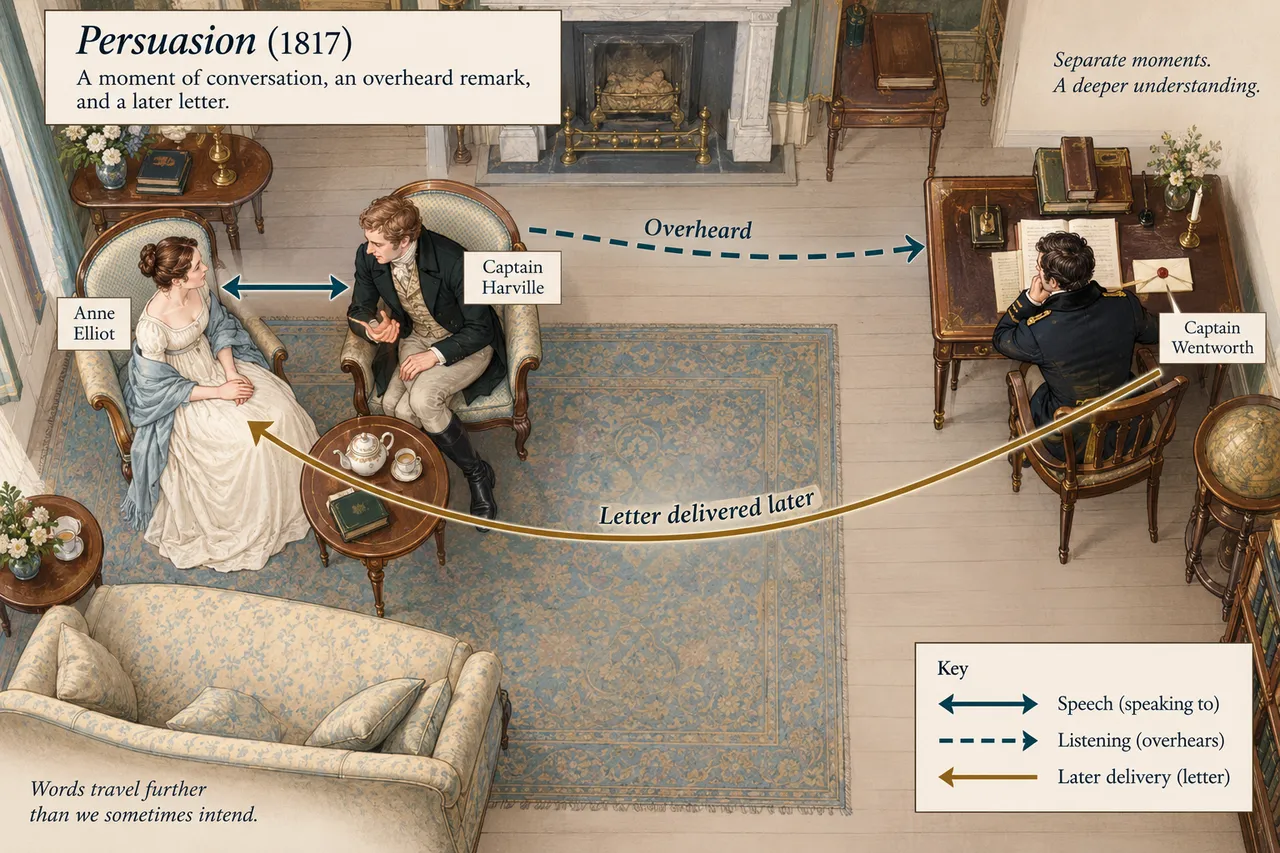
Original myAudience educational illustration. Image: illustration, not a documentary photograph. · myAudience educational illustration; no affiliation with any awarding body.
A conversation, a letter and changing authority: Persuasion23
Persuasion23 turns a conversation about constancy into an opportunity for renewed communication. Anne speaks with Captain Harville while Wentworth writes nearby. The arrangement means that words addressed to one person can be heard by another, and that a private letter can develop while a public conversation continues. Reconstruct those positions before interpreting the scene’s emotional effect. Anne and Wentworth are not initially conducting a direct exchange in which each can clarify everything. The novel makes their relation depend on partial listening, uncertain interpretation and an eventual change in the route by which feeling reaches its intended reader. Form and physical situation cooperate.
Harville appeals to stories, songs and proverbs as evidence about women’s supposed inconstancy. Anne challenges the authority of that material by pointing to men’s greater opportunities to tell the stories that have become available. Her reply is an argument about the conditions under which representations are produced and circulate. It need not deny that any individual story can be illuminating. It rejects the inference that a body of examples shaped by unequal access to authorship can neutrally prove a universal claim about women. An essay should identify that inferential step. Calling her statement feminist may describe a reading, but the label alone does not explain her reasoning.
Anne also admits that each participant begins with a bias towards their own sex. This concession is crucial. Without it, an essay might make her replace Harville’s universal judgement with another universal law and call that the scene’s solution. Instead, she acknowledges that personal circles and remembered cases shape opinion, and that some evidence cannot be publicly offered without betraying confidence. Her argument raises questions about both representativeness and the ethics of disclosure. The scene does not become a statistical demonstration of which sex loves longer. It examines why the available stories cannot straightforwardly settle a question whose terms already invite partial judgement.
Harville’s answer gives male attachment an emotionally specific form through separation from wife and children and the anticipation of reunion. Anne responds by recognising the capacity for warm and faithful feeling rather than denying it. That exchange prevents the debate from becoming two abstract teams who never hear one another. Her later claim concerns continuing love when its object or hope is lost, but it remains a situated claim within a conversation containing concessions. Benwick’s changed attachment complicates what Harville can say in reply. Follow the sequence of admission, example and qualification instead of extracting one statement as the narrator’s settled judgement on every man and woman.
The falling pen briefly changes the scene’s attention. Anne becomes aware that Wentworth is closer than she had supposed and wonders whether he has been listening. The noise is small, but its placement opens a possibility that her words are reaching someone other than their direct addressee. The reader, like Anne, must interpret indications before the private writing is disclosed. This is a narrative mechanism of delayed knowledge, not merely a symbol waiting to be named. Ask what becomes possible after the interruption and what remains uncertain. Wentworth’s subsequent hurry and limited outward response can seem troubling before the letter changes how those actions are understood.
The letter then reorganises the meaning of the room. Wentworth reveals that he has been addressing Anne while appearing occupied with another piece of correspondence. His writing answers what he has heard and discloses continuing attachment, but it also admits uncertainty and resentment. The existence of strong feeling has not made each person’s position transparent to the other. Reading the letter allows Anne access to an account that the preceding social exchange could not openly supply. The narrative delays that access, then records the intensity of its effect. An analysis should distinguish the character’s claims in the letter from a guarantee that the narrator endorses every judgement it contains.
Connect this scene with the two sonnets through the problem of address. Sonnet116 offers a definition and challenge through a direct lyric voice. Remember alters a demand upon its listener. In the novel, an argument meant for Harville is overheard and prompts a letter for Anne, so address is redistributed across speakers, listeners and readers. The connection is not that all three texts provide the same moral about constancy. They show different forms through which constancy is claimed, tested and made consequential. A strong comparison explains what the prose’s mediation and delay allow that a fourteen-line lyric organises differently, while keeping both texts’ details in view.
The room diagram uses separate arrows for conversation, overhearing and later letter delivery. These are successive or overlapping phases represented schematically, not proof that every action occurs simultaneously in an exact floor plan. The illustration’s useful distinction is between where speech is aimed and where it can travel. Your judgement can argue that renewed love becomes possible through being heard, while also recognising the risks of indirect communication and biased interpretation. Anne does not scientifically prove that women invariably love longer, and Wentworth does not become understandable without making a vulnerable disclosure. The scene turns a debate about stories into an event that changes which personal story can now be told and received.
Worked example: How does chapter23 connect being heard with the possibility of renewed love?
Chapter23 connects renewed love with a changed opportunity to communicate. Anne speaks to Harville, but Wentworth’s nearby writing position makes her words available to another listener. The relation between direct address and overhearing matters because neither lover initially possesses a complete account of the other’s feelings. The scene makes communication an event with conditions, not an automatic consequence of continuing attachment.
Anne’s challenge to literary examples establishes part of that argument. She questions whether stories largely told by men can neutrally prove women’s inconstancy, directing attention towards access to authorship. Yet she also admits bias in personal recollection. This concession prevents the exchange from establishing an opposing universal law. Her reasoning examines the authority of available accounts rather than demonstrating a biological rule about who loves longest.
Harville’s account of separation and reunion preserves the depth of male attachment within the conversation. Anne acknowledges that feeling instead of treating him as an opponent who cannot experience constancy. The scene’s ethical force depends on such responsiveness. Its debate contains qualifications and particular memories, which a reader would erase by quoting one claim as the novel’s final judgement on an entire sex.
The pen’s interruption makes listening newly imaginable for Anne. She suspects that Wentworth may have heard more than she thought, while his later hurried behaviour remains difficult to interpret. The narrative withholds the letter’s explanation long enough for actions to acquire uncertain meanings. This formal delay matters: the eventual disclosure changes the account through which those same indications are understood.
Wentworth’s letter answers the overheard conversation and reveals an attachment that social behaviour has not made clear. It also acknowledges hurt and uncertainty, so devotion does not appear as effortless mutual knowledge. Compared with a sonnet’s direct address, the prose distributes expression across a conversation, a listener and a written response. That mediation gives the renewal its particular dramatic and narrative texture.
Being heard therefore enables a new disclosure without settling every general claim made in the debate. Anne’s voice reaches Wentworth, and his letter makes his position readable to her. The conclusion should preserve the difference between that particular renewal and proof about love in all people. The scene’s achievement is to change the possibilities for two characters’ communication while exposing how incomplete and interested stories can obstruct those possibilities.
Answer: Indirect listening enables disclosure without proving universal claims about constancy.
Check your understanding: Does Anne demonstrate that women always love longer than men?
Answer: No. She acknowledges bias and rejects simple proof from books; her argument is situated in restricted opportunities and particular memories, and the novel also stages Harville’s feeling.
Why: A justified answer uses her concessions and the scene’s multiple voices rather than repeating a stereotype.