Reading authority without flattening a tradition
By UK GCSE Religious Studies · independent study · myAudience
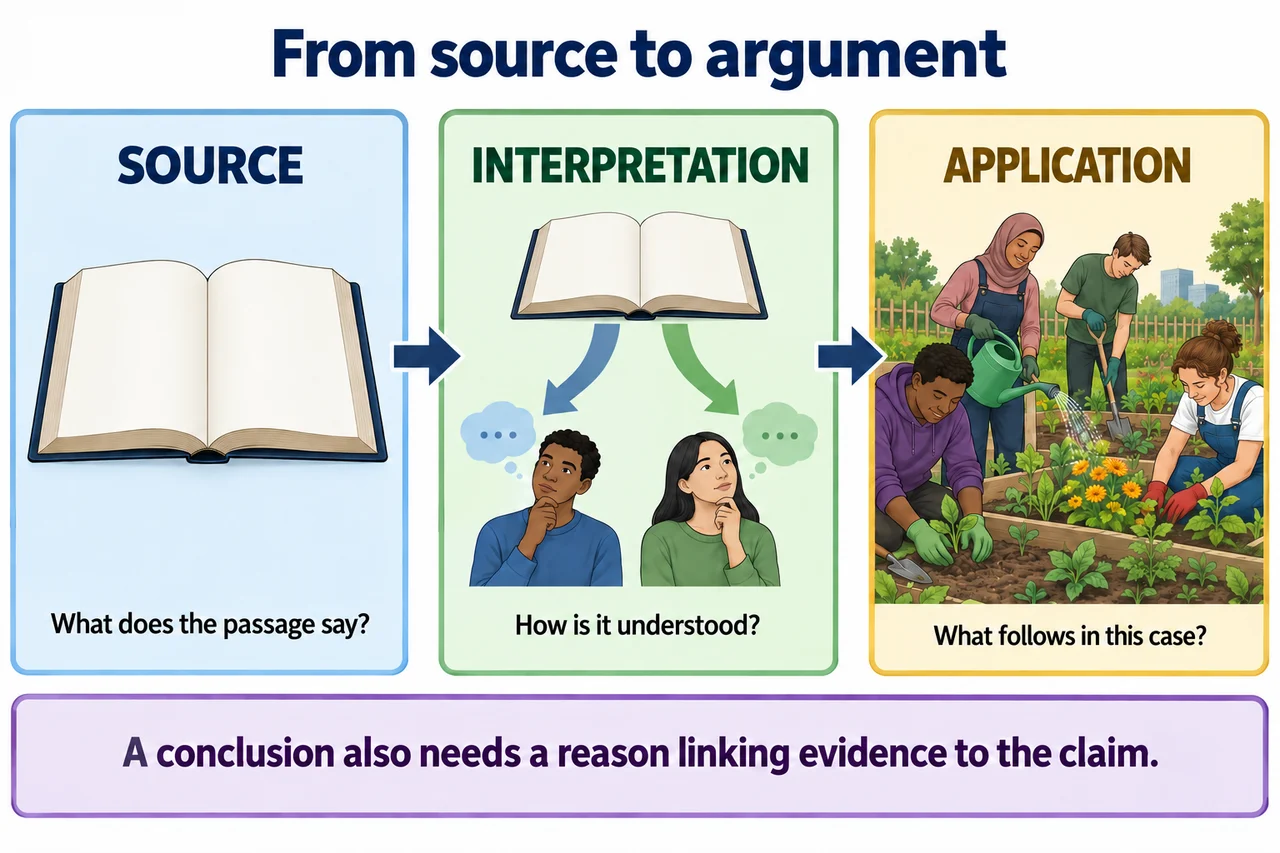
Original myAudience educational illustration. Image: illustration, not a documentary photograph. · myAudience educational illustration; no affiliation with any awarding body.
Reading authority without flattening a tradition
Religious Studies asks what people believe, why a source matters to them and how that belief may affect action. A descriptive claim reports a belief or practice; a normative claim argues what ought to happen. Saying that many Christians regard the Bible as authoritative describes their relationship to a text. Saying that everyone ought to obey it is a different claim requiring argument. Neither believers nor non-believers must adopt the position they explain. Authority means a recognised basis for guidance, not merely an old document or a famous speaker. Scripture, interpretive traditions, reason and lived experience may interact, with different weight in different communities.
A source exercise needs provenance, context and a warrant. Provenance identifies where the passage comes from and whose translation or commentary is being used. Context includes genre and the question being discussed: poetry, letters, narrative and legal instruction do not function identically. A warrant is the reason linking evidence to a conclusion. A passage urging care for others can support a duty of assistance; it cannot by itself show which particular charity uses money effectively. That further empirical claim needs financial and outcome evidence. Our summaries are original paraphrases, not quotations or invented scripture. Qur'an.com supplies English translations of an Arabic text; an English rendering is an interpretation and is not identical to the Arabic Qur'an.
Compare Matthew 25:31–46 with Qur'an 2:177. Matthew's judgement scene connects responses to people in need with accountability before Christ. The identity of the people described as his least brothers is debated, as the USCCB notes explain. Qur'an 2:177 connects faith with generosity, prayer, commitments and patience. A careful comparison finds a shared connection between belief and action while retaining different literary settings and theological claims. It would be inaccurate to call both passages the same rule, or claim they demonstrate that all members of either religion behave generously. A source can establish a teaching without proving universal compliance.
The specification locates these traditions in contemporary Great Britain. Its statement about Christianity's historical predominance does not make every British person Christian or erase Buddhism, Hinduism, Judaism, Sikhism, Islam, atheism and humanism. Atheism concerns lack of belief in gods; humanism generally builds ethical reasoning around human welfare, reason and shared responsibility without requiring supernatural authority. These categories can overlap but are not synonyms. A named organisation's public account gives useful evidence of its own commitments, not a statistically representative account of every adherent. Distinguish an official doctrine, an individual's interpretation and observed practice rather than treating each as interchangeable.
The source-to-argument plate makes this method visible. The blank book stands for evidence; two paths stand for possible interpretations; the garden is an invented application, not proof that religion causes stronger communities. The arrows show stages of reasoning, not an inevitable result. In a worked answer, identify a claim, apply a relevant passage, explain the link, consider an alternative reading and state a limited conclusion. Correct the misconception that a quotation automatically wins an argument: a source can be relevant but misapplied, and a well-supported objection can challenge the warrant without insulting the community that values it.
For summer 2026 onwards, the current five-part section uses 1, 1, 4, 6 and 12 marks. The first four assess AO1 knowledge and understanding; the extended response assesses AO2 analysis and evaluation. The board's March 2025 update explains that source identification and application matter in the new six-mark item. A developed explanation therefore identifies a relevant teaching, explains its meaning and connects it to the specific point; simply attaching a quotation leaves that connection missing. Extended reasoning develops competing arguments and a justified judgement, while clear specialist vocabulary supports communication. Our three-stage checks are original teaching exercises, not reproduced questions, official marking or a guarantee of marks. Two written components each last 1 hour 45 minutes and contribute half the qualification; the chosen route requires both religions and all four selected themes, not whichever topics a learner liked best.
Worked example: An invented council offers a shared garden. A speaker says Matthew 25 and Qur'an 2:177 prove every Christian and Muslim must prefer it to direct food aid. Analyse the claim.
Both texts can support attention to people in need: Matthew connects care and judgement; Qur'an 2:177 places giving alongside belief and worship. This is a defensible common principle, not identity of doctrine.
A garden may improve access to food and social contact, but that is a proposed effect. We need evidence about access, cost, time and people unable to garden. The texts do not compare these two delivery methods.
Direct food aid may meet urgent need faster; a garden may support longer-term provision. Neither possibility proves what every adherent must choose. Interpretive diversity and local circumstances matter.
A justified judgement could favour both, or one under stated conditions. Specify the criterion: urgent hunger, durable access or inclusion. Assess which action meets that criterion rather than counting quotations.
Answer: The sources support a concern for need, but the proposed universal preference is unsupported. A mixed programme is defensible if urgent aid and accessible growing space meet different needs. Someone favouring direct aid can also reason consistently from these passages.
Check your understanding: 1 Define a warrant. 2 Explain one similarity and one difference between the passages. 3 Evaluate whether a religious source alone establishes that a garden is the best form of assistance.
Answer: 1 A warrant links evidence to a claim. 2 Both link faith with care/action; Matthew presents judgement involving Christ, while Qur'an 2:177 describes righteousness through a wider combination of belief, worship and conduct. 3 A source can establish why assistance matters to its reader, but choosing a delivery method needs facts about costs, access and outcomes. A gardener's testimony may show one experience, not everyone's. A source-only conclusion is therefore insufficient, although scripture remains relevant to the purpose and ethical criteria of the decision.
Why: Demand increases from defining a reasoning term to comparing sources and evaluating an inference. Accept alternative practical conclusions when their evidence and warrants are explicit. Reject invented quotations, unsupported claims about all adherents, or the assumption that non-religious reasoning has no ethical content.