Christian oneness and Trinity: distinguish persons from gods
By UK GCSE Religious Studies · independent study · myAudience
Original myAudience educational illustration. Image: illustration, not a documentary photograph. · myAudience educational illustration; no affiliation with any awarding body.
Christian oneness and Trinity: distinguish persons from gods
Monotheism means belief in one God. In mainstream Catholic, Orthodox and Protestant Christianity, the doctrine of the Trinity describes one God as Father, Son and Holy Spirit. A theological person here does not mean three independent human beings or three competing gods. The doctrine holds the persons to be distinct while sharing one divine being. The Catholic Catechism, paragraphs 253–255, presents unity and distinction together. These are claims Christians make about divine reality; Religious Studies can accurately explain them without pretending that a diagram or an empirical measurement proves them.
The Father is described as creator and source; the Son is identified with Jesus Christ, understood as the incarnate Word; the Holy Spirit is associated with divine presence and activity. Incarnation means becoming flesh: mainstream Christian teaching understands Jesus as truly divine and truly human. These distinctions must not imply that only the Father creates, only the Son saves or only the Spirit acts today; Christian theology also speaks of the inseparable action of the one God. Calling Jesus Son of God is therefore not, in this doctrine, a biological claim that God reproduced. The wording expresses a unique divine relationship and identity.
Two tempting analogies create errors. A three-leaf clover may imply that each person is only one third of God; the doctrine does not divide deity into thirds. Water changing between solid, liquid and gas may imply a single person wearing three temporary disguises; that fails to preserve real distinction. Analogies can begin a conversation but their limits must be stated. A precise explanation is stronger than an attractive analogy which changes the claim. The logical question is not simply whether three equals one: the numbers refer to different categories, persons and divine being. That clarification does not remove every philosophical objection, but it addresses a common misdescription.
Belief can influence practice. Baptismal naming of Father, Son and Holy Spirit and prayers addressed through Christ make doctrine part of communal worship. A Christian may connect the Spirit with guidance when making a difficult choice. This is a plausible mechanism of influence: belief shapes the meaning of words and practices. It does not demonstrate that all Christians make identical choices or feel the same experience. Some groups identifying as Christian are non-Trinitarian; the GCSE requires the named mainstream perspectives while awareness of exceptions prevents treating identity labels as perfect predictors.
Use the source-to-argument plate to separate the Catechism's formulation, an interpretation of its theological language and a baptismal application. The blank pages are a reminder to consult the actual numbered paragraphs, not imaginary words in an image. The garden is merely an example of application and does not picture the Trinity. Correct the misconception that the Father, Son and Spirit are ranked from most to least divine. A source supporting their shared divinity cannot be used to justify that hierarchy, even if their roles are described differently.
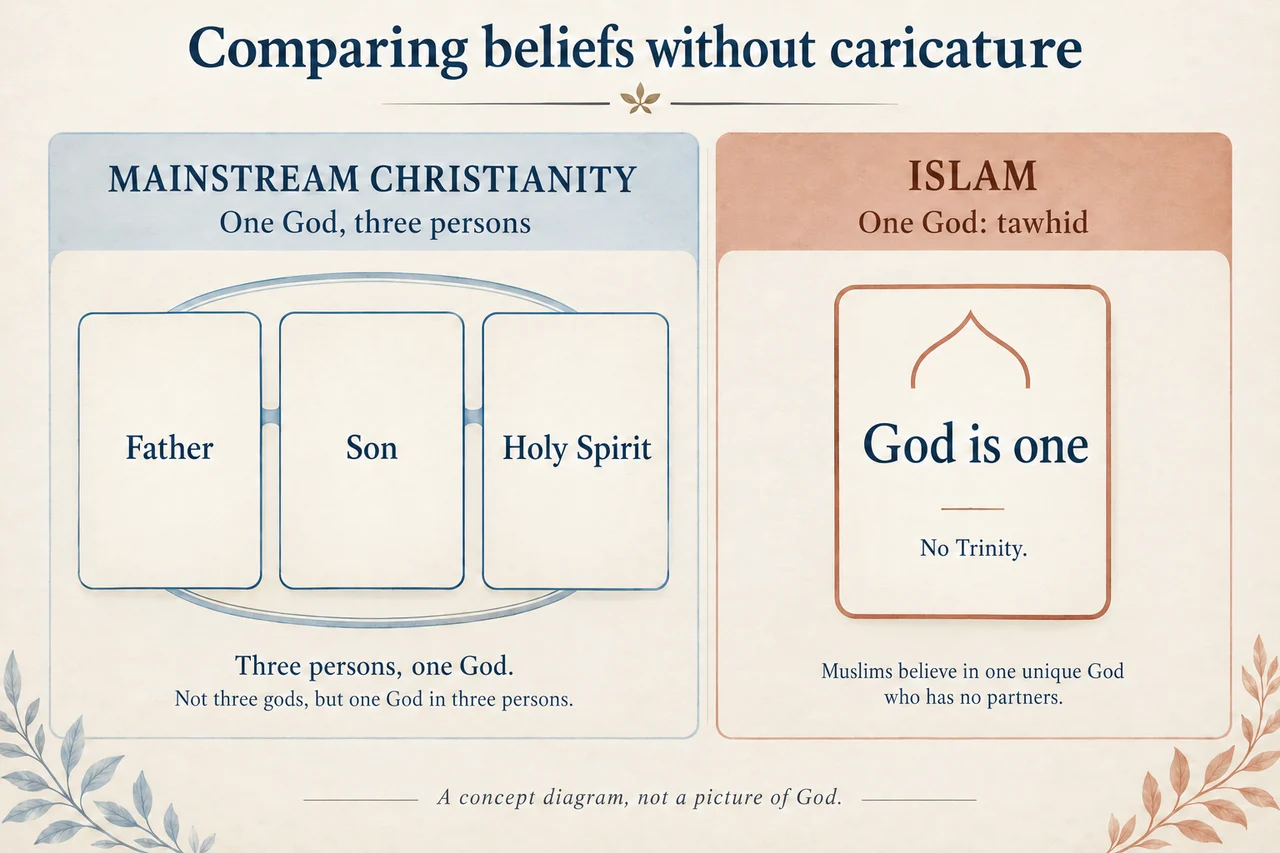
The comparison plate is a concept diagram, not a depiction of God. The three Christian cards name persons within one connected framework; their equal size does not divide God into thirds, create three gods, or restrict creation and love to the Father. Mainstream Trinitarian Christianity and Islam both claim monotheism while differing over Trinity. The arch is decorative, not God's shape. A Muslim critique may reject Trinitarian reasoning without pretending that Christians themselves profess three gods; a Christian reply must explain its own distinctions rather than dismiss tawhid as incomplete Christianity.
Worked example: A fictional pupil writes: 'Christians believe in three gods, and Jesus is one third of God because he is the Son.' Reconstruct a more accurate account and explain an influence.
Separate identity from arithmetic: the doctrine concerns one divine being and three distinct persons. It does not describe three separate gods or three pieces of God.
Explain Son as theological relationship, not fraction or biological parentage. Mainstream incarnation teaching identifies the Son with Jesus, fully divine and fully human.
Apply the doctrine to a particular practice: a baptism using Father, Son and Holy Spirit expresses entry into a community whose confession is Trinitarian.
Limit the conclusion: this explains the doctrine and one influence; it neither proves its truth to everyone nor describes every group using the Christian name.
Answer: A corrected answer distinguishes one God from three persons and links this confession to baptismal worship. It can acknowledge philosophical questions without attributing three-god belief to mainstream Christianity.
Check your understanding: 1 Define monotheism. 2 Explain why the water analogy can mislead. 3 Evaluate 'Different roles within the Trinity mean different degrees of divinity.'
Answer: 1 Monotheism is belief in one God. 2 Water's three states suggest one entity successively changing form, rather than distinct persons. 3 The conclusion confuses role and divine status. Catechism 253–255 preserves unity and real distinction; baptismal language names all three without dividing God into shares. One might still question whether the doctrine is philosophically coherent, but that criticism needs to engage its actual categories. Different roles do not establish a hierarchy of divinity in the doctrine as taught.
Why: The model explains a belief rather than requiring assent. A critical answer earns credit by describing the claim accurately and assessing it, not by declaring agreement or disbelief. Do not teach partialism or temporary-mask analogies as exact doctrine.