Creation and suffering: test the scope of an explanation
By UK GCSE Religious Studies · independent study · myAudience
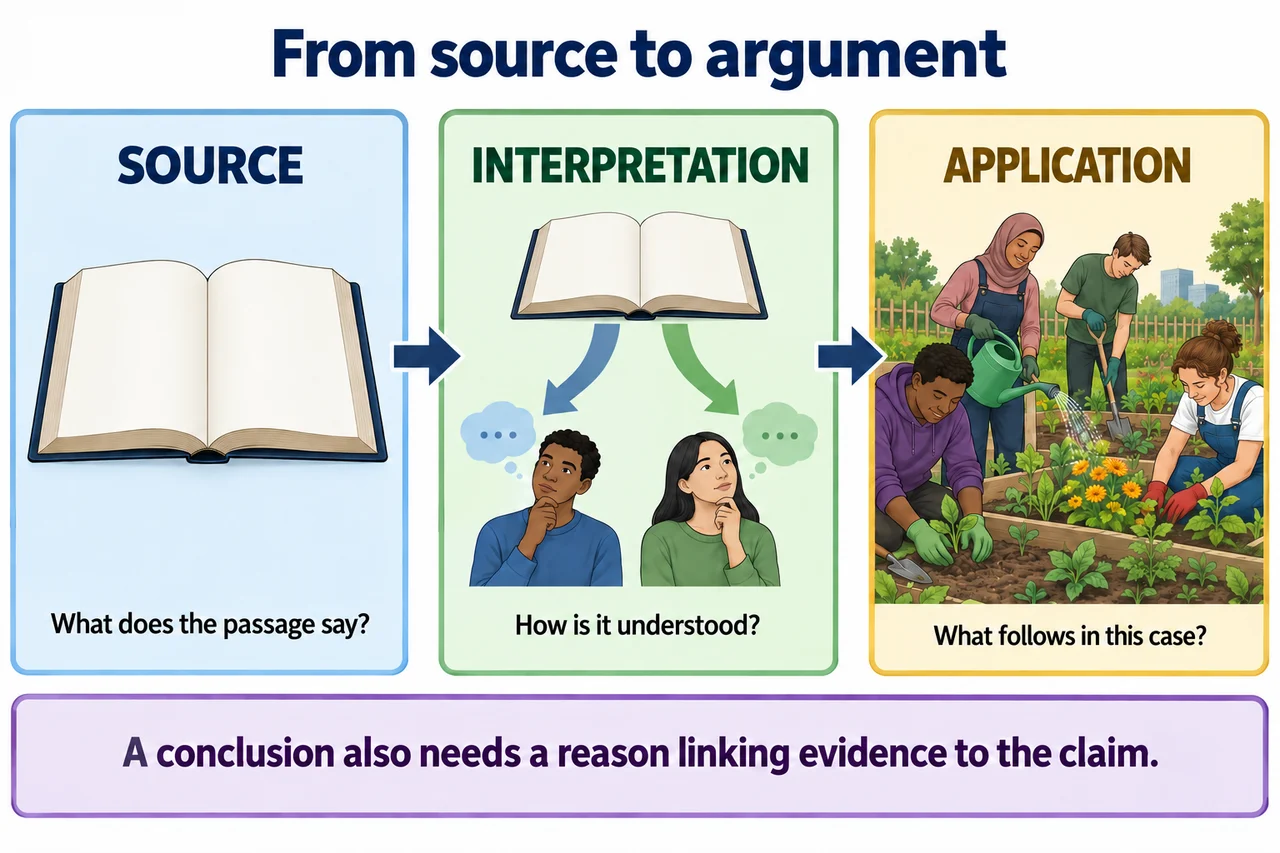
Original myAudience educational illustration. Image: illustration, not a documentary photograph. · myAudience educational illustration; no affiliation with any awarding body.
Creation and suffering: test the scope of an explanation
Creation is the belief that the universe depends on God for its existence. Genesis 1:1–3 presents God bringing order and light; its wording concerning divine spirit or wind depends on translation. John 1:1–3 presents the Word as present with God and involved in creation. Christians commonly identify this Word with the Son. These specified passages are not interchangeable scientific accounts. A literal reading may understand the creation days as an actual sequence of ordinary days. A non-literal reading may treat the ordered account as theological teaching about dependence, goodness and purpose. Both can regard scripture as authoritative while disagreeing over how its genre conveys truth.
Omnipotence is unlimited divine power, often qualified philosophically as power to do what is logically possible. Perfect love concerns willing others' good; justice concerns right judgement and fair treatment. The problem of evil asks whether serious suffering is compatible with a God possessing these attributes. Moral evil results from wrongful human action, such as deliberate cruelty. Natural suffering includes disease and earthquakes, although vulnerability and human decisions can worsen their impact. This distinction matters: a response explaining human misuse of freedom does not automatically explain a disease suffered by an infant.
A free-will response argues that meaningful moral freedom includes the possibility of wrongdoing. If God prevented every wrong choice, the freedom valuable in relationships might be undermined. The objection asks why particular harms are allowed, why freedom could not coexist with more protection and how the response addresses non-human causes. A character-development response argues that a challenging world permits courage and compassion. Its limitation is that extreme suffering may destroy rather than develop agency, and benefits to observers do not automatically justify another person's pain. Present these as arguments, not diagnoses of a sufferer's worth or a claim that a tragedy was deserved.
Religious responses are also practical. A Christian who believes the world is good yet damaged may oppose cruelty and support relief, even while lacking a complete explanation. That is different from proving why the harm occurred. Belief in divine solidarity through Christ can provide meaning to some Christians; others experience suffering as a challenge to faith. Non-religious explanations may investigate mechanisms and responsibilities without claiming a divine purpose. A factual explanation of an earthquake's physical cause does not itself settle the normative question of what assistance ought to be given. Likewise a theological purpose claim does not replace an investigation into building safety.
The source-to-argument plate separates passage, interpretation and application. Here the imagined garden can stand for care for creation, but cannot demonstrate either divine creation or an answer to evil. Work through the arrows with distinct warrants: a text may ground belief in creation; belief in creation may support stewardship; local evidence determines what stewardship requires in a case. Correct the misconception that accepting scientific mechanisms necessarily denies God. Some Christians understand science as describing processes within creation. Whether that reconciliation is convincing is a further argument, not something settled by labelling a reader literal or non-literal.
Worked example: An invented town experiences storm damage. A speaker says freedom explains all suffering, so rebuilding is unnecessary. Assess both inferences.
Storm damage is not simply a free human choice. Human decisions about housing and preparedness may affect losses, but the natural process and the social vulnerability are distinct.
A free-will defence may explain why some wrongdoing is possible; it has not shown why this storm happened or why each loss was permitted. Its scope is limited.
Even if suffering can occasion compassion, the value of responding does not mean the harm was good or help is unnecessary. The practical inference reverses the proposed reason for compassion.
A Christian can argue for rebuilding from love and stewardship; a non-religious person can argue from welfare and mutual responsibility. Plans still need evidence of safety and access.
Answer: Neither claim follows. Freedom is at most a partial response to moral evil, and a theological interpretation does not remove a duty to respond. Rebuilding can be justified under several worldviews without declaring a victim's suffering deserved.
Check your understanding: 1 Distinguish moral evil from natural suffering. 2 Explain one strength and one limit of a free-will response. 3 Evaluate whether a creation text decides how storm relief should be distributed.
Answer: 1 Moral evil involves wrongful agency; natural suffering can arise without a wrongful choice, though choices can worsen it. 2 Freedom explains a connection between agency and some wrongs, but leaves serious natural suffering and the extent of harm unresolved. 3 Creation can support a duty of care for people and world. It does not specify which household has greatest need. Allocation requires facts about damage, vulnerability and fair access. A justified answer combines the ethical principle with evidence rather than treating either as sufficient alone.
Why: Good answers assess an explanation's scope and do not blame people for suffering. A different judgement on the success of a theodicy is acceptable if it addresses the objections and actual claims. Natural/moral categories may overlap in consequences without becoming identical.