Jesus, sin and salvation: explain a connected argument
By UK GCSE Religious Studies · independent study · myAudience
Original myAudience educational illustration. Image: illustration, not a documentary photograph. · myAudience educational illustration; no affiliation with any awarding body.
Jesus, sin and salvation: explain a connected argument
Salvation concerns deliverance from sin and its consequences and restored relationship with God. Sin is a failure in relation to God and right conduct, not simply a breach of a state's law. Original sin refers to the damaged human condition associated in many Christian teachings with the Fall, rather than a newborn's deliberately chosen crime. Christians differ in explaining inherited guilt, corruption and responsibility. Orthodox discussions often emphasise mortality and damaged condition differently from some Western formulations. Do not turn a syllabus term into a claim that every denomination has the same theory of blame.
The incarnation places Jesus at the centre of this account: mainstream Christians believe the Son truly became human while remaining divine. Crucifixion refers to Jesus' execution by crucifixion. His death is interpreted theologically as significant for reconciliation with God; this meaning is not identical to the historical claim that an execution occurred. Resurrection refers to God raising Jesus from death, which Christians take to vindicate him and open hope of life beyond death. Ascension concerns his exaltation and departure from earthly presence. Keep these distinct rather than calling resurrection a return to an ordinary life or ascension another death.
Atonement means reconciliation through Christ's work. Christians have developed several accounts: sacrifice addresses sin, victory over evil emphasises liberation, and moral transformation stresses the power of love to change conduct. These descriptions can overlap, and the GCSE does not require treating one as the only permissible Christian explanation. An argument must show the connection: if separation from God is the problem, a saving action must explain restored relationship. Merely listing execution, resurrection and ascension leaves that connection unstated. An account can also be questioned: how does a death reconcile others, and how are justice and mercy related?
Grace is God's freely given favour or help, not a salary earned by accumulating good deeds. Romans 3:23–24 links human sin with justification as gift through Christ. Law can identify right conduct and wrongdoing, while Christian interpretations differ over its relation to faith, grace and works. The Spirit is understood to guide and transform believers, so moral action need not be imagined as competing with grace; it may be its expression or fruit. Catholic and Protestant accounts differ in how they articulate justification and response, with diversity inside each. Saying that grace removes every responsibility is an inference that requires support and conflicts with the idea of transformed life.
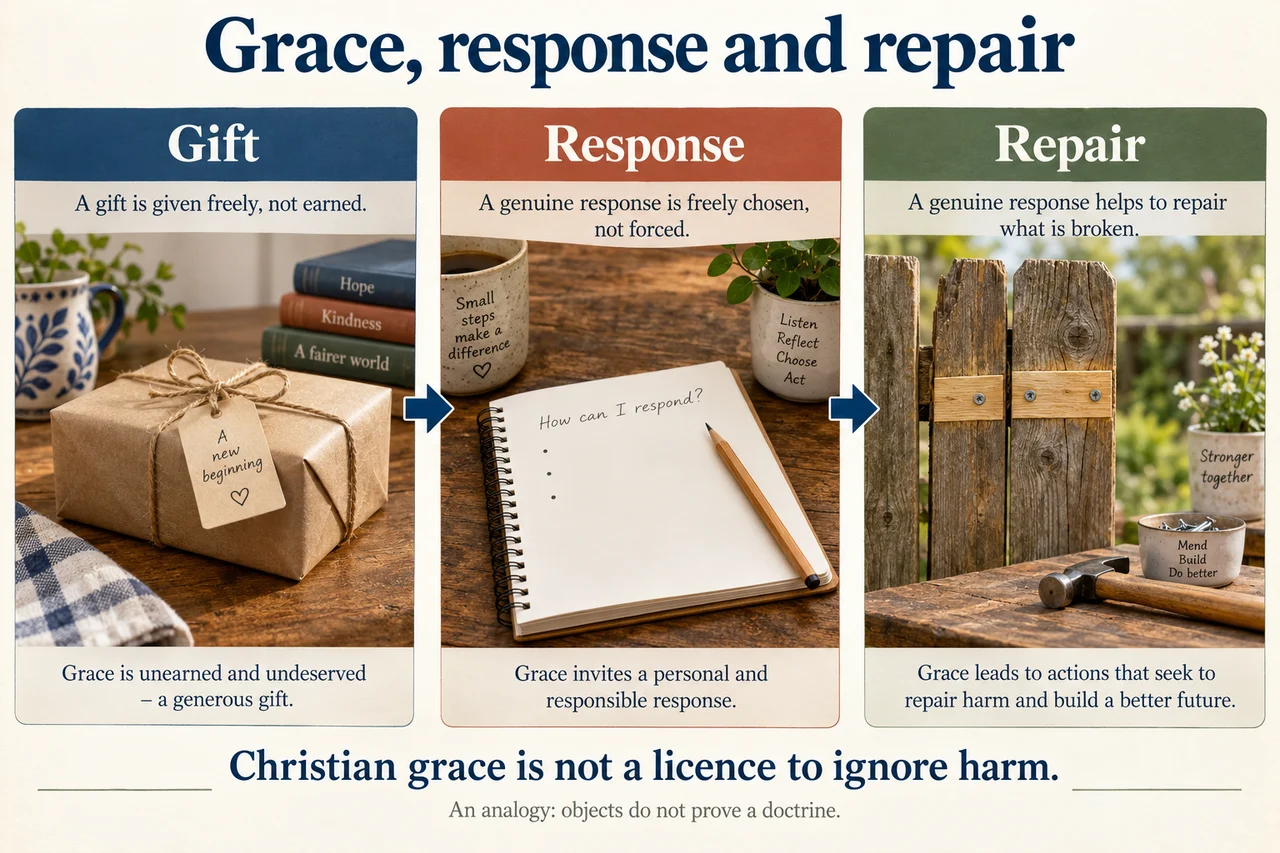
Use the source-to-argument plate to trace Paul's text to an account of gift, then to a believer's response after harming someone. The garden is illustrative only; it does not picture salvation or prove divine favour through social usefulness. A person might seek forgiveness and make restitution because salvation changes the relationship and conduct they desire. That does not make restitution a purchase price for God's grace. Correct the misconception that salvation is guaranteed by membership, by a monetary donation or by an app's reading record. Our task is to explain and assess teachings; neither reading nor this lesson certifies a spiritual or examination outcome.
The gift, notebook and repaired fence are an analogy for grace, response and repair, not a sequence that earns salvation. Their everyday encouraging slogans are not scripture or evidence that a community becomes stronger. A repair action may show a changed response; it cannot establish divine forgiveness by observation. Christian traditions differ over the relation of grace, free response, faith and works. The picture's freely chosen response is an example, not a denial of those debates or proof that every recipient always repairs harm.
Worked example: A fictional Christian says: 'If salvation is a gift, apologising after damaging my neighbour's fence would contradict grace.' Explain and evaluate the reasoning.
Identify the valid starting distinction: grace is described as gift, so a repair bill cannot purchase salvation. That does not yet tell us whether repair is a fitting response.
Link Romans 3's account of sin and gift to reconciliation. A forgiven person can still recognise the harm done to a neighbour and a responsibility to change conduct.
Distinguish cause and response: restitution can express repentance and transformed action without being the price of divine favour. Different Christian accounts describe the relation in different terms.
Test the objection: if no action ever matters, transformation and guidance by the Spirit become empty claims. The speaker has not justified that stronger conclusion.
Answer: Apology and repair can be consistent with grace as responses to forgiveness rather than payments for it. A strong answer distinguishes theological salvation from practical responsibility and avoids declaring one denominational formulation universal.
Check your understanding: 1 Define incarnation and atonement. 2 Distinguish resurrection from ascension. 3 Evaluate 'Grace makes moral action irrelevant' using a relevant source and an objection.
Answer: 1 Incarnation is the Son becoming human; atonement is reconciliation through Christ. 2 Resurrection is being raised from death, while ascension concerns exaltation and departure from earthly presence. 3 Romans 3:23–24 supports justification as gift, which challenges the view that good deeds buy salvation. It does not establish indifference to conduct. Moral action can follow reconciliation and the Spirit's transforming activity. The objection that action becomes a hidden price matters, but can be answered by distinguishing a freely received gift from an appropriate response. The claim of total irrelevance is therefore too strong.
Why: The check moves from terms through relations to evaluation. Other conclusions can be defended if source use and doctrinal distinctions are accurate. Do not equate sin with every civil offence or treat original sin as a newborn's deliberate wrongdoing.