Baptism and Communion: compare signs, agency and meaning
By UK GCSE Religious Studies · independent study · myAudience
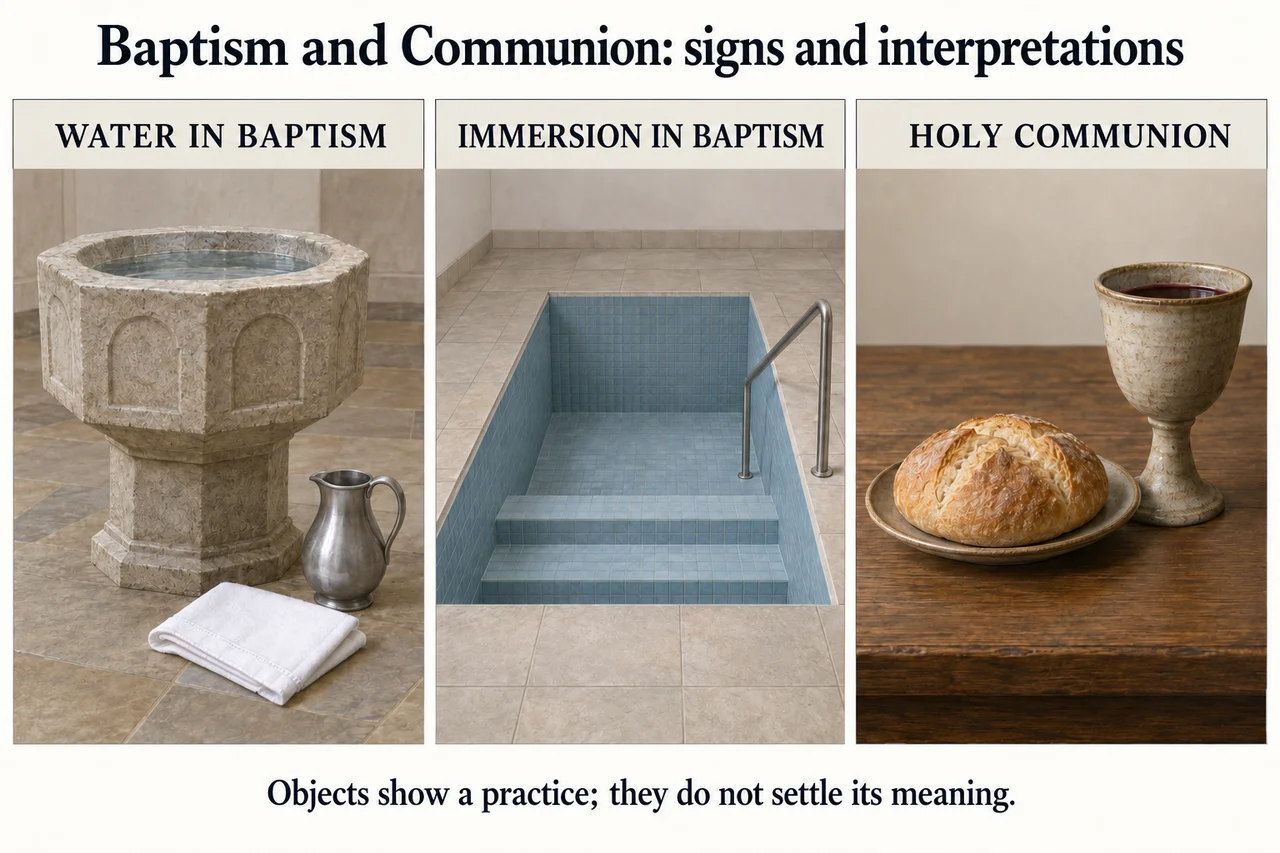
Original myAudience educational illustration. Image: illustration, not a documentary photograph. · myAudience educational illustration; no affiliation with any awarding body.
Baptism and Communion: compare signs, agency and meaning
A sacrament is commonly explained as an outward sign through which divine grace is communicated. Catholic and Orthodox traditions recognise seven sacraments, while many Protestant traditions give particular status to baptism and Communion instituted by Christ. Some Christians describe them as ordinances emphasising obedience and witness; Quakers and the Salvation Army do not practise outward baptism and Eucharist as other churches do. The selected Christianity syllabus requires the meaning and differences, not an assumption that every Christian counts or understands sacraments in one way. A definition should make the theological meaning clear without presenting it as a laboratory mechanism.
Baptism uses water in Christian initiation. Water can signify cleansing, a new life and entry into the Christian community, with language connecting the rite to Christ. Infant baptism, practised in Catholic, Orthodox and many Anglican communities, emphasises grace preceding a child's personal understanding and the community's responsibility to nurture faith. Parents and godparents may make commitments. Believers' baptism, characteristic of Baptist traditions, follows a personal profession of faith and commonly uses immersion. The difference concerns who is baptised and why, not simply whether water is poured or the person submerged. An adult can be baptised by pouring, and Orthodox infant baptism can involve immersion.
The strongest comparison identifies shared and divergent reasons. Both forms can express belonging and a new relationship with God. A supporter of infant baptism may argue that God's gift does not depend on intellectual maturity and that faith develops within a community. A supporter of believers' baptism may argue that an accountable personal response should precede the public sign. Neither view is adequately described as caring versus not caring about children. Churches declining infant baptism may still bless, dedicate and teach children; churches baptising infants may still expect later personal commitment. An observed ceremony therefore needs interpretation, rather than a conclusion about the person's entire future belief.
Holy Communion, also called Eucharist or the Lord's Supper, uses bread and wine in remembrance of Jesus' Last Supper and death. Catholics teach Christ's real presence and transubstantiation: the substance is changed while the appearances remain. Orthodox Christians also affirm real presence without needing to use precisely the same explanatory framework. Protestant interpretations vary, including spiritual presence and memorial emphasis; it is inaccurate to say that all Protestants regard the elements as merely symbolic. Sharing the meal can express communion with Christ and other believers, thanksgiving and renewal. An interpretation of Christ's presence is a theological claim, not something the generated still life can verify.
The sacramental-signs plate shows a font, immersion pool, and bread with a chalice. These are illustrative examples, not rules that fonts are exclusively for infants, all believers use pools or every church uses this kind of loaf. The empty pool helps focus on immersion without claiming to depict a real service. The objects allow a comparison of visible actions while the caption warns that meaning requires sources and testimony. Correct the misconception that transubstantiation means visible meat appears, or that the colour of a chalice proves a denomination. Neither follows from the doctrine or from objects alone.
The corrected picture labels the first two panels by visible water practices rather than assigning a font exclusively to infants and a pool exclusively to adult believers. Infant baptism can involve immersion, and adults can be baptised by pouring. The bread and chalice are illustrative objects, not an exact record of every community's Eucharist. Compare the reasons a community gives for its actions; an object or image cannot establish sacramental meaning by itself.
Worked example: A fictional museum labels a font 'Christian practice before a person believes' and a pool 'the only form involving faith'. Repair the labels and explain what a visitor cannot infer from the objects.
Use the font as an example often associated with infant baptism, but note it can be used for adult baptism. Infant baptism connects grace, belonging and promises of nurture, not absence of all faith in the community.
Use the pool as an example of immersion commonly associated with believers' baptism. A personal profession is central to that account, but immersion alone does not show the candidate's age or inward conviction.
Both practices can involve faith: in one, communal commitments accompany a child; in the other, personal profession precedes baptism. Their difference concerns agency and theological sequence.
A visitor needs the community's explanation, context and perhaps service text. Appearance alone cannot prove sincerity or distinguish every tradition. Compare Communion similarly: identical-looking bread can be understood differently.
Answer: Revised labels should describe common uses and state exceptions. Faith cannot be inferred from a vessel. A substantive comparison explains the timing of personal response and the role of communal nurture without calling either practice faithless. The corrected inference separates visible method from the reason given for it: adult pouring and Orthodox infant immersion are counterexamples to exclusive age labels. A visitor should ask how grace, personal profession and community responsibility are understood in that particular tradition. The objects alone cannot show whether faith is absent, sincere or enduring, so the revised museum labels should invite interpretation rather than assert a person’s inner state.
Check your understanding: 1 Define sacrament. 2 Explain one shared meaning and one difference between infant and believers' baptism. 3 Assess 'The same bread means the same Eucharistic belief.'
Answer: 1 A sacrament is an outward sign understood to communicate grace. 2 Both can express new life and belonging; infant baptism emphasises grace and communal nurture before personal profession, while believers' baptism follows profession. 3 The inference from visible similarity is invalid. Catholics teach transubstantiation; Orthodox Christians affirm real presence; Protestants differ, including spiritual and memorial accounts. Shared remembrance and thanksgiving do not remove these differences. Objects show what is handled, while doctrine and participants' explanations help establish what it means. No opinion on which interpretation is true is required.
Why: The task progresses from vocabulary to a comparison of reasons and then a source/evidence problem. The plate is intentionally limited. Correct the form/age confusion and do not classify all Protestant Eucharistic theology as a single view.