Christian judgement and service: belief, influence and evidence
By UK GCSE Religious Studies · independent study · myAudience
Original myAudience educational illustration. Image: illustration, not a documentary photograph. · myAudience educational illustration; no affiliation with any awarding body.
Christian judgement and service: belief, influence and evidence
Christian afterlife beliefs connect present life with ultimate relationship and judgement before God. Resurrection means being raised to life, not the soul repeatedly entering new earthly bodies. Heaven is commonly understood as fulfilment of life in God's presence; hell as separation from God or judgement, with different literal and symbolic interpretations. Christians differ about the relation between bodily resurrection, an intermediate state and final judgement. Some emphasise everlasting punishment, others understand judgement differently or hope for universal reconciliation. Naming diversity does not mean that every account is equally common or that the syllabus specifies only one picture of flames and clouds.
Matthew 25:31–46 gives a judgement scene in which care or neglect of people in need is linked to response to Christ. It can support the claim that belief in judgement influences ethical responsibility beyond private worship. Its genre and disputed identification of the least brothers matter: a passage used to support general care should not be presented as though all scholars agree on every detail. A Christian can reason that people possess dignity and are not disposable, so helping a hungry person is part of faith in action. This explains an influence; it does not prove that every believer volunteers or that a non-believer lacks motives for assistance.
A food bank is a service distributing food to people facing need. Churches may supply premises, volunteers, donations and support through partnership with others. The mechanism is concrete: shared teaching motivates giving time or resources, an organisation converts them into assistance, and recipients can obtain food. Claims about causes of poverty, reach and lasting benefit require evidence beyond the donors' intentions. A service can relieve immediate need without solving insecure income or housing. Describe a hypothetical local example honestly rather than inventing statistics or portraying need as moral failure.
Christian Aid is the chosen organisation from the specification's permitted charity examples. Its public account grounds work against poverty in Christian commitments while describing assistance regardless of recipients' belief. This is evidence of a stated mission and approach, not independent proof that every programme achieves its aim. It also shows why charity must not be reduced to seeking converts: a faith-based motivation need not make help conditional on religious assent. A critical evaluation can ask about participation, effectiveness and structural causes while representing the organisation fairly. A personal testimony can illuminate a lived motivation but cannot stand in for a representative survey.
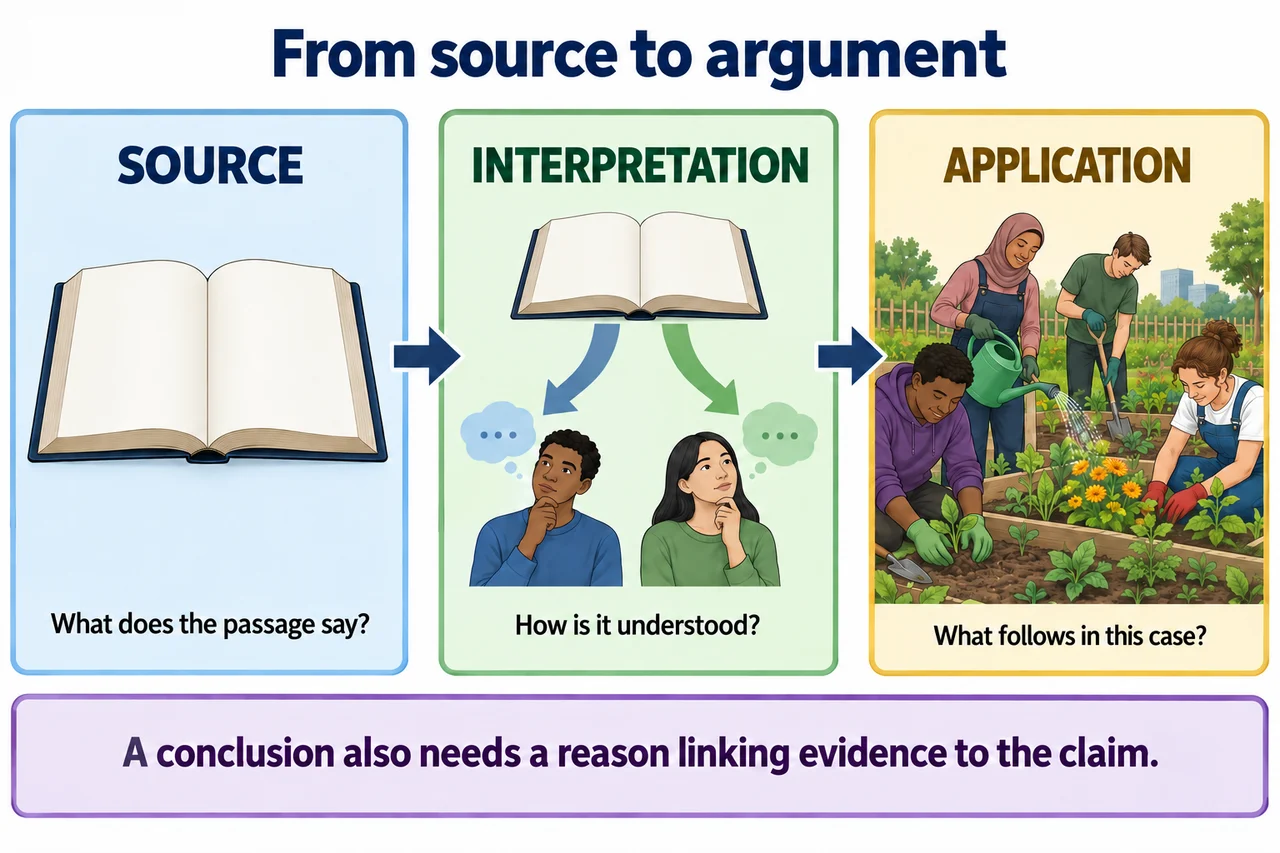
In the source-to-argument plate, the book stands for Matthew or the charity's account, the middle panel for a reading of responsibility, and the garden for an invented form of service. The garden is not Christian Aid project evidence. The arrow from meaning to action needs a warrant, such as care for people in need; the choice of action also requires knowledge of their circumstances. Correct the misconception that judgement implies giving money purchases heaven, or that a generous act proves a specific afterlife doctrine. Behaviour has multiple motives, and Christian accounts of grace cannot simply be replaced by a points system.
Worked example: An invented church funds food parcels and proposes a debt-support partnership. One member says Matthew 25 proves parcels alone solve poverty. Construct a source-based but evidence-conscious response.
Apply Matthew's judgement scene to the importance of responding to need. Explain why care can matter to a Christian rather than merely naming the passage.
Separate moral importance from empirical effectiveness. Parcels may meet urgent hunger; whether they solve longer-term poverty requires facts about income, debt and access.
Use Christian Aid's account as a named example of Christian motivation alongside help regardless of faith. It does not license inventing programme results for the local proposal.
Judge the proposal against urgent relief and lasting support. Both parcels and a well-designed partnership may be justified, but claims about outcomes remain conditional until evidence is gathered.
Answer: Matthew can justify concern and action without establishing that parcels alone solve poverty. Combining urgent relief with a checked partnership is defensible if it meets recipients' needs and protects their agency. Different priorities are possible when supported by evidence.
Check your understanding: 1 Distinguish resurrection from reincarnation. 2 Explain how judgement might influence service. 3 Evaluate whether a charity's stated mission proves its effectiveness.
Answer: 1 Resurrection is being raised to life; reincarnation involves new earthly embodiments. 2 Matthew 25 can encourage attention to vulnerable people because response to need is connected with response to Christ and judgement. 3 A mission statement establishes a declared purpose. It does not demonstrate reach or lasting benefit. Programme evidence, recipients' experience and independent evaluation may support effectiveness. Christian motivation and assistance regardless of belief can be explained accurately while keeping those outcome questions open. Equally, a lack of evaluation does not prove failure; it limits what can honestly be claimed.
Why: These are partial foundations for afterlife and service, not coverage of all festivals, mission or worldwide Church requirements. Credit influence chains and appropriate limits. Avoid the misconception that charity is a transaction buying salvation or that poverty reflects lack of faith.