Tawhid and Muslim belief frameworks: compare without false oppositions
By UK GCSE Religious Studies · independent study · myAudience
Original myAudience educational illustration. Image: illustration, not a documentary photograph. · myAudience educational illustration; no affiliation with any awarding body.
Tawhid and Muslim belief frameworks: compare without false oppositions
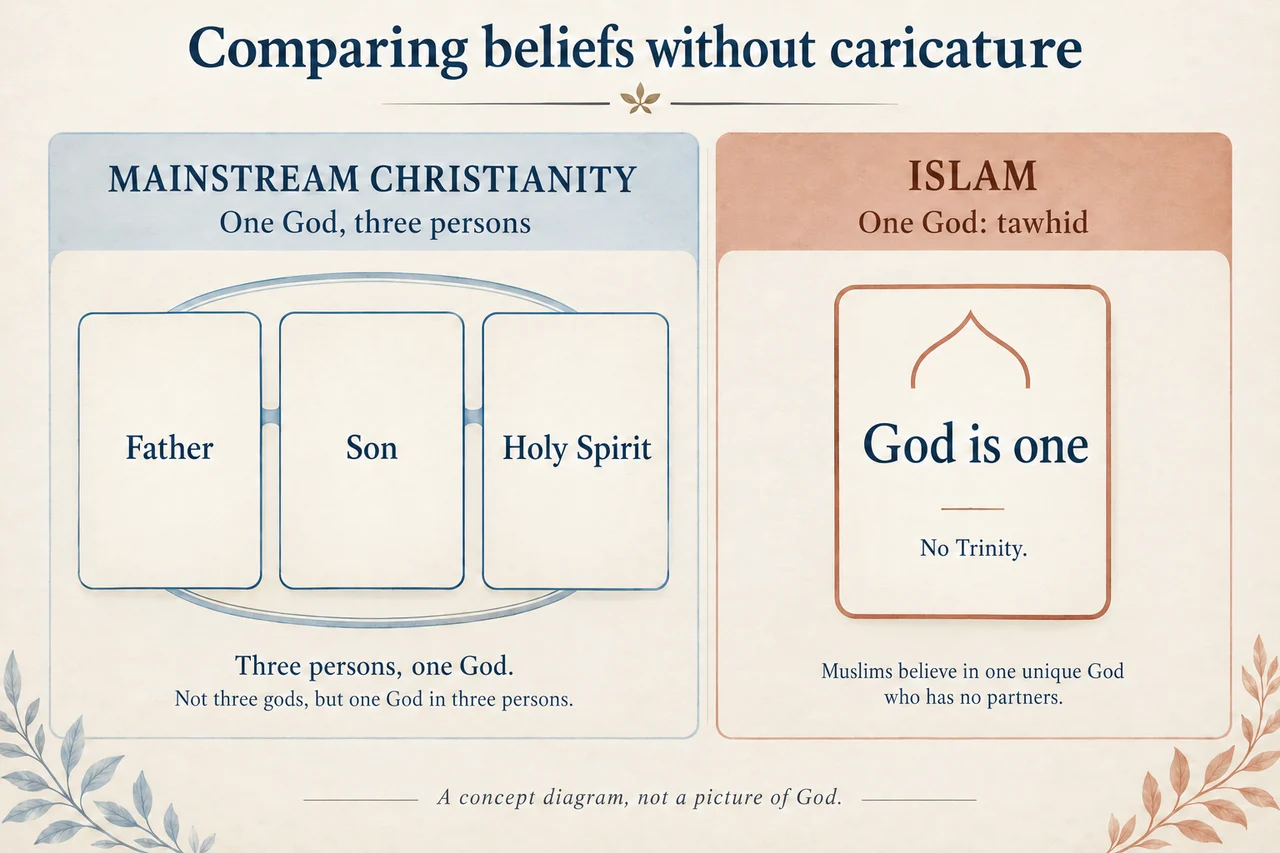
Tawhid is the oneness and uniqueness of God. Allah is the Arabic word for God, not the name of a separate tribal deity. Surah 112 presents God as one and without equivalent, rejecting divine offspring and dependence on parentage. Muslims understand this as excluding partnership in divinity. In comparison, mainstream Christians also affirm one God but describe that oneness through Trinity. A sound comparison identifies both the shared monotheistic claim and the different account of divine unity; it does not call Muslims believers in the Christian Trinity or Christians, on their own account, polytheists.
The six articles commonly taught in Sunni Islam are belief in God, angels, revealed books, prophets, the Last Day and divine decree. The five roots taught in Twelver Shi'a Islam are tawhid, divine justice, prophethood, imamate and resurrection or judgement. The Shi'a teaching source by Sayyid Saeed Akhtar Rizvi identifies these roots explicitly. This difference concerns organisation and emphasis as well as authority. Absence of angels from a five-item list does not show Shi'a denial of angels, and absence of justice as a separate Sunni article does not show Sunni denial of justice. Counting headings is a poor substitute for studying what each framework teaches.
Omnipotence concerns God's power. Beneficence concerns doing good; mercy concerns compassion and forgiveness; justice concerns right judgement. Adalat, divine justice, has a distinct place in Shi'a belief frameworks. These attributes can shape attitudes to responsibility: a believer may trust that hidden wrongdoing is not ultimately overlooked while also seeking forgiveness. That does not establish that a human court's sentence must match a person's guess about God's judgement. Religious Studies distinguishes the divine attribute being asserted from the further policy inference drawn from it.
Transcendence describes God as beyond and not reducible to the created world. Immanence concerns divine closeness or activity within life. These are not simply location coordinates. A Muslim can affirm that God is beyond creation and knows or sustains what happens within it without portraying God as a physical object inside the universe. An illustration of a human figure would misrepresent this concept and is unnecessary here. Theological language makes claims about relationship and reality, while English terms and translations need explanation. A lived response might include trust during difficulty or moral accountability, but people vary in how they interpret and express those commitments.
The source-to-argument plate supports a disciplined comparison. The source panel stands for Surah 112 or a named community's teaching; the middle panel for how its account of unity is explained; the application panel for a hypothetical action influenced by accountability or compassion. No figure in the garden depicts God or a prophet. Correct the misconception that every Sunni person and every Shi'a person fits a uniform profile. The GCSE names specific differences, but those do not erase shared scripture, overlapping practices or diversity of legal schools and personal observance.
The comparison plate is a concept diagram, not a depiction of God. The three Christian cards name persons within one connected framework; their equal size does not divide God into thirds, create three gods, or restrict creation and love to the Father. Mainstream Trinitarian Christianity and Islam both claim monotheism while differing over Trinity. The arch is decorative, not God's shape. A Muslim critique may reject Trinitarian reasoning without pretending that Christians themselves profess three gods; a Christian reply must explain its own distinctions rather than dismiss tawhid as incomplete Christianity.
Worked example: An invented revision chart says: 'Sunnis believe in angels but not justice; Shi'a believe in justice but not angels.' Use the frameworks to diagnose its error.
Identify the lists correctly: Sunni six articles include angels; Twelver Shi'a five roots name divine justice and imamate distinctly.
Distinguish a summary heading from the whole body of teaching. The five roots do not claim to list every accepted being or practice; the six articles do not say unnamed attributes are rejected.
Use Surah 112 as shared evidence of tawhid, while recognising differences over authority and imamate. Shared scripture prevents treating the frameworks as unrelated religions.
Replace the chart with a qualified comparison: distinct organisational emphases alongside many shared beliefs. Do not infer a denial simply from omission.
Answer: The chart mistakes different summaries for mutually exclusive beliefs. A correct comparison describes the shared commitment to God and judgement and the Shi'a roots' explicit treatment of justice and imamate, without inventing Sunni denial of justice or Shi'a denial of angels.
Check your understanding: 1 Define tawhid. 2 Distinguish transcendence and immanence. 3 Evaluate whether the six articles and five roots prove that Sunni and Shi'a have no shared beliefs.
Answer: 1 Tawhid means God's oneness and uniqueness. 2 Transcendence concerns being beyond creation; immanence concerns closeness or activity within life, not a physical position. 3 The conclusion is false: God, prophecy and final accountability are shared concerns, and both traditions recognise the Qur'an. The frameworks differ in organisation and in the special place of justice and imamate among Shi'a roots. Surah 112 can be applied to explain shared divine unity. Genuine disagreements should be specified, but counting six versus five does not establish complete opposition.
Why: Accurate comparison requires shared ground and a named difference, not false symmetry or caricature. The lesson explains Twelver Shi'a roots rather than claiming every Shi'a community has an identical formulation. Critical evaluation does not require religious assent.