Prophethood, revelation and imamate: distinguish forms of authority
By UK GCSE Religious Studies · independent study · myAudience
Original myAudience educational illustration. Image: illustration, not a documentary photograph. · myAudience educational illustration; no affiliation with any awarding body.
Prophethood, revelation and imamate: distinguish forms of authority
Risalah means prophethood or God's communication through messengers. Muslims understand prophets as human recipients and transmitters of guidance rather than divine beings. Adam is associated with the beginning of human life and guidance; Ibrahim with devotion to one God and obedience; Muhammad with the final prophetic mission and the revelation of the Qur'an. These roles are connected by continuity, not by a claim that every prophet founded an unrelated religion. An accurate answer explains a role's significance, such as providing an example of response to God, rather than simply listing names.
Revelation is communication understood to originate from God. Muslims regard the Qur'an as God's revelation to Muhammad, associated with the angel Jibril. Qur'an 96:1–5 connects the command to read or recite with creation and divine teaching; it is one of the specification's named passages in the fasting context. The traditional account connects it with the beginning of revelation, but the verses alone are not a modern eyewitness report specifying every historical detail. Keep the textual content, the religious tradition about its setting and an independent historical investigation distinct. English translation helps a learner analyse meaning but is not a replacement for the Arabic text in Muslim accounts of revelation.
Angels are understood as servants of God with assigned roles. Jibril is associated with conveying revelation; Mika'il with provision and sustaining life, often described through rain and nourishment. This differentiates role from divine status: an angel delivering guidance is not its ultimate author and is not another god. Religious Studies explains what these teachings claim rather than asserting that a generated picture could establish an angel's nature. The absence of sacred figures in our artwork is deliberate; conceptual analysis does not need to invent appearances for beings whose religious description differs from human portraiture.
Islam acknowledges earlier revelation associated with the Torah, Psalms, Gospel and Scrolls of Ibrahim. The importance of these teachings lies in continuity of divine guidance, while Muslim accounts distinguish the authority and preservation of the Qur'an from claims about earlier scriptures as transmitted. The Gospel in this context should not automatically be equated with the four canonical Christian Gospel books as though the accounts of revelation were identical. Likewise recognising Moses or Jesus as a prophet does not mean Muslims adopt every Jewish or Christian doctrinal interpretation. Avoid caricaturing those living traditions as merely failed versions of Islam; identify whose theological claim is being explained.
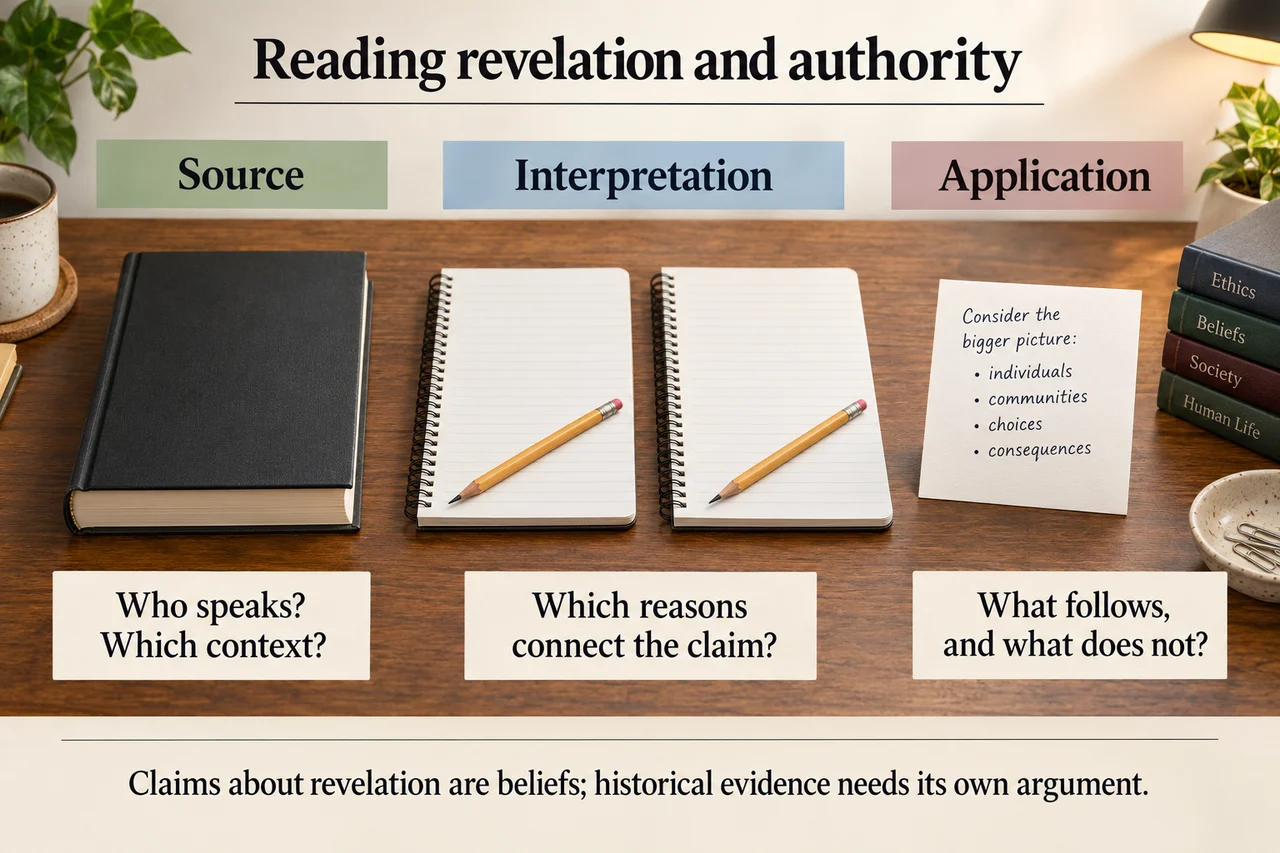
Imamate has a special authoritative role in Shi'a Islam. Twelver Shi'a teaching understands a line of Imams beginning with Ali as divinely designated guides after Muhammad, rather than new prophets bringing a replacement Qur'an. An imam leading a local prayer congregation is not automatically one of these Imams. Sunni accounts of community leadership and scholarly authority differ from this doctrine. Use the source-to-argument plate to distinguish a shared scripture from explanations of who rightly interprets and leads. The hypothetical garden shows application only. Correct the misconception that an Imam must be a prophet, or that shared scripture makes disputes over leadership meaningless.
The authority plate uses an unmarked ordinary book and blank notebooks, not a generated Qur'an, Bible or historical manuscript. It separates a source, interpretation and application so that the missing warrant can be examined. Its examples of people, communities and consequences are possible questions, not a rule that consequences alone settle theology. No pictured object proves revelation, free will, sincerity or divine approval. Compare the source's genre and a community's interpretation before claiming that a belief logically requires one action.
Worked example: A fictional museum calls Jibril 'the god who wrote the Qur'an' and every mosque prayer leader 'a Shi'a successor-prophet'. Rewrite the account with reasons.
Locate ultimate authority: Muslims regard the Qur'an as revelation from God, conveyed through Jibril to Muhammad. The messenger role does not make Jibril divine.
Distinguish categories: Muhammad is the prophet; an angel conveying revelation and a human guiding a community are not the same type of authority.
Explain imamate in the named Twelver Shi'a account as designated guidance after Muhammad, without a new prophetic mission. Distinguish that doctrine from the ordinary use of imam for a prayer leader.
A shared Qur'an does not settle every dispute over interpretation or leadership. Accurate labels should identify whose doctrine is represented and avoid reducing all Muslims to one institutional pattern.
Answer: Jibril is an angel associated with transmitting revelation from God to Muhammad. A congregational imam is a prayer leader; Shi'a Imams have a distinct doctrinal role as guides, not successor-prophets. The repaired labels distinguish divine source, prophetic reception and interpretive leadership.
Check your understanding: 1 Define risalah. 2 Explain the significance of Qur'an 96:1–5 without inventing an eyewitness claim. 3 Assess whether recognition of earlier holy books means Muslims accept every current Christian or Jewish interpretation.
Answer: 1 Risalah is prophethood and communication through messengers. 2 The passage associates recitation, creation and teaching; Muslim tradition connects it to the beginning of Muhammad's revelation. The verses and the traditional account of setting are distinct kinds of evidence. 3 Recognition of earlier divine guidance does not entail agreement with every transmitted text or doctrine. The Qur'an's role and Muslim understandings of preservation matter. A fair comparison attributes this claim to Muslim theology while allowing Christians and Jews to describe their own scriptures and interpretations. Shared figures create overlap, not identical authority claims.
Why: The demanding task tests categories and inference, rather than a prescribed opinion on revelation. Additional historically critical work is still needed. Correct confusing angel, prophet, local imam and Twelver Imam, and avoid invented sacred portraits.