Divine decree and accountability: does knowledge compel a choice?
By UK GCSE Religious Studies · independent study · myAudience
Original myAudience educational illustration. Image: illustration, not a documentary photograph. · myAudience educational illustration; no affiliation with any awarding body.
Divine decree and accountability: does knowledge compel a choice?
Akhirah means life beyond earthly death. Islamic teaching connects resurrection and the Day of Judgement with accountability for actions. Heaven and hell concern the outcomes of judgement, with descriptions interpreted in different ways; a lesson must not turn a broad belief into a claim that everyone pictures exactly the same landscape. Qur'an 99:7–8 emphasises that even very small good and evil deeds will be seen. This can support the importance of apparently unnoticed conduct. The wording is a moral-accountability claim, not a physics definition of an atom or a measurable score awarded by an app.
Divine decree, often discussed through al-Qadr, concerns God's knowledge and governance of events. Human freedom concerns the capacity to choose and act responsibly. The tension is substantial: if God has complete knowledge and power, how can a person be responsible for a wrong choice? A first distinction separates knowing from causing. A person may know a scheduled action without forcing it, but human examples have limits because human knowledge is fallible and incomplete. The distinction shows that knowledge and coercion are not identical concepts; it does not fully settle the relation between divine decree and agency.
Muslim theological accounts differ. Some Sunni discussions strongly emphasise divine decree while explaining human responsibility through the person's willing and responsibility for acts; Shi'a emphasis on divine justice resists portraying wrongdoing as a compulsory action for which a person is then unfairly punished. These are orientations within substantial debates, not a rule that Sunnis have no agency or Shi'a think God knows nothing. The Twelver source used here emphasises freedom of will alongside God's knowledge and power. A good GCSE answer names the tension, gives a qualified account and connects it to responsibility, instead of pretending there is no disagreement.
Accountability can encourage honesty even when no human observer is present. Belief in mercy can encourage repentance rather than despair. Qur'an 39:53 is relevant to God's mercy, but applying it does not mean every action is automatically excused or that harm to another person needs no response. Justice and mercy can be discussed together: a person acknowledges wrongdoing, seeks forgiveness and acts to repair harm. Explain influence as a plausible link, not a claim that everyone holding the belief behaves honestly. Non-religious accounts can also defend honesty through trust, harm and duty without belief in an afterlife.
The source-to-argument plate separates Qur'an 99's language, an interpretation of small deeds' significance and an invented choice about reporting a mistake. Its garden scene does not illustrate heaven, hell or divine surveillance. The blank book prevents mistaking image text for scripture. Correct the misconception that predestination is permission to avoid effort. If a teaching also affirms accountability, a fatalistic conclusion must explain why accountable choices would cease to matter. The conflict is a problem to reason through, not an excuse to stereotype a Muslim pupil's motivation or to promise that this lesson resolves centuries of theology.
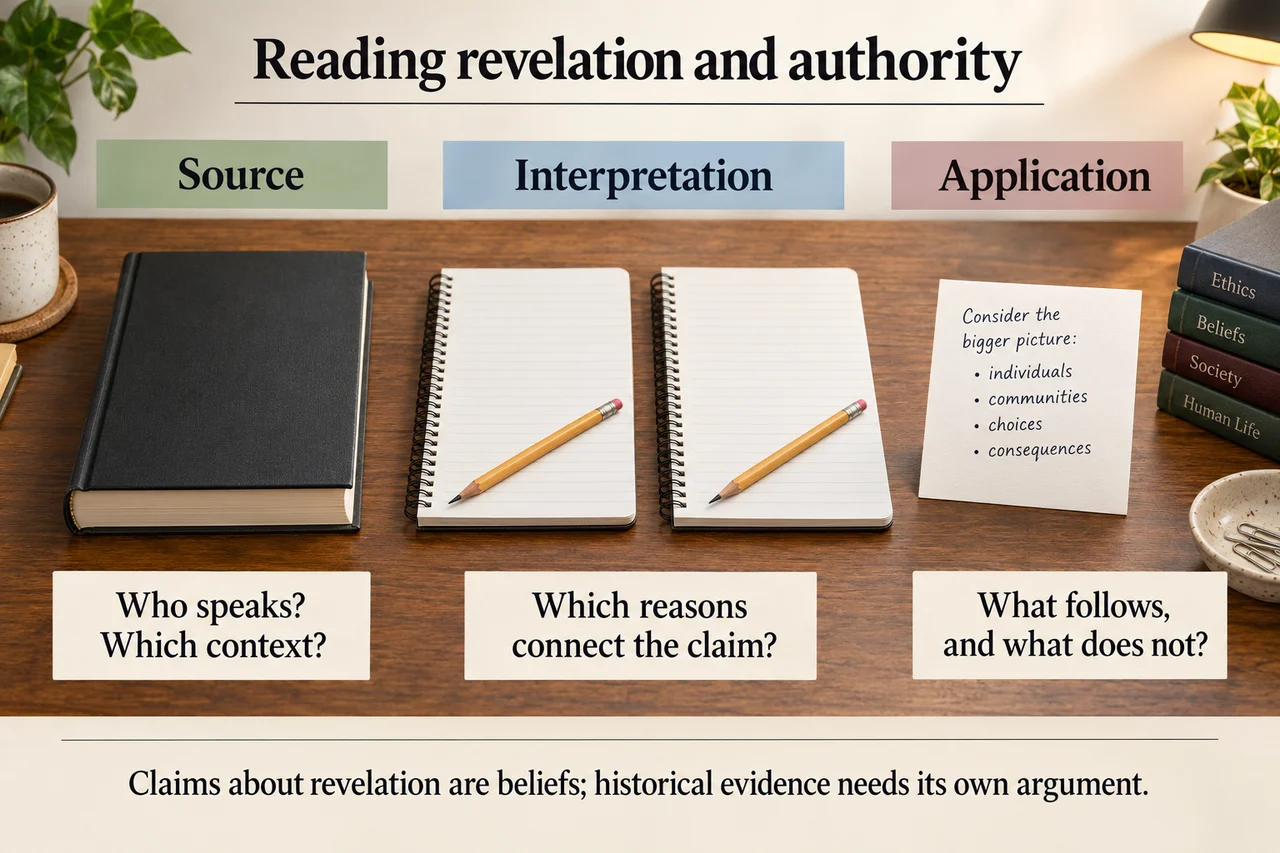
The authority plate uses an unmarked ordinary book and blank notebooks, not a generated Qur'an, Bible or historical manuscript. It separates a source, interpretation and application so that the missing warrant can be examined. Its examples of people, communities and consequences are possible questions, not a rule that consequences alone settle theology. No pictured object proves revelation, free will, sincerity or divine approval. Compare the source's genre and a community's interpretation before claiming that a belief logically requires one action.
Worked example: In an invented classroom case, a pupil keeps a found calculator and says, 'God knew I would, so I could not be responsible.' Analyse the inference and a religious response.
Separate the claim of prior knowledge from the claim of compulsion. The first does not logically establish the second without a further account of what caused the choice.
Use Qur'an 99:7–8 to explain why small acts can matter under judgement. Keeping an item unnoticed by people does not, in that belief, remove accountability.
Acknowledge the harder issue of decree and freedom rather than solving it through an imperfect human analogy. Different theological accounts try to preserve divine power and meaningful responsibility.
A religious response can include returning the calculator and seeking forgiveness. A non-religious response can reach the same action through ownership and trust; agreement in conduct does not imply identical reasons.
Answer: Knowledge alone does not prove coercion. The pupil's excuse also conflicts with a teaching that conduct is accountable. Returning the item is a defensible response under several worldviews; the theological tension remains open to careful analysis.
Check your understanding: 1 Define akhirah. 2 Explain one influence of Qur'an 99:7–8. 3 Evaluate 'Belief in divine decree makes effort pointless', addressing an objection.
Answer: 1 Akhirah is life after earthly death. 2 Awareness of small deeds being seen can encourage honesty when nobody else observes. 3 If decree is interpreted as total compulsion, effort appears powerless; that is a serious objection. But accounts preserving responsibility treat choosing and striving as part of life under God's knowledge rather than outside it. Qur'an 99 gives a reason why choices matter. Knowledge and coercion differ, although this distinction alone does not settle all debates about power and agency. The universal claim of pointlessness therefore overstates what follows from belief in decree.
Why: The answer assesses an implication, not the pupil's faith. Accept a reasoned critique which explains the residual tension. Reject the false binaries that Sunni theology denies all responsibility or that Shi'a theology denies divine knowledge.