Salah in lived traditions: explain form, intention and difference
By UK GCSE Religious Studies · independent study · myAudience
Original myAudience educational illustration. Image: illustration, not a documentary photograph. · myAudience educational illustration; no affiliation with any awarding body.
Salah in lived traditions: explain form, intention and difference
The Five Pillars commonly used to organise Sunni practice are Shahadah, salah, zakah, sawm and hajj. Shahadah is the declaration of faith in one God and Muhammad as God's messenger. Salah is prescribed ritual prayer, distinct from personal supplication, often called du'a. The Twelver Shi'a Ten Obligatory Acts are commonly listed as salah, sawm, zakah, khums, hajj, jihad, enjoining good, forbidding wrong, tawalla (loving allegiance to God and those associated with divine guidance, especially the Imams), and tabarra (disassociation from their enemies and evil). Naming the additional acts does not imply Sunni Muslims reject moral guidance or allegiance to God. This lesson introduces the organising lists; later lessons still need the distinct duties in depth.
Daily salah gives a repeated framework for remembrance, gratitude, submission and accountability. Intention matters because an outward movement is not identical to a person's inward purpose. Preparation includes wudu, ritual washing, understood as readiness and purification rather than a guarantee against all disease. Facing the qiblah, the direction of the Ka'aba in Makkah, expresses shared orientation; it does not mean worshipping a building. A rak'ah is a unit of prayer comprising a sequence of positions and recitations. The specific sequences and adjustments depend on prayer and tradition. Teaching these concepts is descriptive rather than an instruction to perform a religious rite.
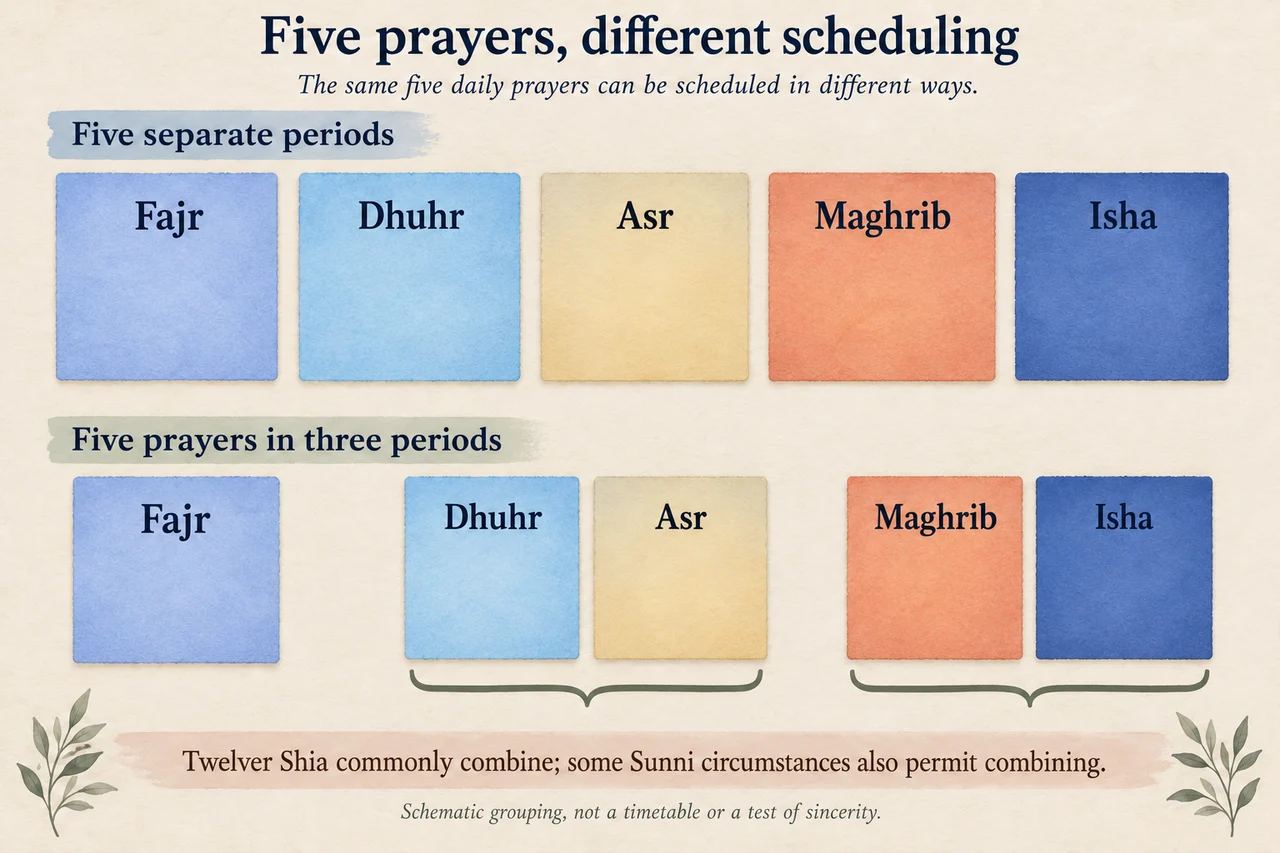
Sunni practice commonly performs five daily prayers at separate times. Many Shi'a Muslims combine noon with afternoon and sunset with night prayer, giving five prayers in three periods. Combining times is not reducing the obligation to three prayers. Some Sunni circumstances also permit combination, so 'only Shi'a ever combine' is false. Differences in hand position or prostration surfaces can be discussed with careful qualification rather than as a way to label strangers. A turbah used by some Shi'a Muslims is an earth-based prostration surface; it is not an object of worship. Local conditions, legal schools and personal practice add further diversity.
Prayer can occur at home, in a mosque or elsewhere in a suitable place. Jummah is Friday congregational prayer associated with a sermon and communal gathering; its obligations and arrangements vary by tradition and circumstance. Communal prayer can support belonging and equality, while private observance can carry devotion through a working day. Physical ability, travel and other circumstances affect practice, and appropriate accommodations should not be confused with lack of commitment. Qur'an 2:177 brings belief, prayer, giving and moral conduct together. It supports the importance of prayer without showing that prayer excuses neglect of other duties.
Use the source-to-argument plate with Qur'an 2:177 as evidence, an account of worship and conduct as interpretation, and a hypothetical timetable discussion as application. The people in the garden cannot be classified as Sunni or Shi'a by appearance. The image is a method plate, not a depiction of a prayer ritual. Correct the misconception that five prayers in three periods means fewer prayers, or that qiblah is a form of building worship. A respectful lived-tradition account explains meaning and practical context while keeping observed action separate from a judgement of sincerity.
Count the prayer cards before interpreting the grouping. Both rows contain Fajr, Dhuhr, Asr, Maghrib and Isha; the lower row joins two pairs into three periods without reducing the number of prayers. Twelver Shia commonly use this arrangement, while Sunni traditions also allow combining in particular circumstances. The corrected cards have no suns, moons or landscape timing imagery. Fajr is before sunrise; this grouping supplies neither exact prayer times nor a real scheduling instruction. Appearance alone is not evidence of devotion or correctness.
Worked example: An invented school timetable survey records five prayers across three periods for one pupil and five separate periods for another. A report calls the first pupil 'less observant'. Evaluate its evidence.
Count prayers and periods separately. Both accounts can contain five daily prayers; the survey records timing, not an automatic difference in number.
Explain that combining certain prayers is common in Shi'a practice and permitted in some Sunni circumstances. The data alone does not identify every pupil's legal school.
Observance includes intention, preparation and practice, none measured adequately by a period count. A judgement about sincerity is even less supported.
An accurate report describes schedules and asks what accommodation supports participation. It avoids ranking pupils' faith from an incomplete measurement.
Answer: The judgement is unsupported. The survey measures periods, not total prayers or sincerity. A corrected account explains the valid combined schedule and recognises that religious identity and commitment require context rather than inference from a timetable.
Check your understanding: 1 Define salah and wudu. 2 Explain how facing qiblah can influence communal identity. 3 Evaluate 'Prayer is only important when performed in a mosque.'
Answer: 1 Salah is prescribed ritual prayer; wudu is ritual washing in preparation. 2 A common direction connects dispersed worshippers to a shared orientation while God, not the Ka'aba, is worshipped. 3 Mosque prayer can strengthen community, particularly through Jummah, but daily prayer can be performed at home and elsewhere. Qur'an 2:177 associates prayer with righteous life without confining all prayer to a mosque. A preference for communal worship may be justified, but 'only' wrongly excludes valid private and everyday observance. Circumstances and accommodations also matter.
Why: This is a conceptual introduction, not a complete ritual guide or coverage of all Shi'a duties. Assess the distinction between form and meaning and between prayers and time periods. Do not equate difference with deficiency.