Sawm and zakah: obligations, exceptions and responsible application
By UK GCSE Religious Studies · independent study · myAudience
Original myAudience educational illustration. Image: illustration, not a documentary photograph. · myAudience educational illustration; no affiliation with any awarding body.
Sawm and zakah: obligations, exceptions and responsible application
Sawm is fasting, especially during Ramadan, understood as an obligation for those to whom it applies. It includes abstaining from food and drink during daylight fasting hours and relates to self-discipline and consciousness of God, not merely changing meal times. Qur'an 2:183 links fasting to mindful devotion; 2:184–185 recognises illness and travel and speaks of ease rather than hardship. A textual obligation and its exceptions belong together. Calling someone who is exempt less faithful misreads the structure of the teaching. This is an explanation of religious practice, not a request that students fast or advice about an individual's health.
The lunar calendar means Ramadan does not stay in one solar season. Fasting days therefore differ in daylight length across places and years. Exact start dates and local arrangements require contemporary community guidance, not an invented universal timetable. Exemptions and their consequences vary with circumstance and interpretation: missed days may be made up, while some lasting inability is addressed through feeding people in need. Pregnancy, menstruation and other situations need qualified treatment by the relevant tradition rather than this lesson prescribing a rule for a person's body. Compassion and religious commitment cannot be inferred from whether a visible person is eating.
The Night of Power concerns the revelation of the Qur'an and is observed with particular devotion in Ramadan. Qur'an 96:1–5 connects recitation and divine teaching and is prescribed in the specification's fasting section. It helps explain why scripture and worship have special significance in the month. Id-ul-Fitr marks the end of Ramadan and involves celebration, prayer, generosity and community, with diverse family and local forms. Festival practice in Great Britain may include mosque gatherings and visits, but an invented household example is not evidence that every family celebrates identically. Separate origin, meaning and contemporary expression rather than listing food as the festival's whole purpose.
Zakah is obligatory giving on specified wealth under applicable conditions; sadaqah is voluntary charity. A commonly used rate for eligible monetary wealth is 2.5%, with a threshold called nisab and a lunar-year framework. This is not a universal 2.5% tax on salary, all property or every asset category. To make an original classroom calculation valid, stipulate eligibility, threshold, timing and any allowed deductions instead of silently assuming them. Benefits can include assistance to eligible recipients and an understanding of wealth as responsibility. A charity's appeal explains its guidance and intended work; it does not by itself establish every programme's effects.
Khums means one fifth and has a distinctive place in Shi'a practice, commonly discussed for eligible surplus income after relevant expenses, with rules about authority and distribution. It is not simply a second name for 2.5% zakah or 20% of every possession. This initial lesson introduces the distinction; independent community-specific review and detailed treatment remain required. The source-to-argument plate separates Qur'an fasting guidance or giving rules, their interpretation, and an invented allocation case. The garden is not a photographed Ramadan or charity project. Correct the misconception that every visible act of giving has the same religious category or that an exception defeats the purpose of an obligation.
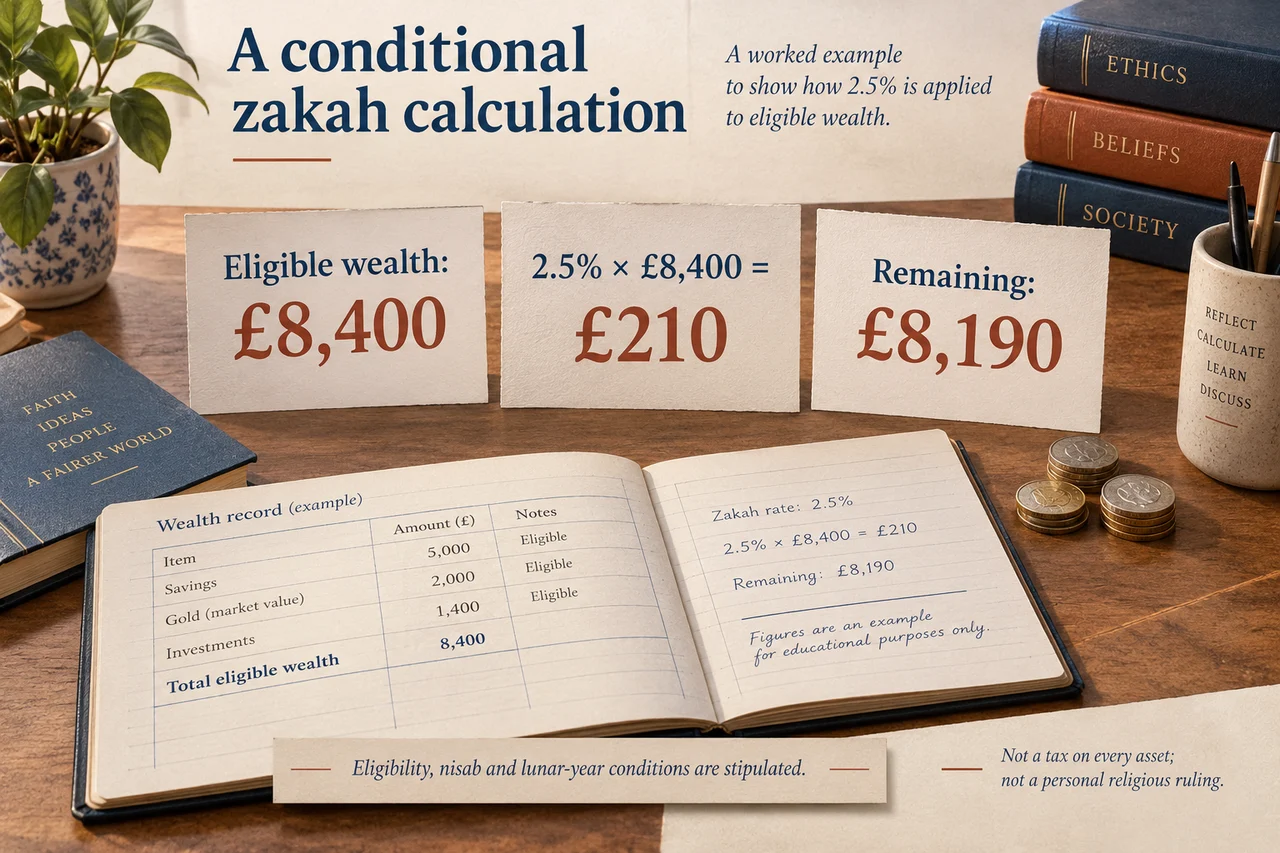
The calculation plate stipulates eligible wealth of £8,400, the relevant nisab threshold and lunar-year conditions. Its £5,000, £2,000 and £1,400 ledger entries simply total that assumed base; they do not establish a ruling on savings, jewellery, investments or deductions in every school. One fortieth gives £210, leaving £8,190. Coins are not a proportional graph. Do not apply this percentage mechanically to every Muslim's assets: legal traditions distinguish categories and conditions, and khums uses a distinct eligible-surplus basis.
The percentage example follows a familiar Sunni eligible-wealth calculation, not a universal asset schedule. A Twelver legal explanation may restrict obligatory zakah to particular crops, livestock and qualifying gold or silver coinage, while treating eligible annual surplus under khums. The source's school and the example's stipulated base therefore matter. It is inaccurate to infer that a Muslim household must owe both 2.5% and 20% on every pound simply because both duties appear in a syllabus.
Worked example: In an invented teaching case, £8,400 is stipulated to be eligible monetary wealth after allowable deductions, above the applicable nisab, assessed when the required lunar-year condition is met. Apply a stipulated zakah rate of 2.5%, then assess a claim that all annual salary is treated this way.
Convert 2.5% to 0.025. The stipulated calculation is £8,400 × 0.025 = £210; remaining eligible wealth after this payment is £8,190.
The result depends on eligibility, the relevant threshold, deductions and timing being satisfied. No current gold/silver price or real individual's liability has been assumed.
Annual salary is a flow over time, while eligible wealth is the defined assessment base. Treating the two as identical can overstate or misdescribe the obligation.
Compare khums conceptually: one fifth is 20%, but a different rate also uses a different base and rules. Neither calculation should be applied to a person's circumstances without the required details.
Answer: Under the explicit classroom assumptions the amount is £210. This does not justify applying 2.5% to every salary, nor does it turn khums into a higher rate on the same universal base. The religious meaning concerns obligation and responsible use of wealth as well as arithmetic.
Check your understanding: 1 Distinguish zakah and sadaqah. 2 Explain how fasting exceptions can express the purpose of the teaching. 3 In a new stipulated case with £12,600 eligible wealth at 2.5%, calculate the amount and evaluate whether the number alone demonstrates moral sincerity.
Answer: 1 Zakah is obligatory giving under specified conditions; sadaqah is voluntary. 2 Qur'an 2:184–185 recognises illness and travel, so a valid exception can express concern for ease rather than rejection of devotion. 3 £12,600 × 0.025 = £315. This assumes the same eligibility and timing conditions. A payment amount does not reveal all motives, conduct or a programme's effect. It can evidence compliance with a stipulated rule, while generosity, justice and sincerity require different considerations. The calculation is not personal financial or religious advice.
Why: Progression moves from concepts to interpretation to numerical transfer and evaluation. Arithmetic is independently checked in the runnable evidence. Avoid diagnosing observance from eating, treating salary as wealth, or presenting khums and zakah as identical.