Marriage, vows and compassion in disagreement
By UK GCSE Religious Studies · independent study · myAudience
Original myAudience educational illustration. Image: illustration, not a documentary photograph. · myAudience educational illustration; no affiliation with any awarding body.
Marriage, vows and compassion in disagreement
Marriage can be understood as a publicly recognised commitment with personal, communal and religious significance. A vow is a solemn promise; sanctity of vows means treating the commitment as possessing special moral or religious weight. Compassion means attending to suffering and responding with care. These principles need not be simple opposites: someone may think commitment itself protects people, while another argues that maintaining a harmful relationship defeats the purposes of commitment. Separate a tradition's teaching, a civil institution and an individual's lived relationship. This lesson analyses sources and arguments; it does not decide a learner's family choices or assume every family has the same structure.
Mark 10:2–12 presents Jesus' response to a dispute about divorce, emphasising the joining of spouses and challenging easy dismissal. Catholic teaching connects marriage's permanence with faithful covenant, as Catechism 1646–1651 explains. This does not mean that separation for protection is never acknowledged; nor is a declaration that a valid bond never existed the same as ending a valid sacramental marriage. A declaration of nullity and civil divorce answer different questions. The Church of England also teaches lifelong commitment while allowing church remarriage after divorce in certain circumstances. 'All Christians reject every divorce' therefore obscures both doctrine and pastoral distinctions.
Qur'an 30:21 connects spouses with tranquillity, affection and mercy. Qur'an 2:229 recognises divorce within limits and concerns honourable retention or release. This supports an account in which marriage is valued and ending it is regulated, rather than a binary in which Muslims either reject commitment or forbid any dissolution. Sunni and Shi'a legal traditions differ over procedures and conditions; this initial source comparison does not provide a complete legal account. A religious text's recognition of a process also does not prove that every practice presented as religious is fair to the people involved. A normative evaluation can ask how mercy, responsibility and power operate in an actual case.
A reasoned argument about divorce can begin with trust: promises create reasonable expectations and responsibilities, including concern for children and shared obligations. It can then test the limiting case of persistent harm. An absolute duty to preserve the shared household might conflict with safety and dignity; ending cohabitation does not automatically erase duties of care. Non-religious reasoning can similarly value commitments because of reliance and welfare, while allowing dissolution when their protective purposes fail. It is not necessary to claim that every non-religious person agrees or that a single family form guarantees a child's welfare. Evidence about protection must concern the circumstances, not a stereotype.
The source-to-argument plate is useful because these passages do not apply themselves. The book represents Mark or the Qur'an, the branching paths represent interpretation of permanence and mercy, and the garden represents a hypothetical shared responsibility after disagreement. It is not an image of a marriage ceremony or a family whose beliefs can be inferred. Correct the misconception that compassion always cancels every promise or that fidelity requires disregarding harm. Strong evaluation specifies which responsibility remains, what circumstances matter and why the conclusion follows. Respectful comparison does not require a single correct normative preference or disclosure of personal family experience.
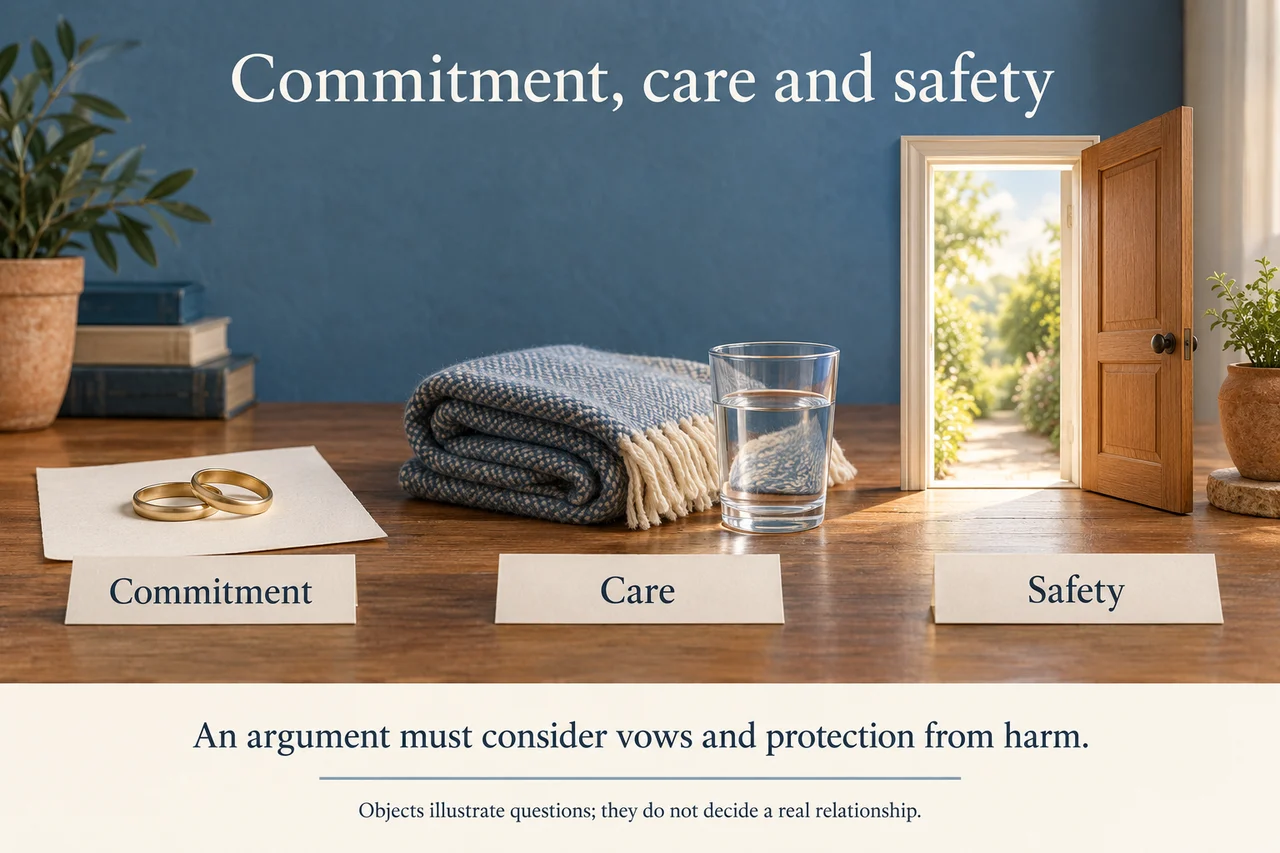
The rings, blanket and open door are conceptual prompts for commitment, care and safety. They do not prescribe a relationship decision or imply that one religion values only one of the three. A reasoned comparison asks how a tradition understands vows, whether separation and divorce are different, and how protection from harm constrains the application of a rule. The open door is not a demand that a learner disclose their own family circumstances. A defensible model conclusion must engage a competing reason rather than merely choose the most appealing object.
Worked example: Evaluate this original claim: 'A promise of lifelong marriage should never allow separation.' Use Christian and Muslim reasoning and address the strongest objection to your judgement.
A strong case for the claim is that reliable promises protect trust and responsibilities. Mark 10's emphasis on a lasting bond and Catholic covenant teaching make commitment more than a convenience that ends whenever feelings change.
The word 'never' must face a hard case. Persistent harm can make continued shared living inconsistent with protection and mercy. Separation is also not automatically the same as dissolving a sacramental bond or abandoning duties to children.
Qur'an 30:21's account of affection and mercy supports marriage's value; 2:229 regulates dissolution rather than denying it. Anglican willingness to consider remarriage shows internal Christian diversity. These sources cannot be collapsed into one universal rule.
My judgement is that lifelong commitment creates serious duties but does not establish an absolute requirement to remain in harmful shared living. The objection that exceptions weaken promises is substantial; a reply distinguishes protective exceptions from treating all commitments as disposable.
Answer: A qualified rejection of 'never' is defensible: commitments retain weight, while protection and mercy can justify separation. A different conclusion can be argued if it deals seriously with harm and distinguishes forms of separation and dissolution. No stance earns credit merely by matching this model.
Check your understanding: 1 Define sanctity of vows. 2 Explain one Christian difference concerning divorce/remarriage. 3 Assess whether Qur'an 2:229 proves marriage is unimportant in Islam.
Answer: 1 Sanctity of vows gives solemn commitments special moral or religious weight. 2 Catholic teaching affirms the enduring sacramental bond, whereas the Church of England permits church remarriage after divorce in certain circumstances; neither description removes concern for people in difficulty. 3 Recognition and regulation of dissolution does not show indifference to marriage. Qur'an 30:21 associates it with affection and mercy, while 2:229 sets limits and conduct around ending it. The claim confuses an exception or process with rejection of the institution. A fair evaluation can still question how procedures apply in lived circumstances.
Why: Credit interpretation, cross-tradition comparison, a genuine objection and justified judgement. No personal belief or family disclosure is needed. The remaining this topic sexuality, contraception, same-sex relationships, family forms and gender requirements are unresolved and must receive separate fair, source-checked teaching.