Stewardship and animal ethics under explicit assumptions
By UK GCSE Religious Studies · independent study · myAudience
Original myAudience educational illustration. Image: illustration, not a documentary photograph. · myAudience educational illustration; no affiliation with any awarding body.
Stewardship and animal ethics under explicit assumptions
Stewardship is responsibility for caring for what is entrusted to someone. Dominion concerns authority over the world or its creatures; the crucial ethical question is how that authority is used. Genesis 1 links creation's goodness and human responsibility, but interpreting dominion as unlimited permission to exploit is an additional argument. Christian readings differ over the relation between human needs and other creatures' value. Awe and wonder can describe responses to the world which motivate care, but an emotional response alone does not establish which policy best protects it. Environmental claims about pollution or resource use need reliable evidence as well as an ethical principle.
Qur'an 6:141 connects harvest, giving what is due and avoiding waste. A Muslim can apply it to restrained consumption and responsibility for resources. The verse is not a modern emissions table and does not specify one recycling scheme. Its application needs a warrant: wasteful use disregards a responsibility understood through the source, so reducing preventable loss may express that responsibility. Non-religious arguments may value ecosystems through consequences for humans, sentient creatures or nature itself. Atheism alone is not a full environmental policy; different ethical theories can operate among both religious and non-religious people.
Animal ethics asks whether and under what conditions humans may use animals for food or research. Sentience means capacity for experience such as pain, not possession of human intelligence or a stated preference in words. A consequential argument compares expected benefits and harms; a duty-based argument asks whether some treatment is wrong even if useful. Christians and Muslims who permit eating animals can still oppose unnecessary suffering; other adherents may choose vegetarianism for ethical reasons. Permission to use animals for one purpose does not logically authorise every practice, and rejecting a particular use need not imply valuing animals and humans identically.
Two named sources illustrate conditional permission rather than a universal voice. Laudato Si', paragraph 130, refers to Catholic teaching that experiments must have reasonable limits and contribute to care or saving life, while needless suffering is rejected. Egypt's Dar Al-Ifta's 24 May 2012 ruling treats injurious use as a qualified dispensation subject to need, alternatives and restraint. It is a specific institution's interpretation, not a survey of all Muslim belief or a current UK legal licence. A contrasting religious argument can hold that concern for creation or mercy rules out a proposed use when harm is avoidable. Our exercise evaluates an invented proposal; it gives no practical instructions for experiments.
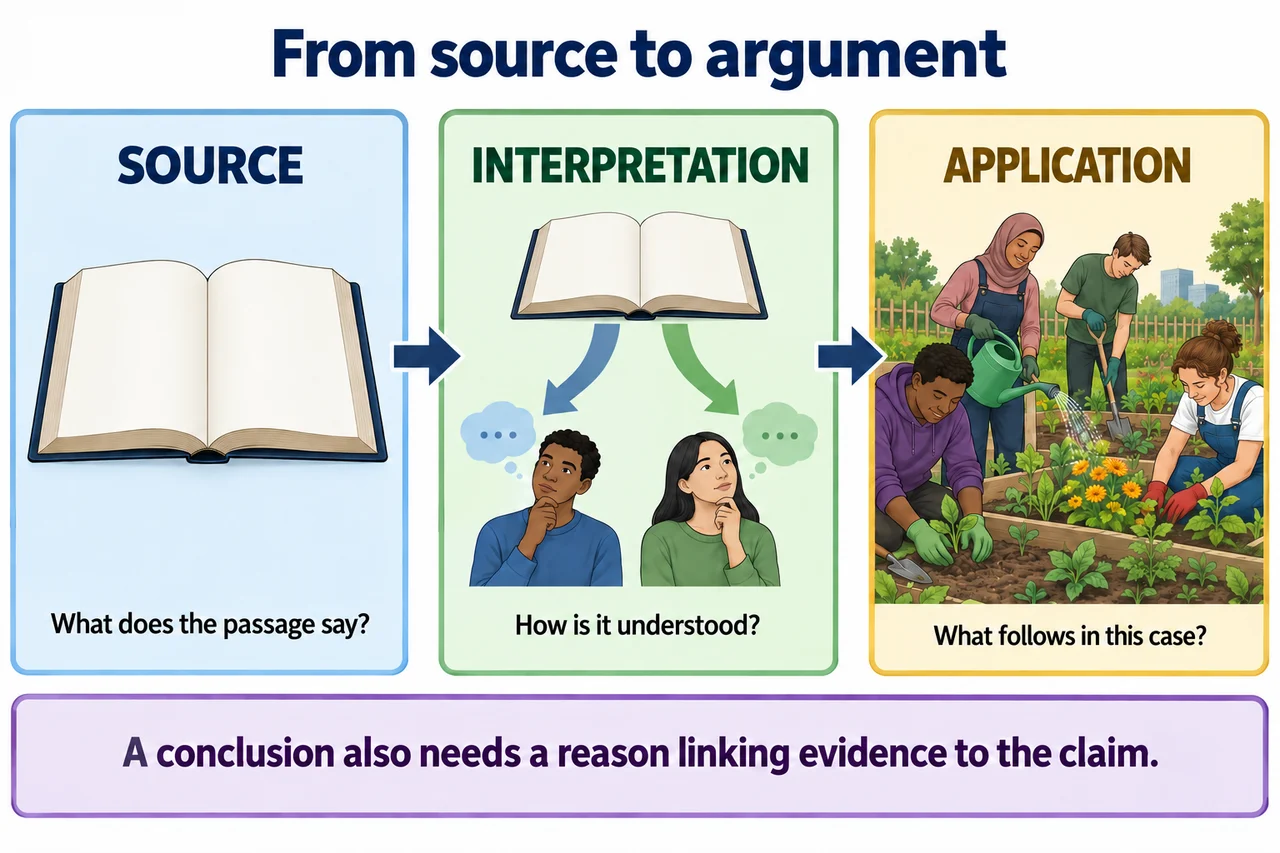
The source-to-argument plate traces a teaching about creation or restraint through interpretation to the garden as a hypothetical use of resources. The garden is neither measured evidence of biodiversity nor proof that every garden conserves water. A technical claim needs data; a normative priority needs reasons. Correct the misconception that human benefit automatically justifies any animal harm or that a scripture quotation determines whether a proposed alternative is scientifically adequate. Stating a benefit does not demonstrate its probability, its importance or the absence of alternatives. Strong reasoning keeps these factual uncertainties visible while comparing moral principles fairly.
Worked example: In an original thought experiment, a research board compares a harmful animal test with a stipulated equally reliable, equally available non-animal method at the same cost. Assess 'Possible human benefit makes either choice equally justified.' Do not assume these stipulated facts describe real research.
A human-benefit argument gives a reason to pursue the goal, but cannot yet distinguish the two methods because both have the stipulated reliability and access. It is not evidence that the animal method uniquely helps.
Catholic limits and the named Dar Al-Ifta ruling both make unnecessary harm ethically significant. Under the stated equal-alternative assumptions, the avoidable harm weakens the animal method's justification.
A consequence-based non-religious argument also finds the same benefit with less harm preferable. A duty-based animal-rights argument may oppose the harm regardless of whether benefits are equal.
An objection says real alternatives may be less reliable. That would matter in another case, but contradicts this thought experiment's explicit premise. If the premise changes, the evaluation must be reopened rather than importing an invented fact.
Answer: Under these stipulated conditions, the methods are not equally justified: the non-animal method offers the same intended benefit with less harm. This conclusion depends on the assumptions. It is a reasoned application, not a claim that all animal research has a proven replacement or that all religious adherents agree.
Check your understanding: 1 Define stewardship and sentience. 2 Explain a religious reason for avoiding waste. 3 Transfer to a new case where the alternative's reliability is uncertain: what changes, and what remains morally relevant?
Answer: 1 Stewardship is care for what is entrusted; sentience is capacity for experience such as pain. 2 Qur'an 6:141 can support restrained use through its teaching against waste; a Christian may reason from creation's goodness and responsible dominion. 3 Uncertain reliability means equal benefit can no longer be assumed. Evidence about validity, expected benefit and feasible alternatives becomes necessary. Avoidable suffering and limits on use remain relevant even if the facts change. A cautious conditional judgement is stronger than declaring human benefit always decisive or importing the previous answer unchanged.
Why: The model separates stipulated facts, source interpretation and ethical judgement. Alternative ethical positions are acceptable with consistent reasons. Big Bang/evolution, human origins, sanctity/quality of life, abortion, euthanasia and afterlife-value requirements remain open; this lesson does not silently cover them.