Peace, pacifism and just war as competing arguments
By UK GCSE Religious Studies · independent study · myAudience
Original myAudience educational illustration. Image: illustration, not a documentary photograph. · myAudience educational illustration; no affiliation with any awarding body.
Peace, pacifism and just war as competing arguments
Peace can mean more than the absence of active fighting: it may include secure relationships, justice and conditions that prevent renewed harm. Justice concerns fair treatment and addressing wrongs. Forgiveness concerns how a person responds to wrongdoing, often involving relinquishing hatred or revenge; reconciliation concerns restoring relationships. They are not identical. A person may forgive without safely resuming a relationship, and reconciliation may require acknowledgement, protection and repair. Religious Studies must not imply that a harmed person is required to restore contact or that forgiveness makes accountability unnecessary.
Pacifism opposes war or violence on moral grounds, with different forms and reasons. Quakers in Britain’s public account connects its peace testimony with the preciousness of each life and active nonviolent work. This supplies a named lived tradition that challenges the claim that pacifism is doing nothing. Mediation, humanitarian assistance, conscientious objection and work against causes of violence can be demanding actions. A serious objection asks whether nonviolent responses can protect people facing imminent attack. A strong pacifist argument must engage that difficulty rather than describe every defender as indifferent; a defender of force must likewise engage risks of escalation and harm.
Just war reasoning treats armed force as needing strict justification, not as good whenever one's own side claims justice. Criteria commonly distinguish entering war from conduct within it. Just cause, legitimate authority, right intention, last resort, reasonable prospect of success and proportionality concern the decision to fight; distinction between combatants and civilians and proportional conduct constrain action once fighting occurs. The Catholic Catechism, 2308–2309 and 2312–2314, provides a named account of limited defence and enduring moral limits. Its formulation groups conditions somewhat differently from classroom lists. Explain the criteria's work rather than treating the list as a points total where passing most permits anything.
Qur'an 2:190 concerns fighting those who fight while forbidding transgression; 5:8 links justice with resisting the influence of hostility. Some Muslim reasoning uses these teachings to permit defence under limits, while Muslims also pursue peace through varied nonviolent commitments. Applying a passage to modern war requires interpretation and context, not an isolated phrase. These verses do not grant any individual unlimited authority to declare violence sacred. Nor should geopolitical conflict be explained solely through a religious label: power, territory, resources and political history can interact. The full holy-war, jihad, nuclear-weapons and contemporary conflict requirements need later dedicated lessons.
The source-to-argument plate helps compare a Quaker statement, a Catholic criterion and a Qur'anic passage without making them interchangeable. The two interpretation paths show that common concern for life can lead to different policies; the garden is only an imagined cooperative alternative, not proof that cooperation always succeeds. Correct the misconception that just cause alone makes all conduct just, or that accepting limited defence endorses revenge. A well-argued conclusion tests the strongest opposing reason and states which criterion is decisive under the facts given. It need not prescribe one universally correct normative opinion.
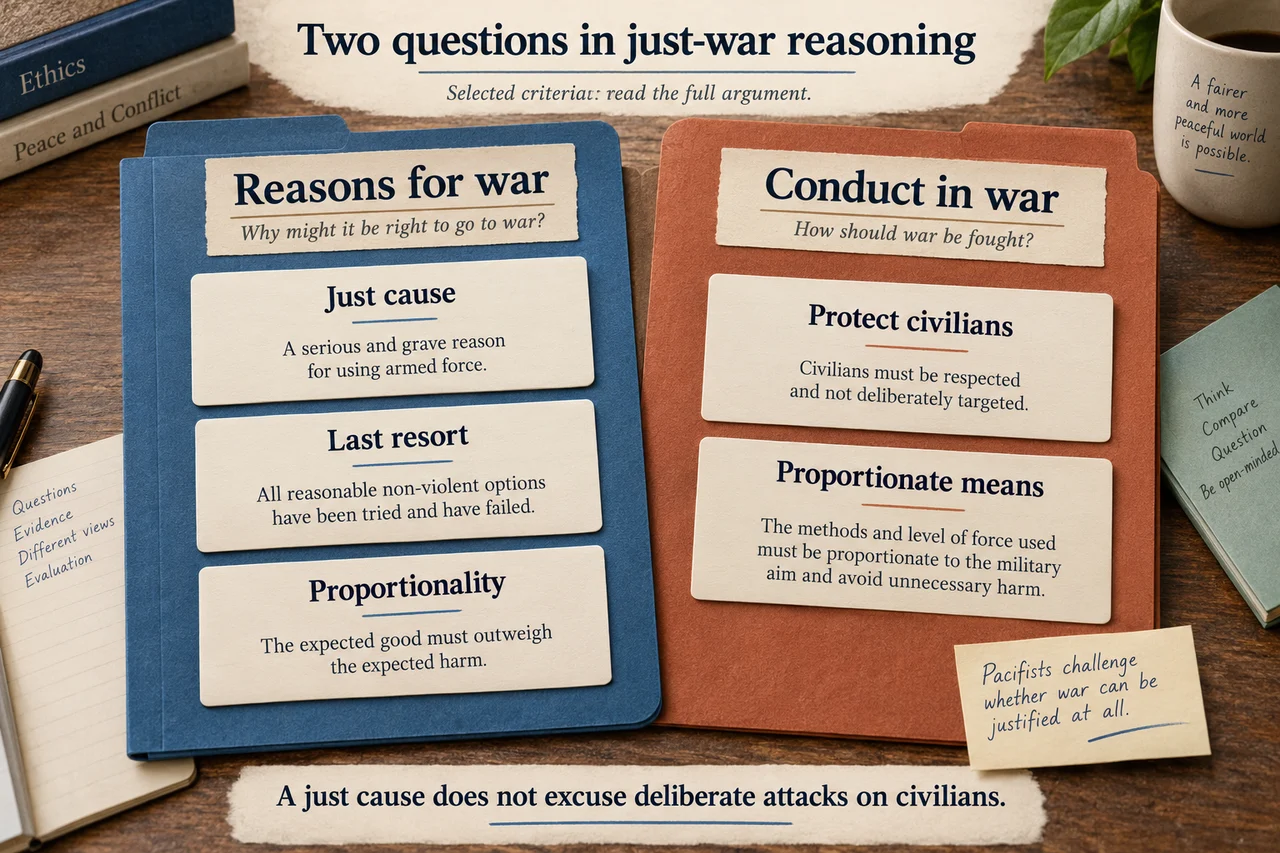
The two folders distinguish reasons for resorting to war from rules governing conduct during it. The displayed criteria are selected examples: legitimate authority, right intention and a reasonable prospect of success still require discussion in the fuller account. A favourable cause cannot cancel protection of civilians; proportionality must be justified rather than asserted. Pacifists challenge whether even these conditions can justify war and should receive a reasoned response. The picture supplies no evidence about a current conflict and no automatic permission to use force.
Worked example: In an invented conflict, an authority claims defensive purpose but proposes an attack that intentionally targets a civilian neighbourhood. Evaluate 'A just cause makes the proposed action just.'
Grant the strongest premise for analysis: defending people against aggression can be a just cause in some accounts. This concerns the decision's purpose, not automatic permission for every tactic.
Apply conduct criteria independently. Intentionally targeting civilians fails distinction and conflicts with Catholic teaching against indiscriminate destruction. Qur'an 2:190's limit on transgression provides a relevant Muslim restraint argument.
A pacifist can object to armed action more broadly from the value of life; a limited-defence advocate can reject this tactic without rejecting all possible defence. These are different objections and should be represented separately.
My judgement rejects the claim: even if the cause is justified, the proposed civilian targeting is not justified by that premise. The objection that urgency excuses limits needs a reason why civilian protection ceases to matter; a label of emergency is not enough.
Answer: A just cause does not make every means just. The proposed action fails a distinct constraint on conduct. An answer may argue for pacifism or for another limited defensive response, but must not treat a good intention as a licence to target civilians.
Check your understanding: 1 Distinguish forgiveness and reconciliation. 2 Explain one active pacifist response. 3 Assess whether 'last resort' means force becomes acceptable as soon as negotiation is inconvenient.
Answer: 1 Forgiveness concerns response to wrong and revenge; reconciliation restores relationships and may require safety and repair. 2 A Quaker-inspired mediation or humanitarian effort can address injustice without taking up arms. 3 Last resort concerns serious assessment of reasonable peaceful alternatives, not inconvenience. It operates alongside cause, authority, prospects and proportionality; meeting it alone does not justify a war or its tactics. A critic may argue alternatives remain possible, while a defender may argue they have genuinely failed. Either must give case evidence rather than merely label the choice unavoidable.
Why: The exercise tests relations between principles and independent constraints. It is not a war simulation or a guide to violence. Contemporary peacemaking individuals, aid to war victims, holy war/jihad links, terrorism and nuclear/WMD requirements remain unresolved.