Punishment, justice and mercy with evidence-aware judgement
By UK GCSE Religious Studies · independent study · myAudience
Original myAudience educational illustration. Image: illustration, not a documentary photograph. · myAudience educational illustration; no affiliation with any awarding body.
Punishment, justice and mercy with evidence-aware judgement
Crime is an act violating criminal law; moral wrong and crime are not identical categories. A person can argue that a law is unjust, while an act permitted by law can still be criticised morally. Intention concerns what an agent means to do, consequence concerns what occurs, and responsibility also depends on knowledge and agency. Reasons for an offence may include need, upbringing, addiction, hate, greed or opposition to a law. Naming a possible reason is not proof that it applies in a particular case, and explaining a cause is not automatically excusing harm. Most people experiencing poverty or mental health difficulties must not be stereotyped as offenders.
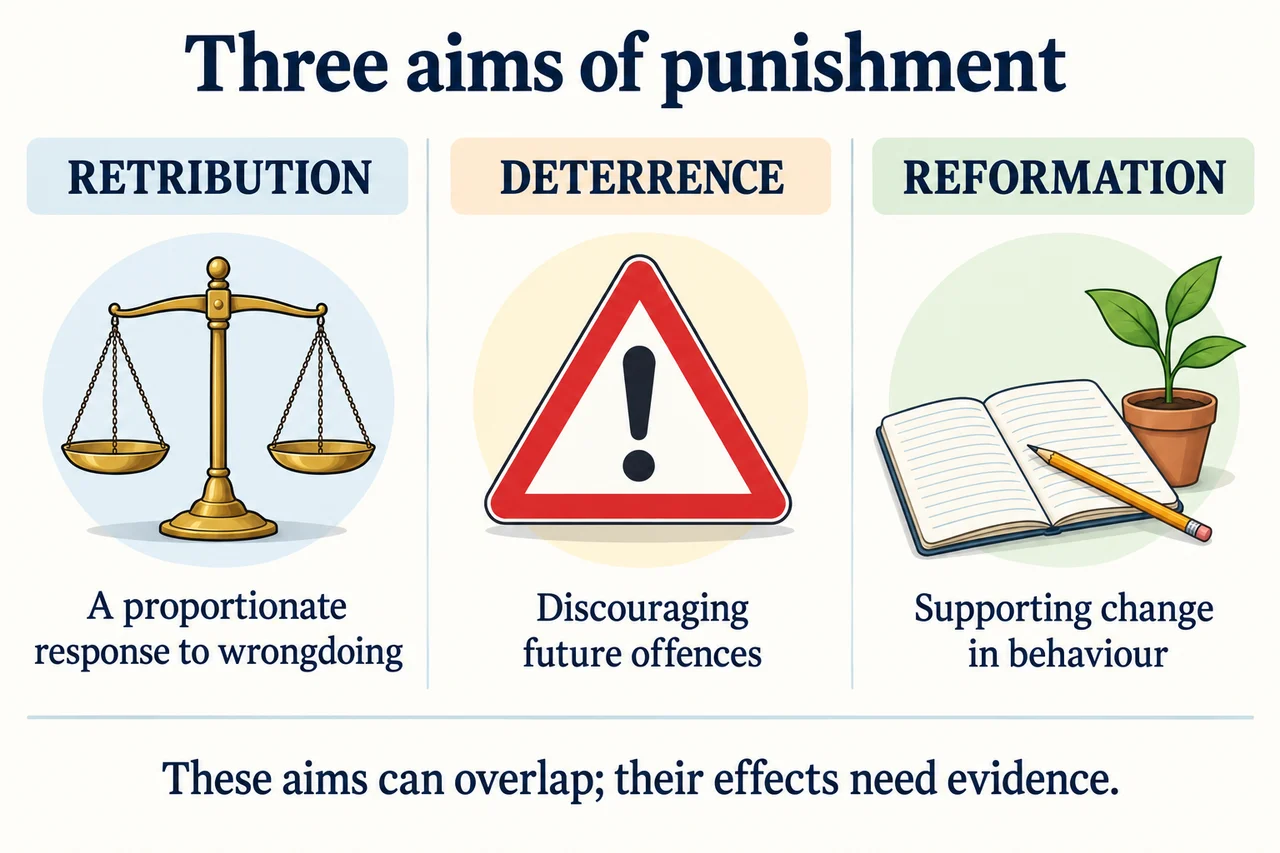
Retribution aims at a proportionate response to wrongdoing, distinct from an uncontrolled wish for revenge. Deterrence aims to discourage future offences, whether by the person punished or by others. Reformation aims to support changed behaviour and a constructive future. Protection and restitution can also matter, although the specification specifically names these three main aims. Prison and community service can serve several aims, with different costs and effects. The punishment-aims plate gives the aims equal visual weight: scales represent proportionality, a warning sign discouragement, and a notebook and plant development. None of these symbols is evidence that a particular sentence will achieve its aim.
Religious justice and mercy can support different judgements without being opposites. Qur'an 4:135 urges justice even when personal loyalties make it difficult. Qur'an 39:53 concerns God's mercy and can support hope of repentance; applying it to criminal justice requires a reasoned link, not an assertion that no sanction may ever be imposed. Catholic teaching on restitution in Catechism 2412 explains repair of wrongs. Forgiveness may relinquish revenge while recognising responsibility and protection. Non-religious arguments can likewise combine public safety, proportionate accountability and opportunities to change. A policy conclusion requires both ethical criteria and evidence about likely effects.
The death penalty raises a sharp issue of irreversibility. A utility argument asks whether consequences, such as protection or deterrence, justify execution; a sanctity-of-life argument gives life a special value which may constrain punishment. Religious positions are internally diverse and have histories. Current Catholic teaching in the revised Catechism 2267, issued in 2018, calls the death penalty inadmissible, so an old Catholic text allowing it conditionally must not be presented as the current position. Muslim legal traditions include capital penalties under specified conditions, while Muslims differ over interpretation, state practice, fairness and opposition to execution. A full comparison of those positions remains pending; one mercy verse does not establish a complete legal policy.
Evidence must be matched to the claim. A fall in reoffending after a programme may suggest effectiveness, but without a suitable comparison it does not establish that the programme caused the change. Different starting populations, support and time periods can matter. A model case may stipulate evidence to isolate an ethical question, but must label it invented. The plant in the plate is an analogy for development, not a promise that every person reforms. Correct the misconception that harsher automatically means more deterrent, that forgiveness means no accountability, or that anyone who raises mitigating circumstances denies a victim's harm.
Worked example: Evaluate this original claim: 'Punishment should aim only at retribution.' Consider a stipulated nonviolent theft case where both a proportionate community sentence and a prison sentence protect the public, but a checked support programme is stipulated to improve prospects of lawful behaviour. These are invented assumptions, not real statistics.
The strongest case for retribution is that wrongdoing deserves proportionate acknowledgement, protecting fairness to victims and avoiding treating an offender merely as a tool for social policy. Restitution can help recognise the concrete harm.
The word 'only' excludes future protection and change. Under the stipulated evidence, refusing to consider the support programme sacrifices a relevant benefit without showing that proportional accountability requires it.
Qur'an 4:135 supports impartial justice; it does not select a sentence by itself. Mercy and hope of repentance can support an opportunity to change, while Catechism 2412 keeps repair of harm visible. A non-religious welfare argument reaches similar practical concerns by a different route.
My judgement combines proportionate accountability with reformation and repair in this case. The objection that support rewards wrongdoing can be answered by distinguishing assistance to prevent further harm from approval of the offence. Victims' interests and consent to any restorative encounter remain important.
Answer: Retribution is a significant aim but its exclusive use is not justified by these premises. A proportionate community response with repair and support is defensible in the stipulated case. Someone preferring prison must explain what relevant criterion outweighs the assumed benefits rather than assert that severity proves justice.
Check your understanding: 1 Distinguish retribution and deterrence. 2 Explain why a cause of offending is not automatically an excuse. 3 Evaluate whether forgiveness requires abandoning punishment, with a religious source and a serious objection.
Answer: 1 Retribution concerns deserved proportionate response; deterrence concerns preventing future offences. 2 A cause helps explain conduct, while responsibility and justification need separate assessment. 3 Forgiveness can reject revenge without denying protection or repair. Qur'an 4:135 supports impartial justice, and mercy language can support repentance rather than automatic exemption. The objection is that punishment may perpetuate hostility; a reply must consider proportionate forms that protect and permit change. Alternatively one can argue a sanction is unjust in a case, but must explain why. Forgiveness alone does not entail abolishing all accountability.
Why: Credit accurate aims, relevant source application, a developed objection and a qualified judgement. Do not require agreement with the model. Hate crimes, murder, corporal punishment, deeper death-penalty comparison and actual programme evidence still require dedicated teaching and independent review.