Proof, interpretation and faith
By UK A Level Religious Studies · independent study · myAudience
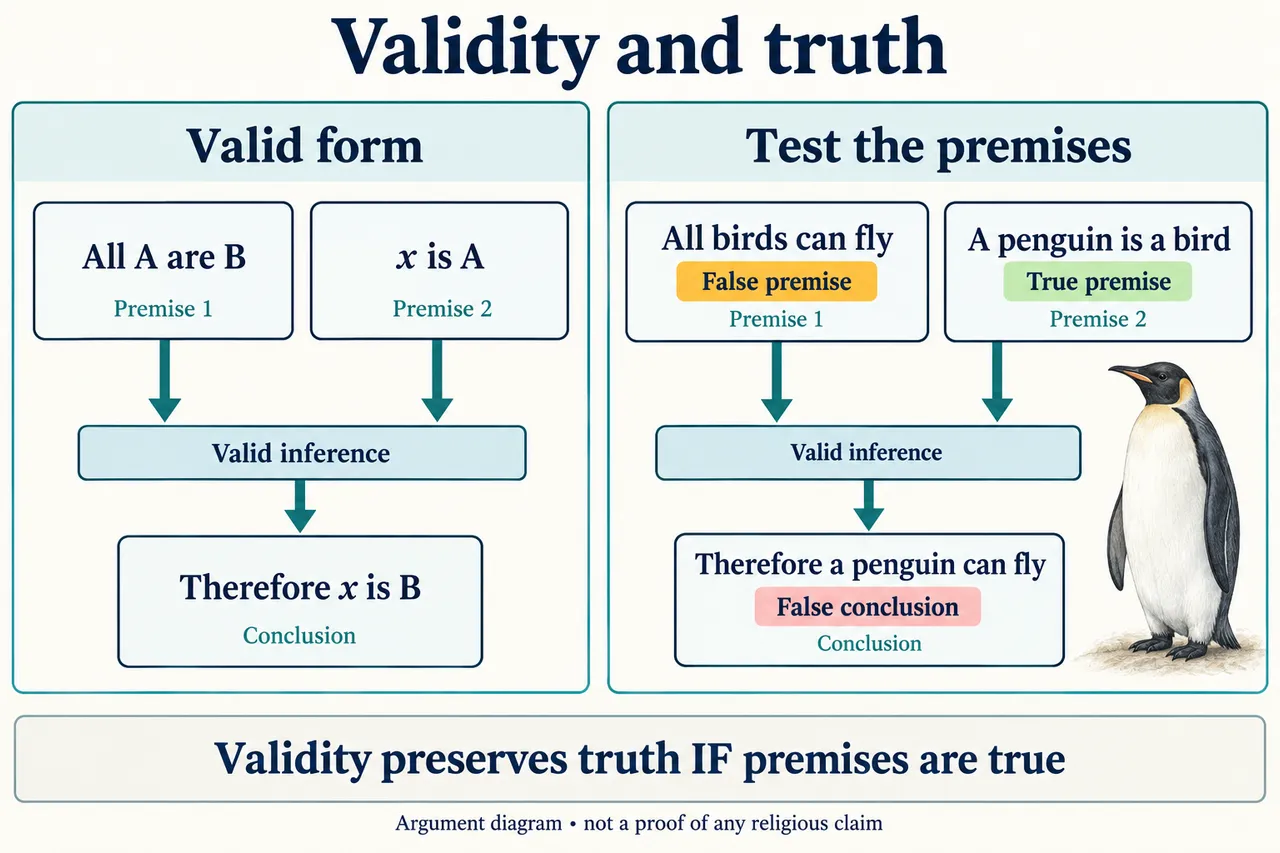
Original myAudience educational illustration. Image: illustration, not a documentary photograph. · myAudience educational illustration; no affiliation with any awarding body.
Proof, interpretation and faith
An argument is a set of reasons offered for a conclusion; a proof claims something stronger about what those reasons establish. For a deductive argument, validity means that there is no possible case in which all its premises are true but its conclusion is false. Soundness adds the requirement that the premises really are true. These are separate tests. Finding an impressive logical structure does not establish the truth of its starting assumptions, and disagreeing with a conclusion does not by itself identify an invalid inference.
The illustration makes that separation visible. All A are B, together with x being an A, entails that x is a B. Substituting the claim that all birds can fly produces a valid argument about a penguin, yet its first premise and conclusion are false. The arrows show dependence, not empirical verification. A useful criticism locates the false premise instead of declaring that the arrows are wrong. Conversely, a conclusion can happen to be true when an argument for it is invalid; truth does not repair a faulty route.
In Summa Theologiae I.2.2, Aquinas distinguishes reasoning from a cause from reasoning through an effect that is better known to us. He argues that effects can establish the existence of a cause without giving complete knowledge of its nature. This is his claim within a Christian philosophical framework, not a result that the reader must accept. It creates two separate questions: whether the proposed dependency is sound, and how far the resulting description of the cause reaches. A conclusion about some cause does not automatically include every Christian divine attribute.
Now compare belief-that with belief-in. Someone can believe that a guide knows the route without trusting that guide enough to follow it; another may entrust a journey to a guide while acknowledging uncertainty about a particular instruction. These fictional cases distinguish acceptance of a proposition from a practical relationship of trust. Philosophical accounts of religious faith disagree about how belief, trust and action fit together. We should therefore state which account an argument supports, rather than treat every use of faith as certainty or every uncertainty as the absence of faith.
A non-demonstrative argument can still provide a reason. A reliable witness who reports a bridge closure supplies relevant evidence, although misunderstanding or outdated information remains possible. The judgement should consider reliability, independence and counterevidence. Two people repeating one original report do not constitute two independent confirmations. Equally, showing that testimony can fail does not show that it always fails. Applied to religion, this explains a form of reasoning about claims and trust; it does not certify any particular revelation, witness or community as reliable.
A serious objection asks whether the available support is adequate for the commitment being made. A tentative hypothesis and a life-shaping allegiance need not carry the same practical stakes. A believer might answer that several independent considerations fit together better on a theistic interpretation, while a critic might challenge their independence or identify a rival explanation. Both should expose the assumptions connecting evidence to conclusion. Adding several arguments with the same unsupported premise does not automatically strengthen that premise; counting reasons without inspecting their dependencies can hide circularity.
Consider a fictional archive that contains an unsigned note saying a benefactor intended its collection for everyone. A second document repeats the note verbatim, and a third records the benefactor opening the archive to visitors. The first two are not independent evidence; the recorded action supplies a different kind of support but may have alternative explanations. A reasonable conclusion can be stronger than mere guessing without becoming a proof of the benefactor's complete intentions. The analogy concerns evidential structure, not an equation between a historical benefactor and God.
For the selected Christianity dialogue, distinguish an argument's value for faith from its capacity to compel every reasonable person. It might clarify a believer's commitments, invite a critic to reconsider a premise, or reveal an assumption that needs further support. None of these outcomes alone settles the religious claim. An evaluated conclusion should specify the kind of rationality meant, explain a serious objection and answer it to the extent the evidence allows. Reading this lesson supplies analytical practice; it does not establish an assessed skill, a religious verdict or a measure of anyone's worth.
Worked example: Can a rational faith rest on an argument that is not a proof? Evaluate by reconstructing two arguments and a serious objection.
Rational faith can rest partly on a non-demonstrative argument if rationality means a commitment responsive to defensible reasons. This qualified answer needs two distinctions: validity concerns what follows if premises hold, whereas soundness also requires their truth; practical trust concerns how a person lives, whereas propositional belief concerns what they accept as true. Neither distinction makes religious commitments automatically reasonable. They specify the standard that an argument must satisfy.
First reconstruct an argument from effects: the observed effect depends on a cause; the effect exists; therefore its cause exists. Aquinas I.2.2 defends reasoning from effects better known to us while limiting what such reasoning tells us about a cause's nature. We must justify the relevant dependency instead of simply assuming that every desired divine attribute belongs to the inferred cause. Even a successful causal inference would need further reasoning before it established a specifically Christian understanding of God.
Second consider an original testimonial argument: a witness has shown competence and honesty concerning a subject; the witness reports a relevant event; therefore there is defeasible reason to believe the event occurred. This is not deductive proof, because an honest competent witness can still be mistaken. Nevertheless, it differs from arbitrary belief: it states support that can be checked and conditions under which confidence should diminish. It supplies a comparison for analysing religious testimony, not confirmation that any named religious witness meets those conditions.
The strongest objection is that a possible rational route does not establish entitlement in the actual case. A person might call faith rational while using dependent reports, ignoring alternatives or treating commitment itself as evidence. The archive example demonstrates this: two verbatim documents add little independent support, even when a third records relevant action. A defender must explain why a religious interpretation is preferable or responsibly acceptable on the actual evidence; merely showing that trust sometimes works leaves this question unanswered.
A reply can distinguish certainty from reasonable revisable confidence without dismissing the objection. Independent testimony, coherent reasoning and acknowledged counterevidence may support trust, but each contribution requires assessment. Alternatively, a critic may judge the evidence insufficient, particularly where rival explanations remain equally strong. Such disagreement need not imply that either person lacks intelligence or integrity. It shows why an argument's value in clarifying faith is different from its success in compelling belief.
My conclusion is conditional: failure to provide proof does not itself make faith irrational, but neither does calling an argument supportive make faith rational. The reasonable position is one that identifies its premises, tests their support, specifies the intended commitment and remains answerable to objections.
Answer: An evaluated model, not a unique mandatory verdict. Credit faithful reconstruction, explicit objections and replies, justified limits and defensible alternatives.
Check your understanding: An archive has an unsigned note about a benefactor's intentions, a second document repeating it verbatim, and a record of an action consistent with it. Does this prove the intentions? Explain independence, alternatives and a justified conclusion.
Answer: No. The second document may depend entirely on the first, so counting documents is not counting independent support. The record of action offers a different source of evidence if its authenticity and relevance are justified, but the action could reflect other purposes. A defensible conclusion is that the intention has some conditional support, not that the benefactor's complete intentions have been proved. A stronger answer specifies what new independent evidence or contrary action would change that judgement. This is a fictional epistemological model, not a historical or religious fact.
Why: Identify the precise premise or interpretive distinction, apply it to the supplied example, and explain both what follows and what remains unestablished.