Paley and the limits of analogy
By UK A Level Religious Studies · independent study · myAudience
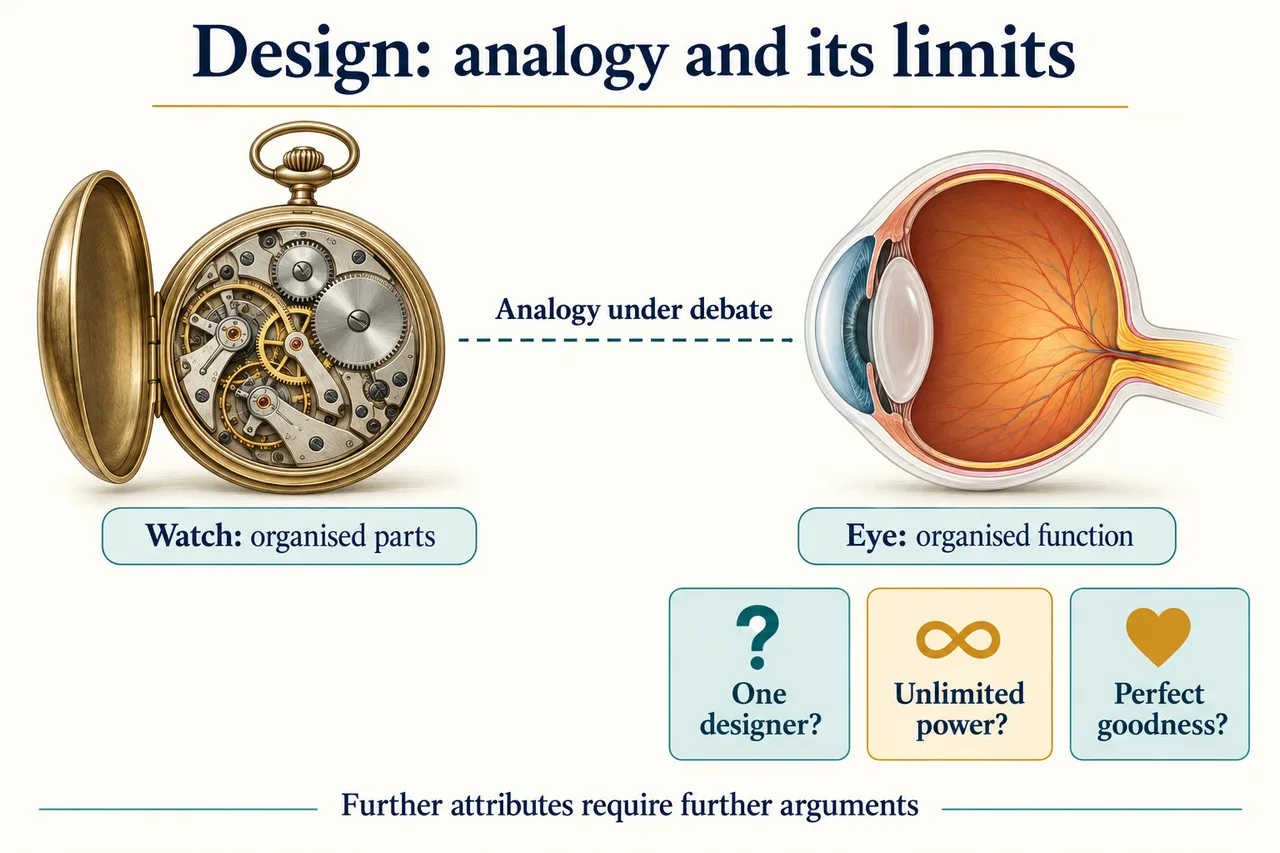
Original myAudience educational illustration. Image: illustration, not a documentary photograph. · myAudience educational illustration; no affiliation with any awarding body.
Paley and the limits of analogy
Finding an unfamiliar object raises two separate questions: how did it come to be, and what explains the arrangement of its parts? In Natural Theology, published in 1802, Paley uses the watch to make a purposive arrangement seem different from an ordinary stone. Components cooperate in a function, suggesting an intelligent arranger. The illustration contrasts an invented watch mechanism with a living eye. It does not label the eye a manufactured object: that is the disputed bridge the reader must examine. An argument begins where the image's resemblance stops being a description and becomes an inference.
Reconstruct the analogy in stages. A watch has parts organised for a function; familiar watches are products of intelligence; organisms also contain parts organised for functions; therefore intelligence is proposed as the explanation of organisms. The conclusion is supported only if the similarities are relevant to origin. Paley's second chapter extends the example to a watch that produces another watch: reproduction would not, he argues, erase the need to explain its purposive organisation. This addresses the objection that generating offspring alone settles the issue, but it does not establish that biological reproduction operates like a human workshop.
Hume's Dialogues Concerning Natural Religion appeared in 1779, before Paley's book; Hume cannot be treated as a reviewer of Paley's 1802 wording. Cleanthes presents an inference from worldly order towards intelligence. Philo questions the strength of the comparison and what the alleged cause would be like. The speakers are characters in an argument, so a sentence voiced by one is not automatically Hume's final personal verdict. A useful reconstruction tests the shared reasoning rather than inventing a face-to-face dispute between the two authors.
The strongest objection concerns the evidence connecting resemblance to production. We have experience of people constructing artefacts, but no comparable sample of complete universes being made. Even if some order suggests a designer, the inference need not identify an unlimited designer. A team could explain complex work; a finite designer could make a finite system; an imperfect arrangement could fit limited skill. These are possibilities relevant to the inference's reach, not established historical accounts of the universe. A causal explanation must earn its specified attributes instead of receiving them from the vocabulary of the conclusion.
A defender can concede that the watch is an imperfect analogy while arguing that coordinated function remains something to explain. The argument need not claim that every detail resembles a clock: it may propose intelligence as the best explanation of a particular kind of organisation. This reply transfers the burden to comparison with alternatives. Mechanisms that explain biological adaptation weaken a simple inference from organisms to intentional manufacture, but identifying an organism's mechanism does not by itself answer every question about why a universe has its conditions. Conversely, moving to cosmic conditions changes the original argument and requires additional evidence, not a silent rescue.
Consider an original example: a visitor sees repeated straight channels in a salt flat and thinks irrigation explains them. Subsequent observations show that the channels develop without gardeners under specified drainage conditions. The alternative weakens this particular inference because it explains the feature that motivated it. It does not prove that no gardener exists anywhere. If the visitor instead finds an inscribed instruction panel, they have introduced a different evidential feature, requiring a fresh comparison. Transfer this discipline to design arguments: specify the observation, the proposed explanation, its rivals and the exact conclusion affected by a counterexample.
For Christian belief, a hypothesis of intelligence is narrower than belief in one omnipotent, perfectly good creator. To reach that conclusion, a defender would need independent reasons for unity, power and goodness, and further reasons for specifically Christian claims. Suffering or apparent poor design presses particularly on goodness rather than simply on intelligence. An argument can therefore contribute to a cumulative case while remaining incomplete on its own. A critic who establishes incompleteness has not necessarily established falsehood; a believer who finds an argument suggestive has not demonstrated every doctrine.
A strong evaluation should ask whether design is a demonstrative proof, a defeasible explanation or a way of interpreting experience. The answer changes the standard of criticism. A counterexample to necessary inference defeats proof, whereas an inference to a best explanation requires comparing explanatory power and assumptions. The watch and eye are teaching examples, not experimental proof of a divine cause. This lesson addresses the specified analogy and selected criticisms; it does not close the course's wider study of scientific discourse, every Hume passage or every contemporary argument about design.
Worked example: A design argument establishes no more than a designer hypothesis. Evaluate the strongest argument and strongest objection.
The statement is substantially right about the argument's limits, although it can underestimate the significance of even a defeasible designer hypothesis. Paley's watch comparison highlights organised function rather than merely an object's existence. Parts cooperate in a result that appears unlikely to arise through arbitrary arrangement. Intelligence is proposed to explain that organisation. This is a reasoned explanatory proposal, but its strength depends on whether the analogy supports an inference about origins.
The strongest supporting version therefore avoids claiming that an eye is literally a watch. It argues that their relevant resemblance is coordination towards a function. Paley's reproducing watch extends the challenge: producing another organised object does not, in itself, explain the organisation of the producing system. A critic must explain why natural reproduction or another process changes the inference, rather than treating the word reproduction as an automatic answer.
Philo's objections in Hume's earlier Dialogues challenge the comparison's evidential reach. Experience connects artefacts with human makers, but we lack a comparable series of observed universe-making cases. A resemblance between effects does not establish the same cause in every respect. Even if intelligence were supported, several designers or a limited designer could remain compatible with the observed effect. Inferring omnipotence or perfect goodness therefore requires premises not supplied by organised function alone.
A defender can reply that an explanatory argument need not achieve certainty. Intelligence might still compare favourably with some alternatives. However, a mechanism that explains the very organisation at issue weakens the proposed need for intentional arrangement. The original drainage example illustrates the point: repeated channels initially suggest gardeners, but a demonstrated non-intentional drainage mechanism changes the comparison. This undercuts that inference, without proving that gardeners cannot exist.
For Christianity the remaining gap matters. Belief in one good creator is more specific than belief in some arranger. Suffering raises an additional question about the inferred cause's goodness; it cannot be dismissed because the argument began with functional order. A cumulative approach may introduce further arguments or sources of authority, but must acknowledge what each supplies rather than attributing the entire conclusion to the watch.
I therefore accept the statement as a limit on what this analogy alone establishes. Its strongest defensible conclusion is a contested explanatory hypothesis, not a complete Christian doctrine. That conclusion may still have value in reflective faith, provided competing mechanisms and missing attributes remain visible. A reasoned alternative judgement could reject even the hypothesis if the comparison with rival explanations is insufficient.
Answer: An evaluated model, not a unique mandatory verdict. Credit faithful reconstruction, explicit objections and replies, justified limits and defensible alternatives.
Check your understanding: Which additional premises would take an intelligence hypothesis to one omnipotent and perfectly good God? Explain why they are additions rather than automatic consequences.
Answer: The defender needs separately justified claims that one cause rather than several explains the organisation, that the cause has unlimited rather than merely sufficient power, and that its purposes and conduct are perfectly good. None follows simply from functional complexity: teams, finite skill and mixed purposes also produce organised systems. Specifically Christian identity requires further independent reasoning or sources. A candidate may question whether such additions can be justified; listing attributes without defending the inferences does not complete the transfer.
Why: Identify the precise premise or interpretive distinction, apply it to the supplied example, and explain both what follows and what remains unestablished.