Anselm, Gaunilo and existence
By UK A Level Religious Studies · independent study · myAudience
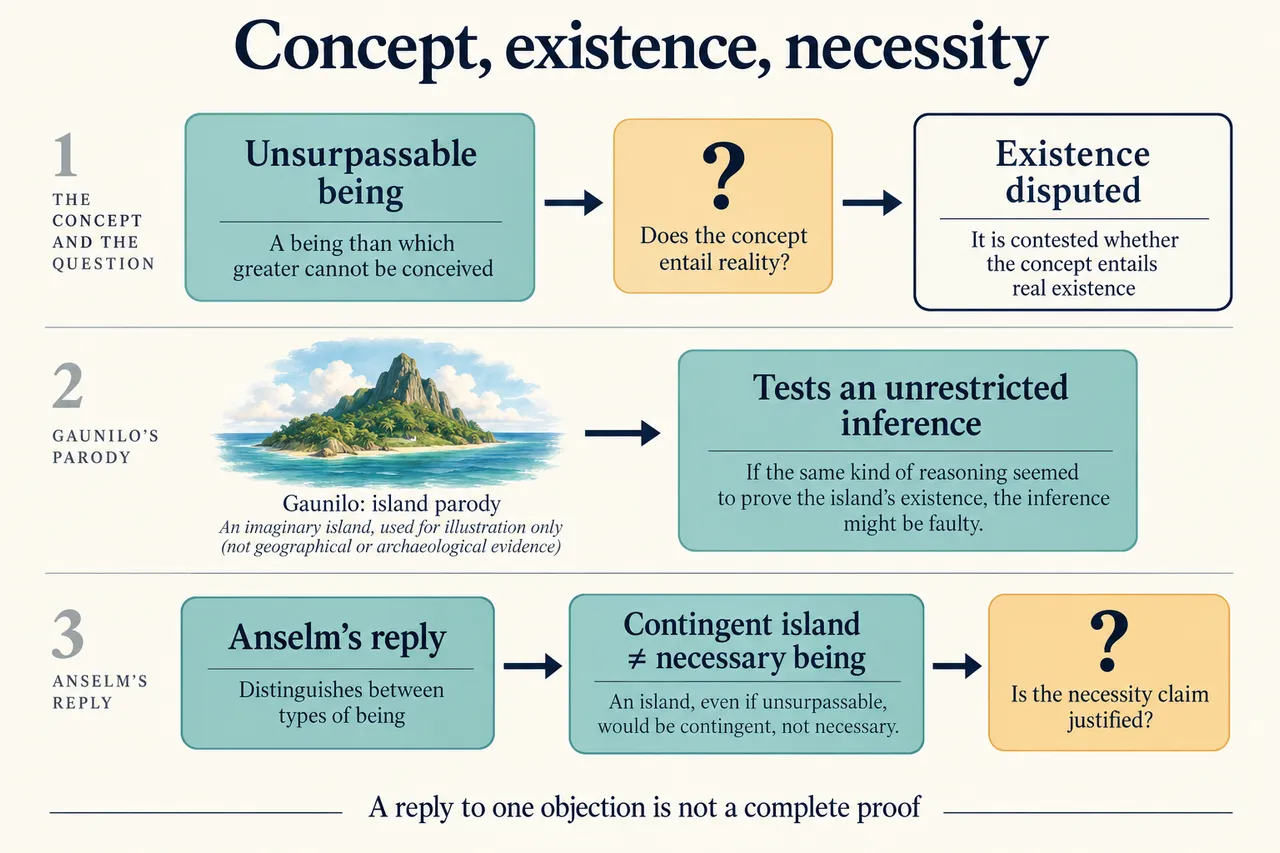
Original myAudience educational illustration. Image: illustration, not a documentary photograph. · myAudience educational illustration; no affiliation with any awarding body.
Anselm, Gaunilo and existence
An a priori argument reasons from concepts rather than beginning with an observed organism or event. Anselm's Proslogion places such reasoning within faith seeking understanding: it is not a neutral historical experiment reported from a laboratory. Chapters II and III examine the idea of a being whose greatness cannot be exceeded. The concept is meant to differ from simply imagining a very impressive object. Our plate shows a concept card, a disputed inference and a separate necessity question. No arrow is labelled a verified discovery of God's existence.
In chapter II, the person denying God can at least understand the stated concept. Anselm then argues that existence in reality exceeds existence only in thought. If the unsurpassable being existed only in thought, a greater being existing in reality could be conceived; this would conflict with its description. The proposed conclusion is that the unsurpassable being exists. Reconstructing this does not grant its premises. In particular, a critic may ask whether conceiving a description already supplies a coherent possible being, and whether the supposed increase in greatness licenses the passage to reality.
Chapter III develops a further contrast between a being that could fail to exist and one that cannot be conceived not to exist. Anselm associates the latter with greater status. This is not the same as saying that strong personal conviction makes non-existence impossible. Necessary existence concerns the kind of being proposed, not a learner's inability to imagine being mistaken. The argument must show that the concept has the relevant coherence and that necessity is legitimately involved. Confusing a description of necessity with a proof that it is instantiated conceals the very issue disputed.
Gaunilo's lost island objection deliberately mimics a passage from understood excellence to actual existence. Understanding an island surpassing other lands would not locate it in an ocean. The parody asks what restricts the form of reasoning to the divine case. Gaunilo's text also questions whether understanding unfamiliar words gives adequate comprehension of their alleged object. His challenge is not answered by laughing at islands: it targets an inference rule that seems capable of generating fictional realities. Nor does its success against an unrestricted rule automatically settle every later argument called ontological.
Anselm replies that his intended concept is different from an excellent contingent island. An island can be conceived not to exist, whereas the intended unsurpassable being involves a special necessity claim. This is a principled distinction only if the defender justifies it without assuming the conclusion. One may also ask whether island excellence has a coherent maximum: more coastline, resources or beauty may compete rather than form a single unlimited scale. That supports disanalogy, but it does not by itself prove the divine concept coherent or instantiated. Removing a parody leaves the positive argument's burden intact.
Kant's objection concerns existence rather than island geography. His comparison of possible and actual monetary holdings separates their conceptual description from whether anything instantiates that description. Having actual money matters greatly to its owner, but existence does not add another descriptive characteristic to the money's concept. Applied here, the concern is that stipulating the concept's perfections cannot establish a corresponding real being. This challenges the use of existence as a greatness-enhancing property. It is not the crude claim that real and imagined money are equally useful, which would miss the distinction between concept and possession.
An original counterexample makes the burden clear. A council defines an ideal archive as the most complete collection of records and declares that completeness requires actual existence. The definition does not place a building in the town. A defender of Anselm must explain why this archive is contingent and why the intended divine necessity cannot be added arbitrarily to a description. The response may dispute whether an archive has a maximum, but must still account for the step from a coherent concept to reality. Merely using the word necessary in the title is not enough.
For Christian thought, the argument can clarify what calling God unsurpassable or necessary commits a believer to. Its conceptual value does not automatically establish its success as a proof, and criticism of one form does not eliminate all reasoned faith. An evaluation should distinguish chapter II's existence move, chapter III's necessity move, the scope of the island parody and Kant's objection. A reasoned conclusion may defend, reject or suspend judgement on the inference, provided it explains the disputed premise and treats alternative readings fairly. No contemporary modal reformulation is certified by this introductory source-bounded study.
Worked example: The island objection defeats every ontological argument. Evaluate scope and Anselm response before qualified judgement.
The claim is too broad. Gaunilo's island exposes a serious risk in moving from an understood description of excellence to actual existence, but defeating an unrestricted inference does not establish that every argument using a divine concept has the same form. A strong answer must reconstruct the inference challenged and assess whether Anselm supplies a relevant restriction.
In Proslogion II, Anselm reasons that a being whose greatness cannot be exceeded cannot exist only in thought: if it did, something existing in reality would be greater. Gaunilo parodies this with an exceptionally excellent island. Understanding its description plainly does not establish that it exists. If the reasoner's rule treats real existence as an automatic consequence of conceptual excellence, the island provides a damaging counterexample.
Anselm's reply distinguishes the intended unsurpassable being from contingent objects. Chapter III associates unsurpassability with a being whose non-existence cannot be conceived. An island is contingent, and its competing qualities may not possess a coherent maximum. This gives a possible principled reason why an island parody fails to match the divine concept. However, the distinction succeeds only if necessity is justified rather than inserted as a label for a being already assumed to exist.
Kant presses a further difficulty. The concept of possible monetary holdings contains the same descriptive properties whether or not the holdings are actual. Existence changes whether the concept is instantiated, rather than adding a descriptive property within it. This challenges the passage from a conceptual inventory to reality even if an island is a poor analogy. It therefore prevents the defender from treating victory over one parody as victory over every objection.
The ideal archive transfer shows the distinction. Defining a collection as maximally complete does not produce records or a building. Calling it necessarily complete changes the proposed description, but does not supply evidence that anything satisfies it. A defender must explain why divine necessity is coherent and why its relation to existence differs from an arbitrary archive definition. A critic should assess that explanation, rather than merely repeating that islands are unreal.
I conclude that the island objection is powerful against an unrestricted existence-from-excellence rule, while the word every overstates its scope. Anselm has a relevant reply concerning contingency and necessity, but that reply leaves the positive burden of establishing the divine concept and inference. Christian faith may gain conceptual clarification from the debate without having received a universally compelling proof. A defensible opposing judgement would need to show that the necessity distinction ultimately reproduces the same unsupported transition.
Answer: An evaluated model, not a unique mandatory verdict. Credit faithful reconstruction, explicit objections and replies, justified limits and defensible alternatives.
Check your understanding: Why is a successful parody not enough to dismiss every argument in a family? Give a principled distinction and explain what it still fails to establish.
Answer: A parody tests a particular inference pattern. An island or ideal archive is contingent, whereas Anselm intends a being whose non-existence is inconceivable; this may be a relevant disanalogy. The defender must establish coherence and justify the necessity-to-existence step rather than merely adding necessity to a definition. Showing that an island is an inadequate parody therefore does not prove God exists, and showing one unrestricted form fails does not refute every different form.
Why: Identify the precise premise or interpretive distinction, apply it to the supplied example, and explain both what follows and what remains unestablished.