Aquinas Third Way and necessary existence
By UK A Level Religious Studies · independent study · myAudience
Original myAudience educational illustration. Image: illustration, not a documentary photograph. · myAudience educational illustration; no affiliation with any awarding body.
Aquinas Third Way and necessary existence
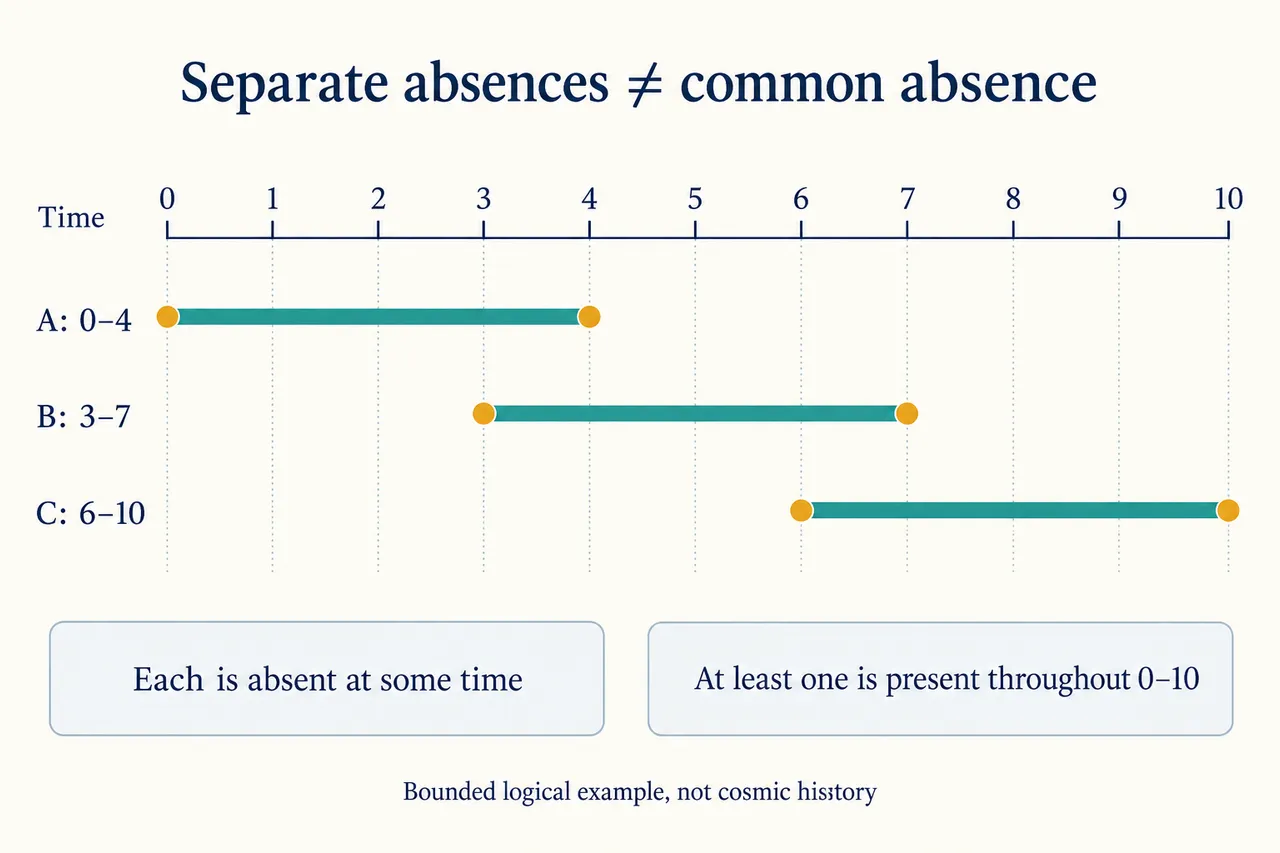
Contingent things can exist and fail to exist; necessary existence is not simply a very long lifespan. Aquinas's Third Way begins with things undergoing generation and corruption and moves towards a necessary source. It should not be replaced with a generic first-cause argument attributed to another Way. specifies this particular argument and its criticisms. Our timeline illustrates a disputed move within its reconstruction: the fact that each depicted thing has a period of absence does not alone show a moment when all things are absent together.
Aquinas reasons that things capable of not existing cannot always exist, and that if everything were of this kind, at some time nothing would have existed. He then argues that nothing could begin to exist without something already existing; since things do exist, not everything can be merely contingent in that sense. A further stage distinguishes necessary things deriving necessity from another from a necessary source not deriving it. This is a reconstruction of the primary passage, not an endorsement of each premise or a claim that its conclusion already contains every Christian divine attribute.
The move from individual possibility of absence to universal simultaneous absence needs scrutiny. Take three fictional occupants: A is present from time 0 to 4, B from 3 to 7, and C from 6 to 10. Within the displayed interval, each occupant is absent at some times, yet at least one occupant is present throughout. Their staggered intervals demonstrate a quantifier problem: for each occupant there is an absence-time differs from there being one time when every occupant is absent. The example does not model the entire universe or settle whether an infinite sequence is possible.
A defender may say that the argument concerns dependency more deeply than a time chart: contingent reality requires an explanation that does not itself remain wholly dependent. That can make the explanatory issue clearer, but a revised argument must state its added premise. A principle requiring a sufficient explanation for the whole contingent order is stronger than noting that each visible object changes. The critic can ask why the whole must have an explanation, whether explaining its members is sufficient, and what a necessary explanation would mean. A reformulation should not conceal these additional commitments behind Aquinas's name.
The distinction between a necessary being and a necessary explanation also matters. A logical truth can be necessary without generating physical objects. Conversely, calling an entity necessary does not automatically show how it explains contingent events. An argument needs a connection between the proposed source and the reality being explained. If that connection entails the events necessarily, the defender must explain how the events remain contingent; if it does not, the critic may ask what explains the particular outcome. These are questions about explanatory sufficiency, not merely demands for an earlier date.
An original archive case offers a second transfer. Every copied document depends on an earlier document for its wording. An endlessly extended copying chain would leave a question about why this wording is present at all, even if every local copying event had an antecedent. This suggests the appeal of a whole-chain explanation. However, documents and universes differ, and our knowledge of authorship cannot simply be imported into cosmology. The case identifies a question; it does not demonstrate that every explanatory chain must end or that a personal creator is its only possible explanation.
For Christian faith, a necessary source could support thinking of God as independent rather than as one vulnerable object among others. That contribution is narrower than establishing personality, goodness or specifically Christian revelation. A critic may regard the universe or its existence as a brute fact; a defender may find that stopping point unsatisfactory. Neither position gains force by redefining its preferred conclusion as self-evident. An evaluation must explain why a demand for further explanation is justified, or why terminating that demand is reasonable in this particular case.
A careful judgement separates the source text, the temporal inference, a possible dependency reformulation and the theological interpretation. The illustrated overlap checks only the move from separate absences to a common absence. It cannot prove that the universe has always existed or that no necessary source exists. This lesson supplies a focused reconstruction and original error analysis; the prescribed detailed Hume and Russell criticisms remain a distinct source-and-assessment gap rather than being claimed complete from an unverified paraphrase. The course's assessed requirements therefore remain open.
Worked example: A necessary explanation is better than accepting the universe as a brute fact. Evaluate assumptions and limits.
A necessary explanation is attractive because it promises to answer why dependent reality exists without postponing the question to another equally dependent item. However, preference for an explanation is not proof that such an explanation exists. The argument must justify both the demand for an explanation of the whole and the ability of the proposed source to provide it.
Aquinas's Third Way starts from things that come into existence and cease to exist. It reasons towards something necessary and ultimately towards a source whose necessity is not derived from another. This has value for Christian belief in an independent creator, but its stages must be distinguished. Observed change supports the contingency of particular things; further reasoning is needed to establish a necessary source of the whole.
The strongest immediate objection concerns the move to a time when nothing existed. A is present from 0 to 4, B from 3 to 7 and C from 6 to 10. Each has an absence-time in the illustrated interval, but their overlapping lives leave no common absence there. Thus individual contingency does not alone establish simultaneous universal absence. This limited countermodel challenges an inference, not the existence of every possible necessary explanation.
A defender can reconstruct the argument around dependency rather than simultaneous absence. The archive copying example makes the appeal clear: knowing how each document copies a predecessor may leave the existence of the whole wording unexplained. Yet an archive analogy does not establish a universal principle of sufficient explanation. The defender must explain why contingent reality requires an account beyond explanations of its members.
The brute-fact position rejects or limits that demand. It can avoid introducing an entity whose explanatory connection remains disputed, but it leaves the existence of the whole without the further account the defender seeks. Neither option is cost-free. In particular, describing a source as necessary does not establish that it produces contingent reality; necessary truths about numbers do not themselves generate physical objects.
I therefore prefer a necessary explanation only conditionally: if the whole legitimately requires an explanation, and if a necessary source can explain it without making every outcome necessary, it offers a deeper account than stopping at brute fact. Those conditions remain substantive philosophical tasks. The Third Way can clarify a Christian understanding of dependence while failing to compel someone who reasonably disputes its explanatory principles. An opposing conclusion is defensible if it identifies why the brute-fact stopping point is less problematic.
Answer: An evaluated model, not a unique mandatory verdict. Credit faithful reconstruction, explicit objections and replies, justified limits and defensible alternatives.
Check your understanding: Using A[0,4], B[3,7] and C[6,10], explain which inference fails and what the countermodel does not establish.
Answer: The intervals overlap over [3,4] and [6,7], so their union covers [0,10]. Each occupant is absent somewhere in that interval, but no displayed time has all three absent. This refutes the inference from separate absence-times to one common absence-time without additional premises. The bounded example does not prove an eternal universe, model all entities, or refute a separately justified dependency argument.
Why: Identify the precise premise or interpretive distinction, apply it to the supplied example, and explain both what follows and what remains unestablished.