Logical and evidential evil
By UK A Level Religious Studies · independent study · myAudience
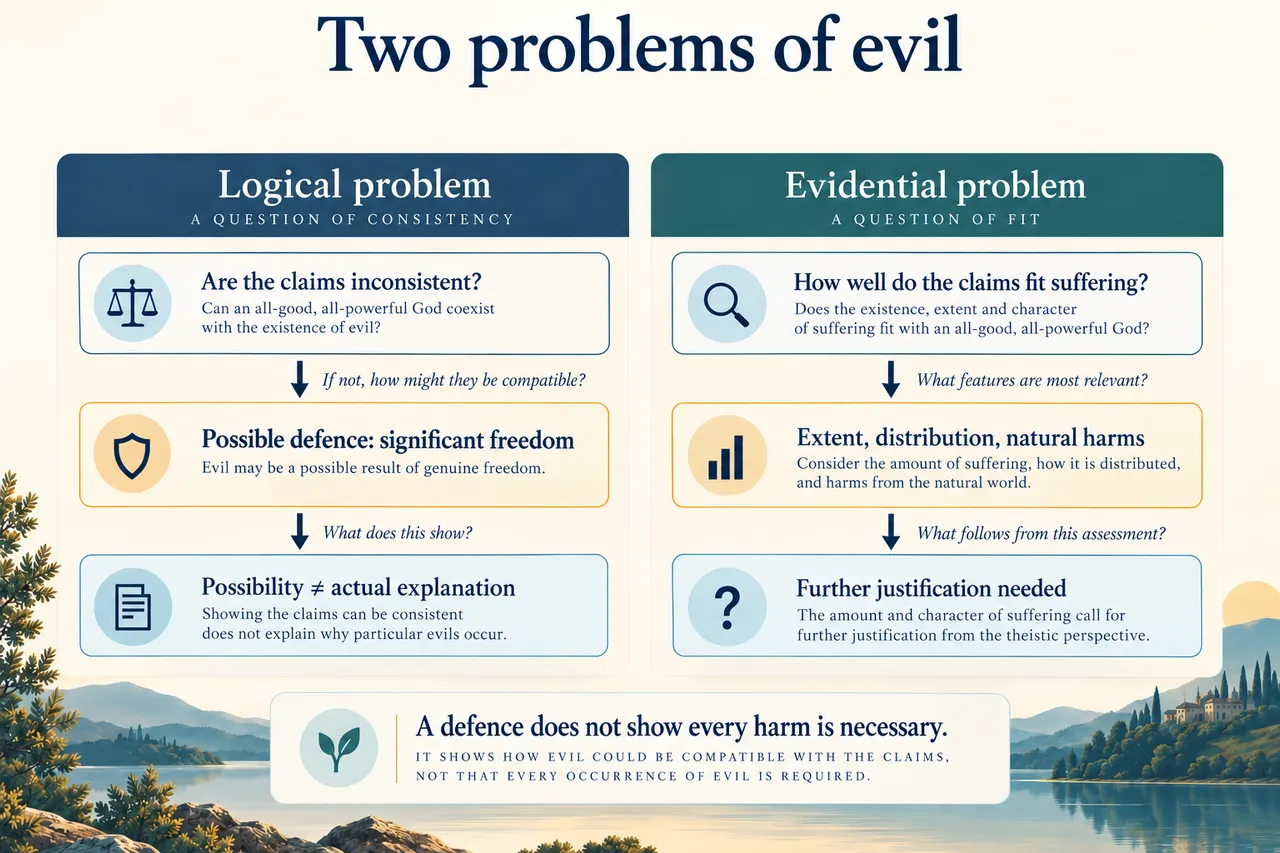
Original myAudience educational illustration. Image: illustration, not a documentary photograph. · myAudience educational illustration; no affiliation with any awarding body.
Logical and evidential evil
The problem of evil concerns a tension between suffering and particular claims about God. It is not a demand that a learner disclose personal distress. Moral evil concerns wrongdoing by agents; natural evil concerns harms such as destructive natural events not simply attributed to an agent's wrongdoing. These categories can overlap in a case where choices increase exposure to a natural hazard. The plate therefore separates argument types rather than displaying injured people. A philosophical classification is not an explanation of an individual's experience.
A logical problem alleges inconsistency: an omnipotent, perfectly good God exists, evil exists, and further premises make these claims incompatible. The contradiction does not appear merely by writing those two existence claims side by side. One needs a bridging claim, such as that a perfectly good being would eliminate every evil it could eliminate without losing a greater good or permitting an equally serious evil. A defender can challenge the bridge or propose a possible reason. Clearly identifying the bridge prevents an answer from declaring contradiction without showing one.
An evidential problem is different. It asks whether the kinds, extent or distribution of suffering count against the proposed God, even if logical consistency can be preserved. A possible explanation is not automatically probable or sufficient for the actual case. An analogy makes the distinction: a locked room could contain a functioning heater, yet evidence of persistent cold might lower confidence that it does. Bare possibility defeats a claim of impossibility; it does not remove every evidential challenge. This is an original reasoning comparison, not a comparison between people and appliances.
The free will defence proposes that morally significant freedom has value and may involve the possibility of choosing wrongly. Plantinga's primary discussion distinguishes a defence against alleged inconsistency from proving the actual reason God permits each evil. On a libertarian understanding, causing every choice to be right may remove the relevant freedom. The argument does not say that every free agent must act wrongly or that goodness is impossible. It concerns what a creator could guarantee while preserving the specified freedom, which requires careful modal reasoning rather than an appeal to blame.
A strong objection asks how far this proposal reaches. Many natural harms are not explained simply by a person's wrongful choice. Even concerning moral wrongdoing, one can ask why preventing some damaging consequences would destroy all significant freedom. A defender might distinguish occasional prevention from total guaranteed control, but then must explain the particular scope and cost of intervention. An account of logical possibility leaves these questions open. It must not be converted into a confident assertion that every actual suffering is necessary or deserved.
Consider a fictional interactive story in which characters can make meaningful choices. If an author changes the script so that each decision is mechanically fixed to the preferred outcome, that changes the stated model of freedom. However, the author could perhaps prevent a particular consequence without fixing every decision. The example therefore supports one restricted reply and one restricted objection. It does not settle whether God and human authors have analogous powers. Identify the specific claim each comparison tests instead of using a story as evidence about divine intentions.
For Christianity, divine power and goodness have to be considered together with views of freedom, providence and care. Redefining power or goodness may resolve one inconsistency at the cost of altering a central belief. A candidate should explain that cost rather than announcing an effortless solution. Responses discussed in the full specification also include Hick's soul-making and Griffin's process theodicy. Those distinct theories require their own primary-source and assessed treatment; this focused defence lesson does not teach them by merely listing their names.
A justified evaluation distinguishes three results: demonstrating inconsistency, showing consistency possible, and showing an actual explanation reasonable. The illustration's two lanes end at different questions so that learners cannot mistake logical defence for complete evidential success. Answers may defend or reject the free will response, but must reconstruct its stated conception of freedom, address natural harms and explain how counterevidence affects the conclusion. These argument exercises offer no diagnosis, consolation prescription or verdict on anybody's character.
Worked example: A free-will defence answers the problem of evil. Evaluate the strongest limited claim and remaining natural-evil problem.
The claim is defensible only with a restricted meaning of answers. A free will defence may challenge an allegation of logical inconsistency without explaining the actual extent of suffering. The logical and evidential problems therefore require different conclusions. Treating any possible explanation as a complete answer confuses those standards.
The logical problem needs bridging premises connecting perfect goodness and power to the prevention of evil. A defence proposes a possible valuable good: morally significant freedom. If such freedom includes choices not determined to be right by the creator, guaranteeing the right outcome through determining every choice would change the freedom described. Plantinga's discussion uses this distinction to contest the assumed inconsistency, rather than to reveal God's actual reasons for every event.
The strongest support is consequently conditional. If significant freedom is a good, and if preserving it makes a guarantee of universal right choice unavailable, the existence of wrongdoing need not alone contradict perfect goodness and power. This does not imply that every free agent must choose wrongly. A possible free agent choosing well is compatible with the argument; the issue is what can be guaranteed under the stipulated conception of freedom.
The strongest objection asks why this accounts for natural harms and preventable consequences. A destructive natural event is not simply a human decision. Moreover, preventing one consequence need not determine every choice. The fictional story case shows the distinction: fixing the entire script removes its stipulated freedom, but blocking one outcome might leave meaningful alternatives. The defender owes further reasoning about intervention rather than treating all prevention as equivalent to total control.
An evidential critic can therefore accept logical possibility while judging the actual pattern of suffering difficult to reconcile with perfect care. A defender may acknowledge this and offer further explanations, but those additions need their own evidence. Merely naming soul-making or process theology does not supply that reasoning. Revising divine power may ease a difficulty while changing the Christian belief that the original question concerned.
I conclude that the free will defence can answer a particular logical challenge on its stated assumptions, but the broad wording overclaims its reach. Its value lies in exposing a missing premise and a possible consistency relation. Its limits concern the plausibility of that relation, natural suffering and the difference between possible and actual explanations. A contrary conclusion remains defensible if it identifies precisely why the proposed freedom is incoherent or inadequate, rather than assuming that any evil creates an immediate formal contradiction.
Answer: An evaluated model, not a unique mandatory verdict. Credit faithful reconstruction, explicit objections and replies, justified limits and defensible alternatives.
Check your understanding: In the fictional story, why does preventing one consequence differ from fixing every decision? Which part of the defence and objection does each test?
Answer: Fixing every decision removes the stipulated libertarian alternatives, supporting the claim that determined universal right choice would alter that freedom. Preventing one consequence does not by itself fix every decision, so it questions a blanket inference that any intervention destroys significant freedom. Neither example proves a real divine policy, accounts for natural evil or establishes the actual reason for any suffering.
Why: Identify the precise premise or interpretive distinction, apply it to the supplied example, and explain both what follows and what remains unestablished.