Natural law, intention and consequences
By UK A Level Religious Studies · independent study · myAudience
Original myAudience educational illustration. Image: illustration, not a documentary photograph. · myAudience educational illustration; no affiliation with any awarding body.
Natural law, intention and consequences
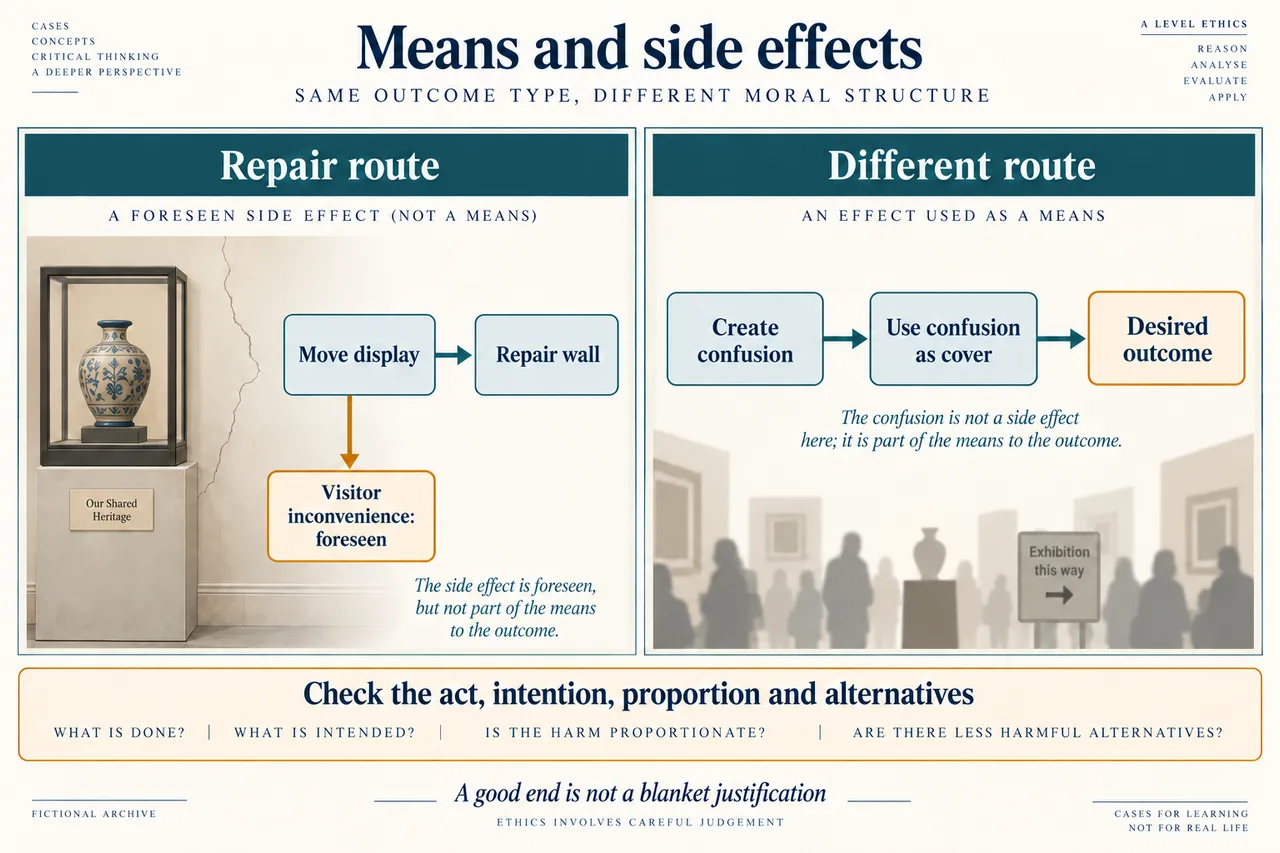
Natural moral law asks how practical reason identifies human goods and directs action towards them. It is not identical to obeying whatever happens in nature: predators or natural disasters do not supply a straightforward moral rule for humans. Aquinas connects rational action with goods and purposes. The plate begins with a decision, separating what is chosen as a means from an effect merely foreseen. This teaches an analytical distinction without declaring that every use of the vocabulary resolves a difficult case.
In Summa I-II 94.2, Aquinas describes a basic orientation towards pursuing good and avoiding evil, with more particular precepts related to human inclinations. His treatment of practical reasoning in 94.4 distinguishes general principles from contingent applications. This does not make every preference a justified exception. It does show why recognising a good and applying a principle require reasoning about the act and its circumstances. A learner should explain the connection to a human good rather than announcing that an action is right simply because it is described as natural.
The principle of double effect distinguishes intended and foreseen effects. Aquinas's discussion of self-defence in II-II 64.7 links intention and proportion; later formulations make several conditions explicit. In a common formulation, the chosen act must be permissible, the bad effect must not be intended as an end or as the means, and the good sought must provide a proportionate justification. These are not interchangeable checks. Good intentions cannot compensate for deliberately using a prohibited means, and mere foresight does not settle whether an outcome is being used.
Use an original benign example. A fictional archive must move a fragile display to repair the wall behind it. The curator aims to protect the collection and foresees temporary inconvenience to visitors. If the inconvenience occurs alongside the repair rather than causing it, it is a side effect. If instead a manager deliberately misleads visitors so their confusion creates cover for an unrelated decision, that confusion is being used as a means. Both managers may claim an eventual good, but the causal routes and chosen actions differ. The comparison is analytical, not legal or professional advice.
A misconception is that describing a harm as unintended ends the evaluation. Foreseen effects can still be disproportionate, avoidable or wrongly imposed. In the archive case, an available less disruptive repair schedule matters. A careful answer examines alternatives, the relation between means and ends, and the seriousness of the burden. It also asks whether the actor's description is credible: relabelling a deliberately useful effect as collateral does not alter its role. The plate's arrows show this causal test rather than an automatic permission.
Proportionalism raises a distinct dispute about norms, goods and effects. Veritatis Splendor 75–78 describes and criticises proportionalist approaches from an official Catholic standpoint. That is a primary source for the Church's criticism, not a neutral or exhaustive statement by every proportionalist. Our teaching comparison asks whether a proportionate reason can justify an otherwise prohibited kind of choice. The counterargument defends protection against treating people or truth as expendable means; the reply asks whether rigid classification neglects context. Neither side is reduced to merely counting convenient outcomes.
Consider a fictional disagreement over an announcement: organisers know the timing is uncertain but want to prevent disappointment by announcing a definite start. A defender of a strict truthfulness norm objects to choosing deception as a means. A contextual response asks about the consequences of different wordings, but must address why honest qualified wording is unavailable. Here a clear alternative weakens the purported conflict: announce the uncertainty. The example tests reasoning about lying without supplying a universal instruction for morally dangerous situations or claiming one fictional case settles the theory.
Evaluation should therefore distinguish a good end, a permissible object, a chosen means, foreseeable side effects, proportionality and available alternatives. Christian natural-law reasoning may be defended as protecting enduring goods or challenged for disputed accounts of human purposes and absolute norms. A reasoned conclusion must address the strongest alternative rather than attaching a theory's label to an intuition. This slice does not complete Fletcher, Aristotle, the prescribed life-and-death applications or a full scholarly treatment of proportionalism. All assessed coverage remains open.
Worked example: A morally good end can justify a normally forbidden action. Evaluate natural law and proportionalist responses with an original case.
A good end matters, but it does not automatically justify any chosen means. The question becomes clearer by separating the desired outcome from the kind of action selected and from its side effects. Natural moral law evaluates action through human goods and practical reason; calling an outcome beneficial does not answer every part of that evaluation.
Aquinas's account of intention and proportion provides a basis for the double-effect distinction. In a common later formulation, an act must be permissible, a bad effect must not be intended as an end or means, and the good sought must supply a proportionate reason. These conditions resist the claim that sincerity alone excuses wrongdoing. They also resist the opposite mistake that every foreseen burden is necessarily an intended means.
The fictional archive case demonstrates the difference. Moving a display to repair its supporting wall may inconvenience visitors without using their inconvenience to achieve the repair. Deliberately creating confusion to provide cover for another decision gives that confusion a different causal role. A good eventual purpose does not erase this difference. Even the repair requires examining less disruptive alternatives and whether the burden is proportionate.
A proportionalist challenge asks whether a sufficient reason can justify choosing an otherwise prohibited kind of action in a particular context. The Catholic criticism in Veritatis Splendor rejects treating calculated benefits as permission to choose an intrinsically wrong object. This source is a participant in the dispute, not evidence that every opponent has been exhaustively or neutrally represented. The strongest disagreement concerns how enduring goods relate to contextual judgement.
The uncertain announcement tests both sides. Organisers might defend definite wording as preventing disappointment, but honest qualified wording offers a way to communicate without choosing deception. Unless they explain why that alternative fails, their appeal to a good end is weak. Conversely, a critic of absolute norms can ask whether other cases create genuinely unavoidable conflicts. One manageable example cannot establish that every difficult choice has an equally simple solution.
My conclusion is that a good end supplies a relevant reason, not a blanket justification. Double-effect analysis preserves the distinction between means and side effects, while proportionalist criticism presses the adequacy of context-sensitive judgement. A convincing answer must justify its act-description, examine alternatives and explain the disputed norm. Defensible alternative conclusions are possible, but they must answer those questions rather than simply proclaim that consequences always, or never, matter.
Answer: An evaluated model, not a unique mandatory verdict. Credit faithful reconstruction, explicit objections and replies, justified limits and defensible alternatives.
Check your understanding: In the uncertain-announcement case, identify chosen means, available alternative and why the appeal to a good end is incomplete.
Answer: The definite wording uses a misleading claim to secure reassurance, whereas acknowledging the uncertain timing communicates without that chosen deception. The good end therefore does not establish that the misleading means is necessary or justified. A fuller evaluation must explain the truthfulness norm, effects, alternatives and proportionality. Calling the message well-intended cannot replace those reasons.
Why: Identify the precise premise or interpretive distinction, apply it to the supplied example, and explain both what follows and what remains unestablished.