Bible, Church and interpreted authority
By UK A Level Religious Studies · independent study · myAudience
Original myAudience educational illustration. Image: illustration, not a documentary photograph. · myAudience educational illustration; no affiliation with any awarding body.
Bible, Church and interpreted authority
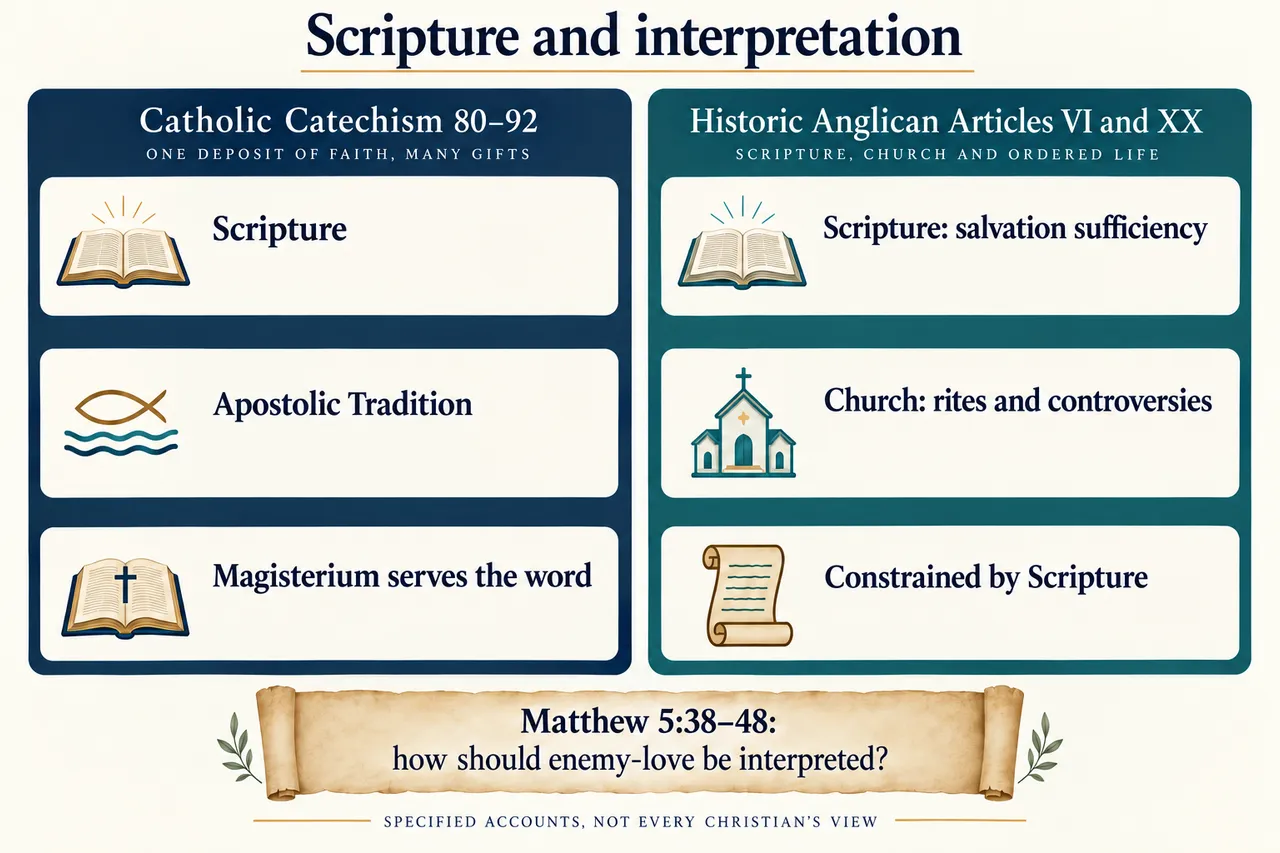
Sources of authority answer related but different questions: which texts or traditions matter, who interprets them, and how an interpretation guides life. Christianity contains disagreements on all three. The plate compares a specified Catholic account with the historic Anglican Articles, rather than displaying a single hierarchy labelled all Christians. A Bible can be central in both accounts without both assigning the same role to church teaching. This is a comparison of documented positions, not a survey proving how every individual Christian behaves.
The Catholic Catechism 80–83 relates Scripture and apostolic Tradition as distinct but connected ways of transmitting the faith. Paragraphs 84–92 explain the role of the teaching office, or Magisterium, while describing it as serving the word rather than standing above it. Apostolic Tradition is not simply every local custom: the source distinguishes the two. A strong answer should not turn this account into the claim that a church institution may arbitrarily invent any belief. It should explain both the claimed authority and the source's stated constraints.
Article VI in the historic Church of England formulary identifies Scripture as sufficient for what is necessary to salvation. Article XX assigns the Church authority concerning rites and controversies while denying permission to set teaching against Scripture. This specified comparison therefore challenges a simple contrast between Catholics having a church and Anglicans having none. A dispute can concern the ground and limits of interpretive authority, rather than whether a community interprets at all. These Articles do not represent every Protestant denomination or guarantee every contemporary Anglican's personal account.
Matthew 5:38–48 supplies a focused textual case. In this passage, Jesus contrasts retaliation with responses to wrongdoing and extends the demand for love beyond one's own group. Verse 43 reports a saying involving hatred of an enemy; it is the position being challenged, not Jesus's final instruction to hate. The examples and movement of the passage matter for interpretation. This lesson uses original paraphrase of the identified King James Version, not a copied modern translation or an invented quotation attributed to Jesus.
Two interpretive questions follow. Do the passage's concrete examples function as universal literal instructions, provocative illustrations of a principle, or instructions requiring contextual application? And how does a reader connect enemy-love with protection of others and wider ethical reasoning? Different answers need evidence and argument. A learner should not use the text to instruct a person to remain in danger, nor assume that a single slogan settles every disagreement over force or justice. Literary context, other sources and the claimed interpreter's authority each need explicit assessment.
In an original classroom case, Reader A concludes that every response to wrongdoing must copy one example literally. Reader B argues that the examples expose retaliatory attitudes and therefore require application of a wider principle. Reader C dismisses the passage as irrelevant because it is difficult. A stronger discussion first identifies what each reading explains or overlooks. A accounts for concrete wording but owes an account of differing situations; B offers flexibility but must avoid emptying the demand of force; C needs a reason why difficulty destroys relevance rather than requiring interpretation.
The question of Bible alone is therefore ambiguous. It may concern sufficiency for salvation, the existence of other sources, or the exclusion of every interpretive institution. The Anglican Article supports the first in its specified sense without automatically supporting the third. The Catholic account denies reducing the transmission of faith to Scripture alone while also constraining interpretation. A philosophical critic can ask whether the proposed authority is justified; a believer can ask how it supports coherent understanding. Neither question is answered by caricaturing the rival tradition.
An evaluation should define the meaning of authority used, identify a documented position and show how it operates in a concrete interpretive dispute. Possible influence on a reader's conduct may be reasoned through the enemy-love example, but no participation rate or psychological benefit is inferred. The lesson does not complete every Christian source, every theological view of inspiration, all interpretations of Matthew or the dialogues on ethics. It offers a bounded comparison with room for justified alternative readings, while every assessed demand remains open.
Worked example: Christian ethical authority comes from the Bible alone. Evaluate specified traditions and implications for enemy-love teaching.
The statement needs qualification because alone can refer to sufficiency for salvation or to exclusion of every other interpretive authority. These are different claims. The Bible's importance in Christianity does not establish that its meaning is always self-evident or that churches share one account of its relation to tradition.
Article VI in the historic Anglican formulary identifies Scripture as sufficient concerning what is necessary to salvation. This supports an important form of scriptural priority. However, Article XX also assigns the Church a role in rites and controversies while constraining it by Scripture. The documented position therefore does not require the disappearance of communal interpretation. Treating these Articles as the views of every Protestant would overstate the evidence.
The Catholic Catechism relates Scripture to apostolic Tradition and describes the teaching office as serving the transmitted word. A defender argues that the community's authorised interpretation protects continuity and coherence. A critic may question how that authority is justified or checked. The criticism should address the actual account, rather than assuming that every local custom has identical status or that the teaching office claims unrestricted invention.
Matthew 5:38–48 demonstrates why the distinction matters. The passage challenges retaliation and directs love beyond one's own group. A literal copying of each example and a contextual application of a wider enemy-love principle can produce different judgements. The first must explain how differing cases fit the wording; the second must show that flexibility does not dissolve the demand. Simply possessing the passage does not remove these interpretive questions.
Scriptural priority can therefore be defended as a constraint against arbitrary institutional claims, while an interpretive tradition can be defended as a resource against arbitrary individual claims. Neither defence proves that its proposed interpreter cannot err. A sound evaluation must examine the source, its limits and how a contested judgement is justified. It should not offer unsafe practical instructions or assume that every difficulty makes the text irrelevant.
I conclude that the unqualified statement is inadequate. A specified claim about Scripture's sufficiency can be reasonable within the Anglican account, whereas excluding all tradition conflicts with the Catholic position and overlooks interpretation. The stronger question is which relation between text and interpreter is justified, and by what reasons. A different conclusion remains defensible if it explains that relation and answers the strongest opposing account rather than treating the word Bible as a complete argument.
Answer: An evaluated model, not a unique mandatory verdict. Credit faithful reconstruction, explicit objections and replies, justified limits and defensible alternatives.
Check your understanding: Compare Readers A and B in the classroom case. Explain one strength and one unfinished obligation for each, without deciding the issue by authority alone.
Answer: A takes concrete examples seriously but must explain their relation to different circumstances and the wider passage. B can apply the enemy-love principle across contexts but must show that this flexibility does not dilute its challenge to retaliation. Each must justify how textual details and interpretive authority support the reading; neither mere literal wording nor a general principle automatically settles every application.
Why: Identify the precise premise or interpretive distinction, apply it to the supplied example, and explain both what follows and what remains unestablished.