Faith in dialogue with philosophical criticism
By UK A Level Religious Studies · independent study · myAudience
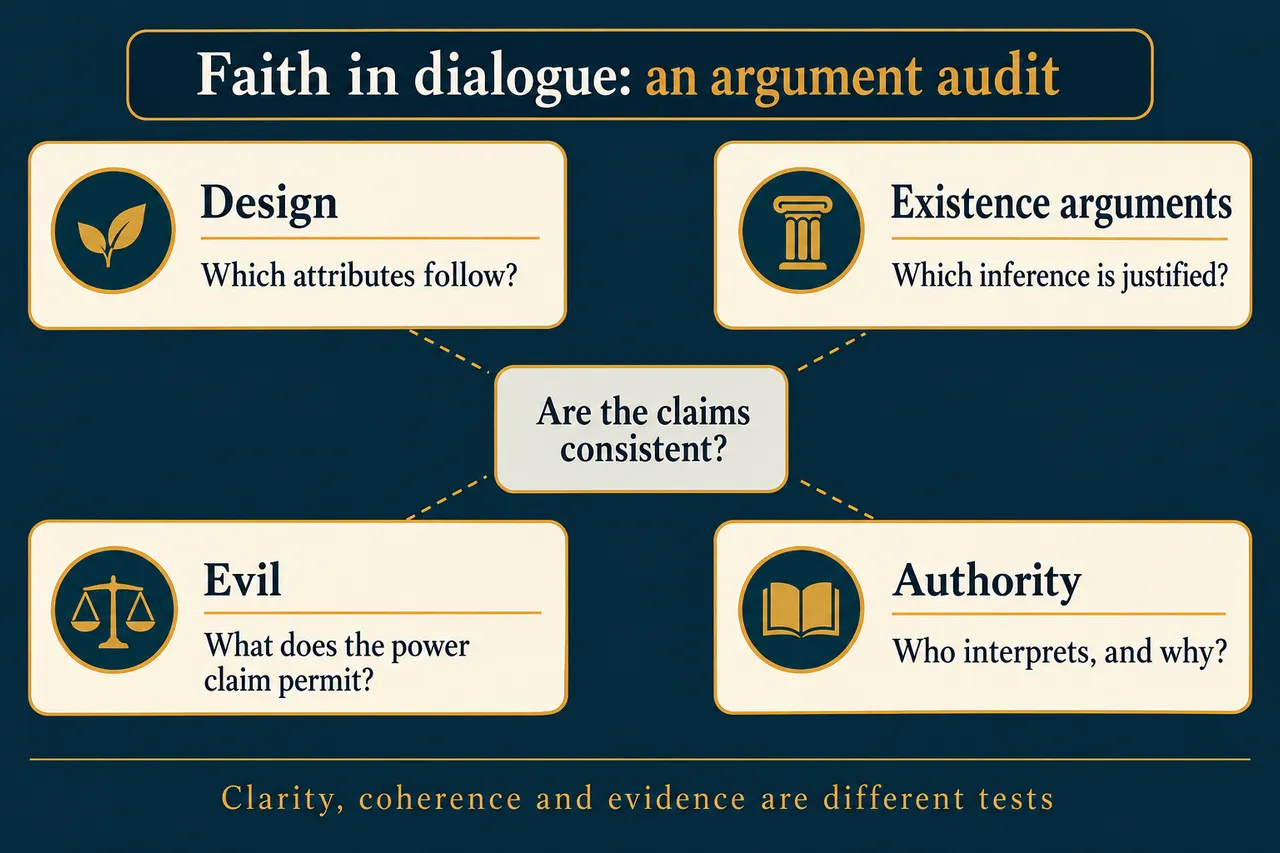
Original myAudience educational illustration. Image: illustration, not a documentary photograph. · myAudience educational illustration; no affiliation with any awarding body.
Faith in dialogue with philosophical criticism
Dialogue requires connected reasoning, not a list of names attached to a conclusion. A philosophical challenge can lead a Christian thinker to clarify a belief, reject a proposed defence or revise an interpretation. Conversely, a theological commitment can shape which philosophical questions and standards matter. The concept map shows possible argumentative relationships, not evidence that a particular discussion has improved society. Its arrows are conditional links to examine; they do not report measured influence or establish that all Christians respond in the same way.
Begin with three different tests. Coherence asks whether beliefs fit together without contradiction; reasonableness asks whether accepting them has defensible grounds; meaningfulness asks what their statements convey and to whom. Passing one test does not automatically pass the others. A fictional story can be internally coherent without being factual. A meaningful claim can be false. An interpretation may have reasons in its favour yet contain an unresolved tension. A dialogue answer should identify the test used instead of treating the word rational as a substitute for explanation.
Design illustrates a restricted contribution. Paley's comparison offers an explanatory proposal about organised function, while Hume-style criticism questions the analogy and inferred attributes. A Christian defender may concede that functional order alone does not establish perfect goodness and therefore seek support elsewhere. This can strengthen intellectual care by restricting an overclaim. However, the additional source must then receive scrutiny. Moving from analogy to scriptural authority changes the grounds of the case; it does not show that the original argument silently established more than its premises warranted.
An ontological debate has a different starting point. Anselm's faith-seeking-understanding context places conceptual reasoning within a religious commitment, while Gaunilo and Kant press the passage to existence. This relationship is neither simply faith being created by proof nor faith being immune to criticism. The argument can clarify what a believer means by necessary or unsurpassable while leaving its inferential success disputed. To show mutual influence, trace how a commitment motivates a question and how an objection constrains a proposed answer, rather than inventing statistics about conversion or public belief.
The problem of evil makes explanatory cost especially visible. Suppose a defender revises omnipotence to mean only a limited capacity to influence events. This could weaken a logical challenge depending on unlimited prevention, but it would also alter the divine power being defended. If the same answer later describes design as the work of an unlimited creator, an inconsistency may return. A revision can be coherent if carried through, yet a critic may judge that it preserves a different belief rather than defending the original one. That is a reasoned dispute, not an automatic victory for either position.
Authority also enters the dialogue. A specified Catholic account connects Scripture, apostolic Tradition and the teaching office; the historic Anglican Articles combine scriptural sufficiency with a constrained interpretive role for the Church. A philosophical objection can ask whether either claimed interpreter is justified. An interpreter can answer by explaining its standards and limits. This reciprocal questioning does not require treating the two positions as identical, nor assuming that an institutional claim proves itself. The Matthew enemy-love case shows that possessing a text and justifying an interpretation are related but different tasks.
Consider an original argument audit. A speaker says that the design analogy proves an unlimited good creator, then answers suffering by denying that the creator could prevent any particular harm. A reviewer should ask what power is asserted in the first claim, what is denied in the second and whether a justified distinction connects them. One consistent answer might limit both claims; another might retain power but provide a distinct reason against intervention. Simply changing wording when challenged leaves the inconsistency unresolved. The exercise assesses premises, not the speaker's personal worth or faith.
The judgement that criticism strengthens Christianity therefore needs a criterion. It may strengthen clarity and disciplined reasoning while undermining confidence in a particular argument. It may support a revised coherent interpretation while challenging the original belief's scope. A warranted answer recognises these different outcomes and explains which matters most. This focused dialogue draws on the prior seven lessons; the full route still requires religious language, experience, miracles, other truth claims and ethical dialogues with their prescribed sources. No eight-lesson slice completes those assessed demands.
Worked example: Philosophical criticism strengthens Christianity more than it undermines it. Evaluate mutual influence with competing reasoned conclusions.
The claim is plausible if strengthens means improving clarity and responsiveness to reasons, but less secure if it means increasing the evidential support for every Christian belief. Criticism can expose a weak defence while helping someone formulate a more precise position. A good evaluation therefore distinguishes intellectual improvement from confirmation of the belief being examined.
The design debate illustrates this distinction. Paley's analogy proposes intelligence as an explanation of organised function. Hume-style criticism asks how far similarities justify conclusions about origin and divine attributes. A defender who acknowledges that perfect goodness does not follow from functional order avoids an overclaim. However, seeking goodness through another source creates a new justificatory task; it does not retroactively complete the analogy.
Anselm supplies a different relation between faith and reasoning. His faith-seeking-understanding setting shows commitment motivating conceptual enquiry. Gaunilo and Kant then constrain the attempted passage from a concept to existence. The dialogue can clarify what necessary existence means even if proof remains disputed. Thus belief shapes the question, while criticism shapes the acceptability of an answer. No conversion rate or uniform Christian response follows from that conceptual relationship.
The strongest counterargument is that better clarity can reveal a serious cost. A defender may answer evil by limiting divine power, but that changes a belief in unlimited power and affects other arguments. The original audit exposes a tension if an unlimited creator is asserted in design and denied when discussing prevention. Resolving it requires a justified distinction or a consistent revision. Improved argument management cannot alone establish that the original claim survives.
Sources of authority face similar questioning. The specified Catholic and Anglican accounts offer different relations between Scripture and interpreters, each with stated constraints. Philosophy asks whether those authorities are justified; their answers may refine or fail to support the proposed interpretation. In the Matthew case, an adequate reading must account for the wording and its application rather than relying entirely on a label for the interpreter.
I therefore accept the claim conditionally: criticism can strengthen reflective Christianity by exposing overclaims, clarifying connections and requiring consistent reasons. It can also undermine a particular proof or interpretation, especially if the revision abandons a central commitment. Which effect predominates depends on the belief and standard assessed. A defensible contrary judgement would explain why the losses to justification outweigh gains in clarity, rather than treating criticism itself as either hostility or guaranteed support.
Answer: An evaluated model, not a unique mandatory verdict. Credit faithful reconstruction, explicit objections and replies, justified limits and defensible alternatives.
Check your understanding: In the original audit, how would changing divine power affect both the evil response and the design conclusion? Explain the cost of one consistent revision.
Answer: Limiting power may reduce the claimed ability to prevent harms, but the design conclusion can no longer assert unlimited power without a further distinction. Carrying the limit through both claims improves consistency while changing the original divine-attribute claim. Alternatively the defender can retain power and justify a reason against intervention; that requires separate reasoning. Neither revision automatically proves the explanation true or completes the evidential response.
Why: Identify the precise premise or interpretive distinction, apply it to the supplied example, and explain both what follows and what remains unestablished.