Complex arithmetic and the real-coefficient condition
By UK A Level Further Mathematics · independent study · myAudience
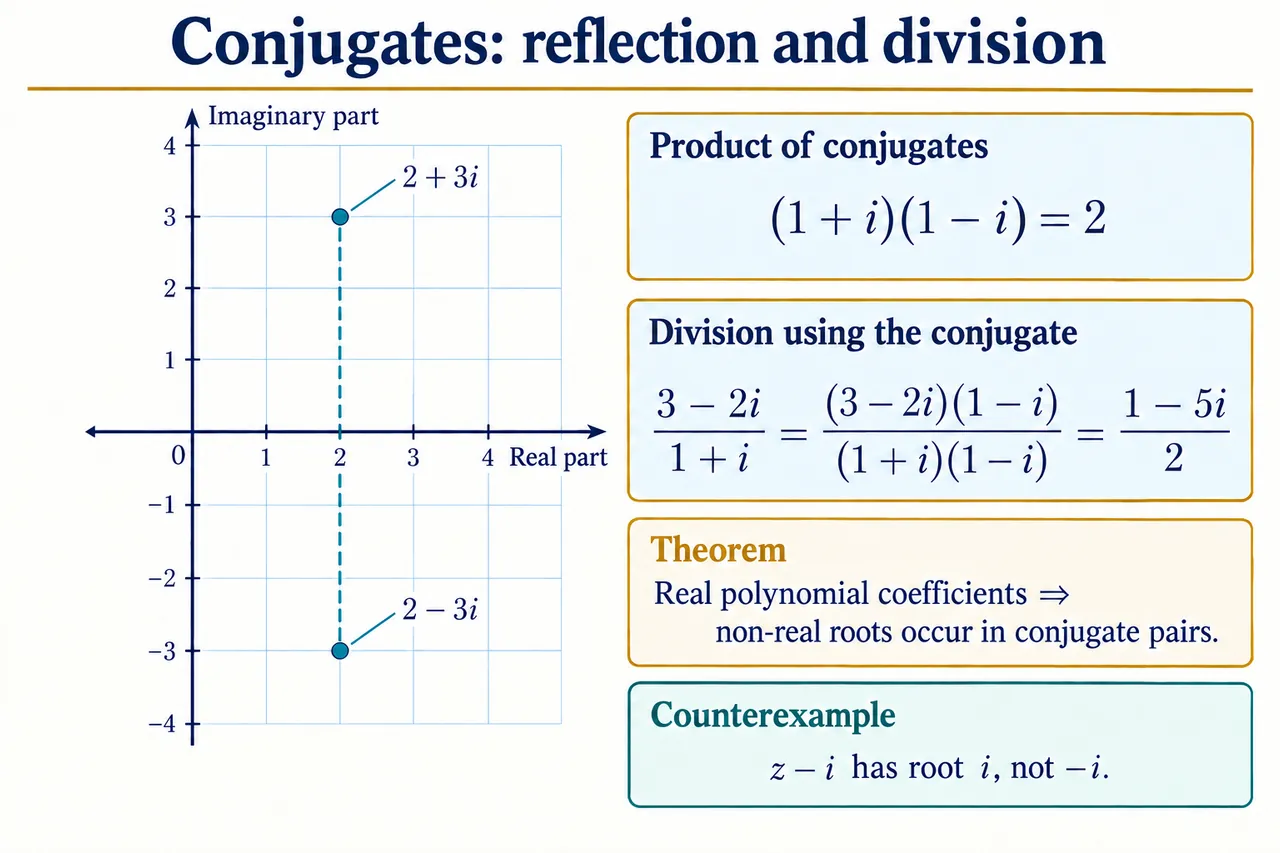
Image: illustration, not a documentary photograph. Exact relationships follow the algebra; rendered diagram positions are illustrative. · Original generated project artwork; no source textbook or exam-board figures reused.
Complex arithmetic and the real-coefficient condition
The equation i²=−1 extends real arithmetic consistently to numbers a+bi with real a and b. Addition combines corresponding real and imaginary parts, while multiplication expands distributively and replaces i² with −1. The imaginary part of a+bi is the real number b; the imaginary term is bi. Confusing those terms makes later statements about coordinates and polynomial coefficients ambiguous. Complex numbers have exact algebraic meaning even when they are represented as points on a plane.
The conjugate of a+bi is a−bi. Their product is a²+b², a nonnegative real number that vanishes only when both parts are zero. This identity explains division: multiply numerator and denominator by the denominator’s conjugate, provided the denominator is nonzero. Multiplying only the denominator would change the quotient. The calculation is not merely a mnemonic for “changing a sign”; it follows from the difference-of-squares structure and the definition of i.
A negative real quadratic discriminant no longer means that there are no roots at all. It means that there are no real roots. Completing the square or the quadratic formula supplies complex roots, and every obtained root should be checked in the original polynomial. For a real-coefficient quadratic these roots form a conjugate pair. A repeated real root is allowed, and the conjugate-pair statement applies to non-real roots rather than demanding two distinct partners for every real root.
The real-coefficient condition is essential. Conjugation distributes over addition and multiplication, and leaves real coefficients unchanged, so conjugating f(z)=0 produces f(conjugate z)=0. With non-real coefficients, that final equality need not hold for the same polynomial. The polynomial z−i is a simple counterexample: it has root i but not −i. The theorem concerns algebraic structure, not an aesthetic preference for symmetry in drawings.
For a cubic or quartic, this foundation slice assumes enough supplied factor information to reduce the problem; it does not claim a general radical-solving algorithm. Once a real linear factor is identified, polynomial division or coefficient comparison can leave a quadratic whose roots are found exactly. Count multiplicities and verify the full solution set. A cubic with one real root and one non-real conjugate pair has three roots over the complex numbers, even though only one appears on a real-axis graph.
Solve z²−4z+13=0 and explain precisely why the roots occur as a conjugate pair. Show how conjugation makes division by 1+i possible. Completing the square gives (z−2)²+9=0, so (z−2)²=−9 and z=2±3i. Substituting 2+3i yields (−5+12i)−(8+12i)+13=0; its conjugate works similarly. The pair is not an accident of this example. For a polynomial with real coefficients, conjugating each term of f(z) gives f(conjugate z). If f(z)=0, its conjugate is still 0, so the conjugate input is also a root. The real-coefficient hypothesis matters: z−i has root i but not −i. For division, multiply numerator and denominator by the denominator’s conjugate. Since (1+i)(1−i)=2, the denominator becomes a nonzero real number. For example,(3−2i)/(1+i)=(3−2i)(1−i)/2=(1−5i)/2. The answer is 1/2−(5/2)i. The imaginary part is −5/2, not −(5/2)i; the latter is the imaginary term. Conjugating is valid here because the denominator is not zero. It does not mean conjugation changes the value of just the denominator: the same nonzero multiplier must appear above and below. Exact arithmetic makes these mechanisms visible; a rounded calculator display can check but does not replace the algebra or explain why the root-pair theorem has a restricted scope.
Given that z=2 is a root of z³+z−10, solve it completely and check the conjugate-pair condition. z³+z−10=(z−2)(z²+2z+5). The quadratic is (z+1)²+4, hence remaining roots −1±2i. All three are 2,−1+2i,−1−2i. Their sum 0 agrees with the absent z² term. Real coefficients justify the non-real pair; the supplied real root allows an informed factorisation.
The conjugate-root plate must place 2+3i and 2−3i at the same real coordinate with opposite imaginary coordinates. Reflection across the real axis visualises conjugation for this polynomial, not a universal guarantee for complex coefficients. A further counterexample is f(z)=z²−i: conjugating its coefficients produces a different polynomial. The divisor panel shows conjugate factors producing a real nonzero denominator. Notice that both numerator and denominator are multiplied, so the quotient is preserved.
Worked example: Solve z²−4z+13=0 and explain precisely why the roots occur as a conjugate pair. Show how conjugation makes division by 1+i possible.
Complete the square: (z−2)²=−9, giving z=2±3i.
Substitute either root into z²−4z+13 to check it.
For real coefficients, conjugating f(z)=0 gives f(conjugate z)=0.
For division, multiply both numerator and denominator by 1−i; the denominator is 2.
Answer: The quadratic roots are 2±3i. Real coefficients justify conjugation; division by 1+i uses its conjugate and requires a nonzero denominator.
Check your understanding: Given that z=2 is a root of z³+z−10, solve it completely and check the conjugate-pair condition.
Answer: z³+z−10=(z−2)(z²+2z+5). The quadratic is (z+1)²+4, hence remaining roots −1±2i. All three are 2,−1+2i,−1−2i. Their sum 0 agrees with the absent z² term. Real coefficients justify the non-real pair; the supplied real root allows an informed factorisation.
Why: Credit exact equivalent derivations with the stated hypotheses, complete candidates and justified restrictions; a correct final value alone does not establish the full reasoning.