Arguments, quadrants and geometric conditions
By UK A Level Further Mathematics · independent study · myAudience
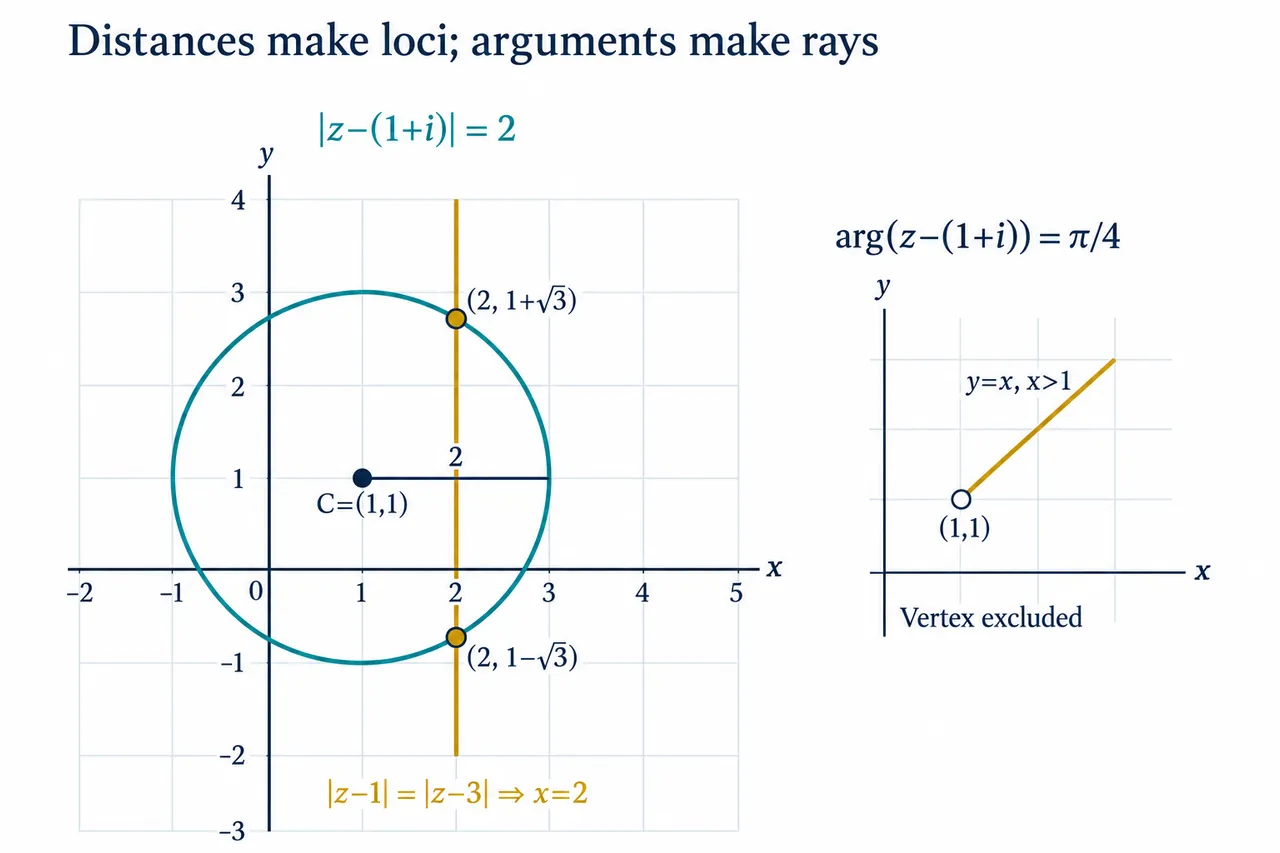
Image: illustration, not a documentary photograph. Exact relationships follow the algebra; rendered diagram positions are illustrative. · Original generated project artwork; no source textbook or exam-board figures reused.
Arguments, quadrants and geometric conditions
An Argand diagram puts the real part on a horizontal axis and the imaginary part on a vertical axis. A complex number can be read as a point or as its displacement vector from the origin, depending on the operation being interpreted. Adding complex numbers adds those displacement vectors; subtracting two points gives the displacement between them. Equal numerical scales on both axes are required if a drawn distance or angle is to match the algebra.
The modulus is Euclidean distance from the origin. For x+iy it is √(x²+y²), whereas an argument specifies direction. A tangent ratio alone does not identify the quadrant: points on opposite rays have the same ratio y/x. Choose an argument using both coordinate signs, and state a principal-argument convention if one is needed. Other valid arguments differ by 2π. Zero has no direction, so assigning it an argument merely because a calculator returns a value is invalid.
Multiplication in modulus–argument form multiplies lengths and adds angles; division divides lengths and subtracts angles when the denominator is nonzero. A result outside the chosen principal range must be wrapped by a multiple of 2π. The argument of a product is therefore equal to the sum modulo 2π, not necessarily as two literal principal values. Cartesian multiplication gives an independent coordinate check when a quadrant decision is uncertain.
The expression |z−a| is the distance from the point z to the fixed point a, not the distance from the origin unless a=0. Constant distance makes a circle; equal distance from two distinct points makes their perpendicular bisector. Squaring both nonnegative distances is reversible and leads to a Cartesian equation. This is different from squaring an unrestricted signed equation, which can introduce extraneous candidates. Translate the geometry into coordinates before solving intersections.
Argument constraints define directed geometry. The condition arg (z−a)=θ describes the ray from a in the specified direction, excluding a itself because the argument there is undefined. The full straight line also contains the opposite ray, whose argument differs by π. Inequalities may include or exclude circle and sector boundaries, so the distinction between<and≤changes the solution set. A shaded sketch is incomplete unless its boundary and exceptional points are stated.
For z=−√3+i find modulus and a principal argument. Describe |z−(1+i)|=2 and |z−1|=|z−3|; locate their intersections. The modulus of −√3+i is √(3+1)=2. The point lies in quadrant II, so an argument in (−π,π] is 5π/6, not −π/6 from a one-argument arctangent without quadrant correction. Other arguments differ by 2π; the zero complex number has modulus 0 but no direction and therefore no argument. This is a geometric definition, not a convention that assigns zero an arbitrary angle. Writing a general z=x+iy,|z−(1+i)|=2 becomes (x−1)²+(y−1)²=4, a circle centred at (1,1). The equidistance equation is (x−1)²+y²=(x−3)²+y². Cancellation gives 4x=8 and hence x=2, the perpendicular bisector of the two real-axis points. Combining this with the circle gives 1+(y−1)²=4, so the intersections are 2+i(1±√3). This derivation identifies the exact boundary points rather than trusting a sketch’s approximate crossings. A strict inequality would change which boundary is included. An argument condition such as arg (z−(1+i))=π/4 instead describes only the ray y=x with x>1: the opposite ray has a different direction, and the vertex makes the argument undefined. Sketches should display these distinctions, while algebra establishes them.
Find modulus/argument of (−√3+i)(1−i), and explain why the equation arg (z−(1+i))=π/4 is not the whole line y=x. The product is (1−√3)+(1+√3)i. Its modulus is 2√2 and argument 5π/6−π/4=7π/12 in quadrant II. The argument locus requires the displaced vector to point northeast, so y=x and x>1. The centre (1,1) is excluded; southwest points on the same line have angle −3π/4, not π/4.
In the plate, the circle centre is (1,1), its radius is 2 and the vertical bisector is x=2. Locate both intersections above and below y=1; their exact ordinates 1±√3 come from the equations, not a reading of rounded pixels. The separate argument ray has an excluded vertex. Testing the southwest point (0,0) relative to (1,1) gives argument −3π/4, so belonging to the same straight line is insufficient. Accurate boundary language prevents an attractive sketch from concealing an incorrect solution set.
Worked example: For z=−√3+i find modulus and a principal argument. Describe |z−(1+i)|=2 and |z−1|=|z−3|; locate their intersections.
For −√3+i, modulus=√(3+1)=2 and the quadrantII argument is 5π/6.
The distance circle is (x−1)²+(y−1)²=4.
Equidistance from 1 and 3 gives (x−1)²+y²=(x−3)²+y², hence x=2.
Substitute x=2 into the circle: y=1±√3.
Answer: Modulus 2, principal argument 5π/6; circle centre (1,1),radius 2; bisector x=2; intersections 2+i(1±√3).
Check your understanding: Find modulus/argument of (−√3+i)(1−i), and explain why the equation arg (z−(1+i))=π/4 is not the whole line y=x.
Answer: The product is (1−√3)+(1+√3)i. Its modulus is 2√2 and argument 5π/6−π/4=7π/12 in quadrant II. The argument locus requires the displaced vector to point northeast, so y=x and x>1. The centre (1,1) is excluded; southwest points on the same line have angle −3π/4, not π/4.
Why: Credit exact equivalent derivations with the stated hypotheses, complete candidates and justified restrictions; a correct final value alone does not establish the full reasoning.