Powers, roots and regular polygons
By UK A Level Further Mathematics · independent study · myAudience
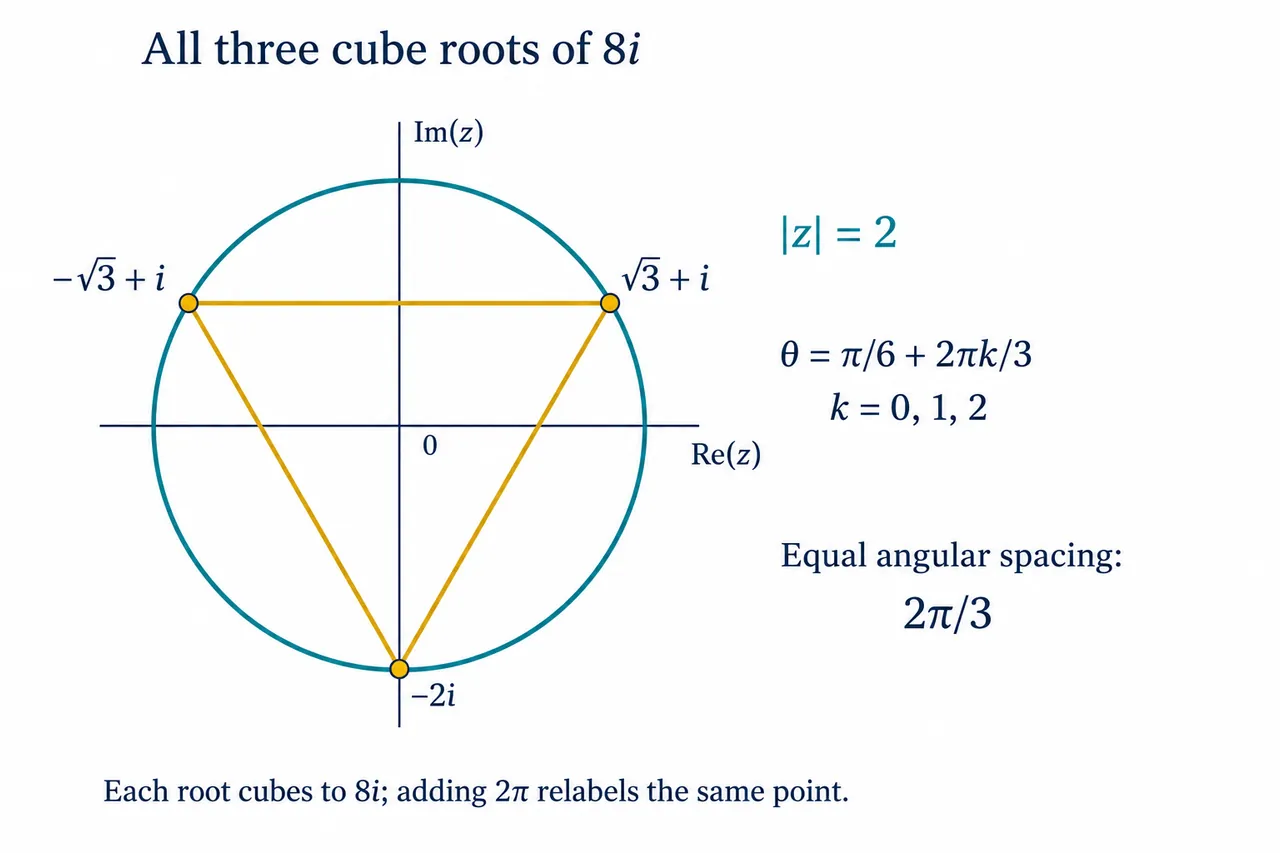
Image: illustration, not a documentary photograph. Exact relationships follow the algebra; rendered diagram positions are illustrative. · Original generated project artwork; no source textbook or exam-board figures reused.
Powers, roots and regular polygons
The form z=r exp (iθ) encodes modulus r and direction θ through exp (iθ)=cosθ+i sinθ. Here r is nonnegative and angle descriptions differing by 2π give the same number. Multiplication follows angle addition, so positive integer powers have modulus r^n and angle nθ. The notation is useful because it keeps two mechanisms separate: magnitude grows multiplicatively and direction changes additively. It is not a claim that imaginary values are physical rotations in every application.
De Moivre’s identity can be justified by repeated use of the trigonometric angle-addition formulae or by an induction using those formulae. It says (cosθ+i sinθ)^n=cos (nθ)+i sin (nθ) for integer n in the appropriate domain. Negative powers additionally require a nonzero complex number. Later multiple-angle and finite-series applications need their own derivations; solving a small root example does not close all of that assessed demand.
To find all nth roots of a nonzero number R exp (iα), choose radius R^(1/n) and solve nθ=α+2πk. The values k=0,…,n−1 give distinct points spaced by 2π/n; other integer k repeat those points. A principal root is one selected value, not the complete solution set of the polynomial equation. Zero is a separate case: z^n=0 has the single value 0 with algebraic multiplicity n, not n distinct polygon vertices.
A regular-polygon drawing follows from equal modulus and equal angular separation. Check both before calling a plotted shape regular. Equal angles on stretched coordinate axes may look wrong, and a perspective illustration cannot provide calibrated complex-plane lengths. The sum of symmetrically spaced roots can often be checked geometrically, while products and polynomial coefficients provide a separate algebraic consistency test. Agreement between methods is useful; neither should be based solely on the appearance of a sketch.
An error involving arguments can produce plausible-looking but wrong answers. Dividing only the displayed principal angle by n gives one root and misses the shifts 2πk/n. Adding 2π to that already divided angle merely relabels the same root; the next distinct root is obtained by adding 2π/n. Verify every candidate by taking its nth power. This catches both incorrect modulus scaling and missing or duplicated roots without relying on a rounded angle display.
Solve z³=8i, give all roots in Cartesian form, and explain their spacing and why three labels of the same point do not count as three roots. Write 8i=8exp(iπ/2). A cube root has modulus 2 and an angle satisfying 3θ=π/2+2πk. Thus θ=π/6+2πk/3. Taking k=0,1,2 gives the distinct roots √3+i,−√3+i and −2i. Their arguments are π/6,5π/6 and 3π/2; the final angle can equally be written −π/2. Taking k=3 reproduces the first point because adding 2π does not change a complex number. The n roots for a nonzero radicand are distinct points, not infinitely many angle labels. Each root has cube modulus 8, and tripling each displayed argument gives π/2 modulo 2π, which verifies the equation. The three roots sum to 0; their real parts cancel and their imaginary parts 1+1−2 cancel. They are vertices of an equilateral triangle centred at the origin, since adjacent arguments differ by 2π/3 at the same radius. A diagram must retain equal axis scale for that shape claim. The product is 8i: multiplying the first two gives −4, then multiplying by −2i gives 8i, agreeing with the constant-term relationship for z³−8i. De Moivre’s rule follows from angle addition under multiplication. It explains both powers and roots, but computing one calculator principal root does not recover the full polynomial solution set.
Solve z⁴=−16 and distinguish the four roots from four choices of argument for one root. The modulus is 2 and arguments are π/4+kπ/2 for k=0,1,2,3. Cartesian roots are √2+i√2,−√2+i√2,−√2−i√2,√2−i√2. They are distinct square vertices. Adding 2π to one argument returns the same root, whereas adding π/2 produces the next root. Fourth powers have modulus 16 and argument π modulo 2π.
The roots-of 8i plate needs equal Cartesian scales and three points at radius 2, with angle differences 2π/3. Each point’s cube lands at the same complex number. The drawing labels distinct roots, whereas adding a full turn merely changes an argument label. A final boundary case is z³=0: the only root is 0, so the nonzero-radicand hypothesis behind the regular-polygon result is essential. The later demands involving multiple-angle identities and sums of series remain open rather than being implied by one correctly solved triangle.
Worked example: Solve z³=8i, give all roots in Cartesian form, and explain their spacing and why three labels of the same point do not count as three roots.
Write 8i=8exp(iπ/2), so each root has modulus 2.
Set 3θ=π/2+2πk; use k=0,1,2 for distinct roots.
Convert angles π/6,5π/6,3π/2 into √3+i,−√3+i,−2i.
Check cubes, zero root-sum and product 8i; k=3 repeats k=0.
Answer: All roots are √3+i,−√3+i and −2i. They have radius 2 and distinct argument spacing 2π/3.
Check your understanding: Solve z⁴=−16 and distinguish the four roots from four choices of argument for one root.
Answer: The modulus is 2 and arguments are π/4+kπ/2 for k=0,1,2,3. Cartesian roots are √2+i√2,−√2+i√2,−√2−i√2,√2−i√2. They are distinct square vertices. Adding 2π to one argument returns the same root, whereas adding π/2 produces the next root. Fourth powers have modulus 16 and argument π modulo 2π.
Why: Credit exact equivalent derivations with the stated hypotheses, complete candidates and justified restrictions; a correct final value alone does not establish the full reasoning.