Composition order and fixed geometry
By UK A Level Further Mathematics · independent study · myAudience
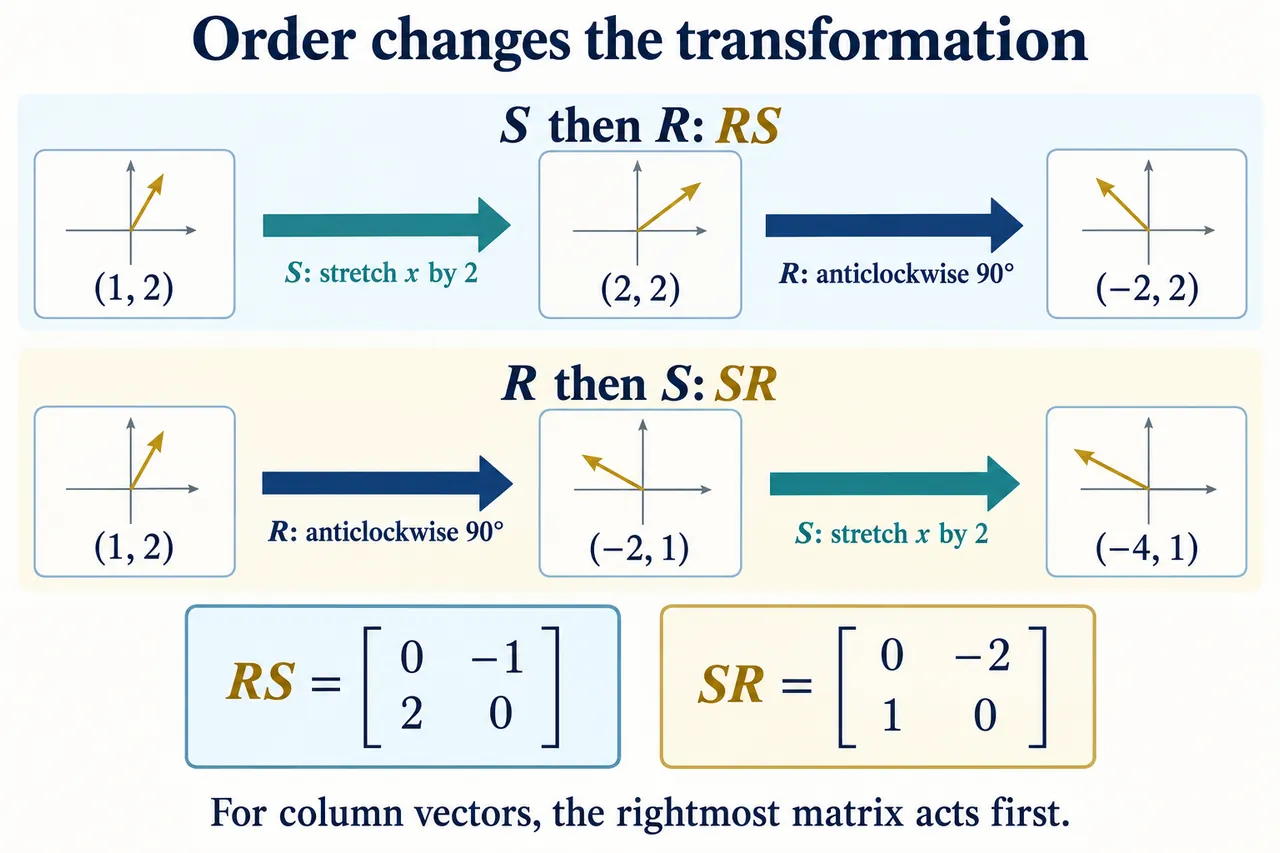
Image: illustration, not a documentary photograph. Exact relationships follow the algebra; rendered diagram positions are illustrative. · Original generated project artwork; no source textbook or exam-board figures reused.
Composition order and fixed geometry
A linear transformation preserves vector addition and scalar multiplication. Its matrix columns are the images of the coordinate basis vectors, so a transformation matrix can be derived from how it acts rather than guessed from a picture. A translation with nonzero displacement is not represented by an ordinary 2×2 linear matrix acting on (x,y), because it does not fix the origin. This lesson keeps origin-centred rotations, reflections and stretches distinct from affine extensions.
For column vectors, the rightmost matrix in a product acts first. A rotation followed by an axial stretch is therefore written SR when R is the rotation and S the stretch. Reversing the matrices reverses the physical order. This convention follows from A(Bv)=(AB)v, not from a linguistic trick about reading backwards. Label each intermediate vector and calculate it directly when interpreting a diagram of successive transformations.
Conformability controls which products exist. The number of columns in the left matrix must equal the number of rows in the right matrix. Even where both AB and BA exist and are square, they need not be equal. Associativity allows grouping of three products, whereas commutativity would allow swapping factors; these are different properties. A single counterexample refutes a universal commutativity claim, but one successful commuting pair does not establish the general rule.
An invariant point returns to itself. An invariant line is mapped to that same line as a set, which does not require its individual points to remain fixed. A reflection fixes points on its mirror line and can preserve the perpendicular line by reversing its points through the origin. State which notion is intended before solving equations. For fixed points solve Av=v; for a preserved line inspect the entire line’s images or derive its transformed equation.
Transformations can share one fixed point without being the same map. Every ordinary linear map fixes the origin, so testing only (0,0) is an ineffective comparison. Images of two independent basis vectors determine a 2D linear map, while one vector can already show that two candidate matrices differ. A diagram should preserve consistent axis scaling and show actual intermediate coordinates; decorative arrows cannot substitute for the numerical effect of each operation.
With R=[[0,−1],[1,0]] and S=[[2,0],[0,1]], compare RS and SR on (1,2). Explain which operation happens first. RS=[[0,−1],[2,0]], while SR=[[0,−2],[1,0]]. Acting on the column vector (1,2), RS gives (−2,2), whereas SR gives (−4,1). In RS the rightmost map S acts first: it sends (1,2) to (2,2), and the anticlockwise quarter-turn then sends this to (−2,2). In SR rotation first gives (−2,1), after which the x-stretch doubles its first coordinate to (−4,1). The same named operations in different orders therefore yield different answers. Transformation columns are the images of the basis vectors, so the matrix convention is derived rather than memorised as an unexplained reversal. Multiplication associates but does not generally commute. The counterexample is decisive because equality of matrices would require equality on every vector, and here one vector already produces unequal results. For F=[[1,0],[0,−1]], reflecting in the x-axis, RF=[[0,1],[1,0]] is reflection in y=x; reversing the order yields FR=[[0,−1],[−1,0]], reflection in y=−x. Under RF each point on y=x is fixed, whereas the line y=−x is preserved as a set but its nonzero points change to their negatives. Calling both lines fixed would confuse pointwise invariance with line invariance. The origin is fixed by both compositions, so checking only the origin would not distinguish the transformations.
For F as above, show why RF and FR are different reflections. Find fixed points of RF and give a preserved line with non fixed points. RF sends (x,y) to (y,x), so fixed points satisfy x=y. FR sends (x,y) to (−y,−x), fixing x=−y instead. Under RF, points (t,−t) become (−t,t), still on y=−x but different unless t=0. Thus y=−x is an invariant line as a set, not a line of individually fixed points.
The transformation plate shows two coordinate journeys from the same starting vector. Follow the intermediate point as well as the final label: S then R gives (−2,2), while R then S gives (−4,1). If the two final points coincide in an illustration, that artwork has contradicted the model and cannot be accepted. The reflection transfer further distinguishes a fixed mirror line from a line preserved only as a set. This bounded 2D comparison does not demonstrate every 3D rotation or the full invariant-line requirement.
Worked example: With R=[[0,−1],[1,0]] and S=[[2,0],[0,1]], compare RS and SR on (1,2). Explain which operation happens first.
Compute RS=[[0,−1],[2,0]] and SR=[[0,−2],[1,0]].
S then R: (1,2)→(2,2)→(−2,2).
R then S: (1,2)→(−2,1)→(−4,1).
Unequal results on one permitted vector disprove matrix commutativity.
Answer: RS (1,2)=(−2,2), while SR (1,2)=(−4,1); the rightmost matrix acts first on a column vector.
Check your understanding: For F as above, show why RF and FR are different reflections. Find fixed points of RF and give a preserved line with non fixed points.
Answer: RF sends (x,y) to (y,x), so fixed points satisfy x=y. FR sends (x,y) to (−y,−x), fixing x=−y instead. Under RF, points (t,−t) become (−t,t), still on y=−x but different unless t=0. Thus y=−x is an invariant line as a set, not a line of individually fixed points.
Why: Credit exact equivalent derivations with the stated hypotheses, complete candidates and justified restrictions; a correct final value alone does not establish the full reasoning.