Area, orientation and when inversion fails
By UK A Level Further Mathematics · independent study · myAudience
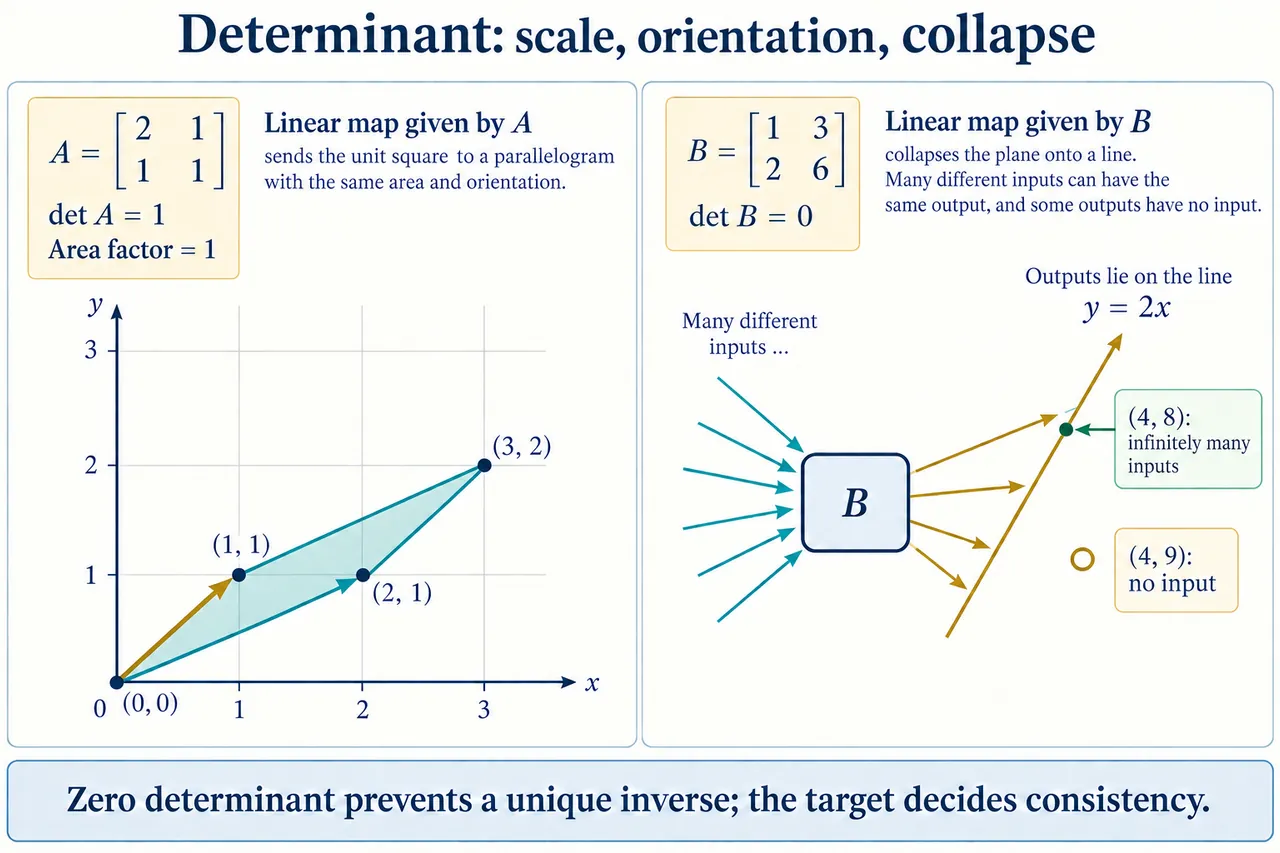
Image: illustration, not a documentary photograph. Exact relationships follow the algebra; rendered diagram positions are illustrative. · Original generated project artwork; no source textbook or exam-board figures reused.
Area, orientation and when inversion fails
The determinant connects algebraic invertibility with geometric scale. For [[a,b],[c,d]], it is ad −bc, the signed area of the parallelogram formed by the two image basis vectors. Absolute value gives the area factor; sign indicates whether orientation is preserved or reversed. A negative determinant is not a negative physical area. Determinant 1 does not guarantee preserved lengths or right angles, since many shears preserve area but change shape.
A nonzero determinant means the transformed basis vectors remain independent, so the map has a unique inverse on the whole plane. Solving for that inverse yields (1/det)[[d,−b],[−c,a]]. The formula must not be applied at det=0. Verification by multiplication checks that both products give the identity. Calculator inversion may assist arithmetic but does not explain why a singular matrix fails or what its target-dependent solution sets look like.
A singular matrix collapses some nonzero displacement to zero. Distinct inputs can then have the same output. Its range may be a line or, for a zero matrix, a single point, so not every target is reachable. A reachable target can have infinitely many preimages; an unreachable target has none. Thus “singular means no solutions” confuses inability to obtain a unique solution for every right-hand side with actual inconsistency of one particular system.
A parameterised determinant can locate where the geometry changes. For B=[[1,t],[2,6]], det B=6−2t. At t=3 the second row is twice the first; changing the right-hand side decides whether the same dependency is respected. On either side of 3 the area factor is nonzero, but the sign changes across the collapse. Near a singular parameter, inverse entries may be large: rounding then deserves special care, although this lesson does not claim a complete condition-number analysis.
Exact substitution is an important check when a result has been obtained from an inverse. It verifies the actual original equations rather than merely reproducing a computation on a calculator. Distinguish the matrix’s properties from the target vector’s information: determinant is determined by coefficients, consistency of a singular system depends on its right-hand side, and a solution must satisfy both. Higher-dimensional determinants and orientation need further taught examples beyond this bounded 2D foundation.
For A=[[2,1],[1,1]], find A⁻¹ and solve A(x,y)=(7,4). Explain what the determinant tells us and what it does not. The determinant is 2·1−1·1=1. The inverse is therefore [[1,−1],[−1,2]], since multiplying it by A gives the identity. Applied to (7,4), it gives (3,1). Substitution checks 2·3+1=7 and 3+1=4, so the answer satisfies the original equations. The determinant being nonzero establishes unique invertibility; the solved coordinates are not justified merely by displaying an inverse formula without checking the right-hand side. Geometrically the transformed basis vectors are (2,1) and (1,1), enclosing signed area 1. Absolute determinant gives the area scale, while its sign records orientation. Det=1 does not make A the identity or an isometry: lengths and angles can change even though area and orientation are preserved. Consider B=[[1,t],[2,6]]. Its determinant 6−2t becomes zero at t=3. Then both output equations depend on the same linear combination x+3y. For output (4,8), every point satisfying x+3y=4 is a solution; for output (4,9), the second equation contradicts twice the first. Hence singular does not mean no solutions: it means an inverse cannot yield a unique solution for every target. On opposite sides of t=3 the determinant signs differ, so the orientation reverses, but the exact singular case collapses the plane onto a line. A diagram must distinguish that dimensional collapse from ordinary shrinking.
Analyse B at t=2,3,4. For t=3 classify targets (4,8) and (4,9), and explain why dividing by determinant at t=3 is invalid. Determinants are 2,0,−2 respectively: equal area factors 2 at t=2/4 with opposite orientation, and collapse at 3. At 3 the first target gives the line x+3y=4 of solutions; the second demands simultaneously 2x+6y=8 and 9, impossible. The inverse formula divides by 0 at 3 and is undefined, not an approximation to a unique solution.
The determinant plate distinguishes a parallelogram’s unsigned area from its orientation, and then shows a singular map collapsing outputs onto one line. The target marked reachable has infinitely many preimages, while the off-line target has none. A useful counterexample to “area preserved means unchanged” is [[1,2],[0,1]], whose determinant is 1 but sends (0,1) to (2,1). The image illustrates that mechanism; the determinant and exact equations establish it. No claimed pixel length is being used as calibrated numerical evidence.
Worked example: For A=[[2,1],[1,1]], find A⁻¹ and solve A(x,y)=(7,4). Explain what the determinant tells us and what it does not.
det A=2·1−1·1=1, so A is invertible.
A⁻¹=[[1,−1],[−1,2]], checked by multiplication.
A⁻¹(7,4)=(3,1); substitute into both originals.
The signed determinant gives orientation; its absolute value gives area factor, not length preservation.
Answer: A⁻¹=[[1,−1],[−1,2]] and (x,y)=(3,1). Determinant 1 gives signed area factor 1, not an identity or isometry.
Check your understanding: Analyse B at t=2,3,4. For t=3 classify targets (4,8) and (4,9), and explain why dividing by determinant at t=3 is invalid.
Answer: Determinants are 2,0,−2 respectively: equal area factors 2 at t=2/4 with opposite orientation, and collapse at 3. At 3 the first target gives the line x+3y=4 of solutions; the second demands simultaneously 2x+6y=8 and 9, impossible. The inverse formula divides by 0 at 3 and is undefined, not an approximation to a unique solution.
Why: Credit exact equivalent derivations with the stated hypotheses, complete candidates and justified restrictions; a correct final value alone does not establish the full reasoning.