Three planes: a point, a line or no meeting
By UK A Level Further Mathematics · independent study · myAudience
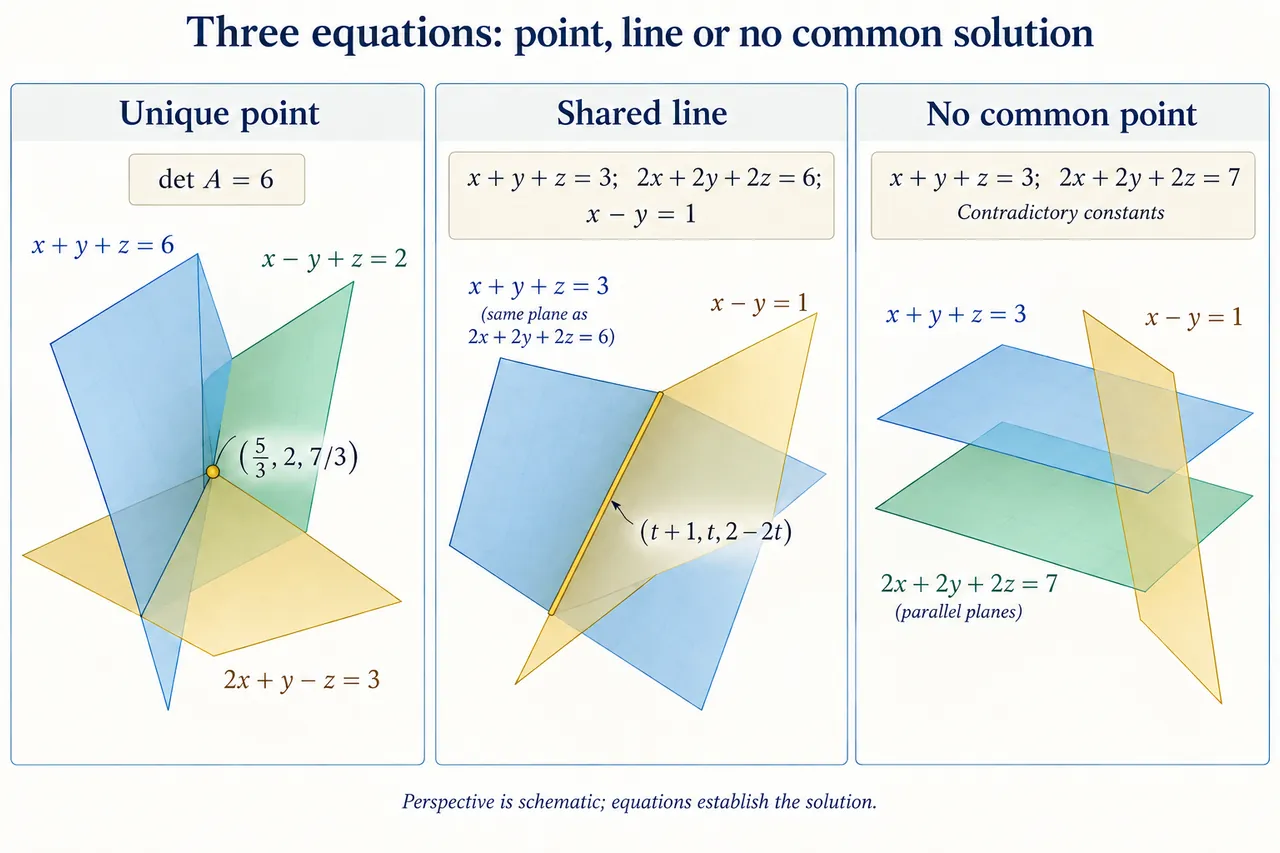
Image: illustration, not a documentary photograph. Exact relationships follow the algebra; rendered diagram positions are illustrative. · Original generated project artwork; no source textbook or exam-board figures reused.
Three planes: a point, a line or no meeting
A plane in three-dimensional space is described by one nontrivial linear equation ax+by+cz=d. Three such equations can be assembled into a coefficient matrix and an ordered right-hand-side column. Column order must stay x,y,z throughout: swapping a column without changing the meaning of the corresponding coordinate can generate a numerically neat but irrelevant answer. A row operation on an equation must also act on its right-hand side.
If the 3×3 coefficient matrix is invertible, the system has exactly one solution for every right-hand side. Multiplying by its inverse is legitimate, but elimination explains how the equations constrain coordinates and gives an independent route to check the result. An inverse printed by a calculator still needs the correct entered coefficients and targets. Fractions should be retained until the exact solution has been substituted into each original equation.
The geometric interpretation depends on consistency as well as rank. Three planes may meet at one point, share a line, coincide or fail to have a common intersection. Zero determinant rules out a universally unique inverse but does not distinguish all these cases. Identifying that one equation is a multiple of another is a statement about coefficients; whether the constants have that same multiple decides if the planes coincide or are distinct and parallel.
In a dependent but consistent system, a free parameter describes infinitely many solutions. Its value is not a measurement error or an unanswered arithmetic step: it represents genuine geometric freedom along a line or plane. Substituting the parameterised point into every original equation verifies the entire family. Checking only one chosen parameter would establish one solution but not that the full claimed family satisfies the system.
An inconsistent system produces a contradiction such as 0=1. That conclusion cannot be repaired by changing the free parameter or by reading an approximate meeting point from perspective artwork. A sheaf of planes sharing a line is different from three pairwise-intersecting planes with no common point. This slice uses a bounded dependent example and a parallel contradiction; the full prescribed geometric configurations and unfamiliar inverse calculations still require additional depth and assessment.
Solve x+y+z=6, x−y+z=2, 2x+y−z=3 and explain the three-plane interpretation. Verify the answer in all equations. Subtracting the second equation from the first gives 2y=4, hence y=2. The first then gives x+z=4, and the third gives 2x−z=1. Adding these last two yields 3x=5, so x=5/3 and z=7/3. The coefficient matrix has determinant 6, which is nonzero; consequently the system has a unique solution and an inverse representation is valid. Checking the original equations gives 5/3+2+7/3=6,5/3−2+7/3=2 and 10/3+2−7/3=3. These checks test the solution rather than a rewritten equation that might already contain an error. Each equation represents a plane, and here their common intersection is precisely the point (5/3,2,7/3). Nonzero determinant establishes that uniqueness independently of an approximate perspective sketch. Contrast x+y+z=3,2x+2y+2z=6,x−y=1. The second plane is the same as the first, so combining with the third leaves the line (x,y,z)=(t+1,t,2−2t). There are infinitely many common points. If the second right-hand side changes to 7, its plane is parallel and distinct from the first; their contradictory equations rule out any common point before the third plane is considered. Both cases have a singular coefficient matrix. Thus zero determinant alone does not separate infinitely many solutions from inconsistency, and a plausible-looking picture cannot repair contradictory algebra.
Classify the two dependent systems above, give an explicit parameterisation when solutions exist, and explain why the same singular matrix can yield either outcome. With second constant 6, x=t+1,y=t,z=2−2t satisfies all equations for every real t. With second constant 7, doubling the first forces 6 while the second requires 7, so no solution. The coefficient matrix is unchanged and singular in both: the right-hand side determines consistency. Uniqueness requires invertibility; singularity merely prevents that universal conclusion.
The three-plane plate is a perspective schematic: the labelled equations establish the point, line or inconsistency rather than apparent depth on the page. Keep the distinction between coincident planes and distinct parallel planes visible. The model’s fractional point is exact even if the sketch uses schematic positions. To assess an unfamiliar system, first test dependencies and right-hand-side consistency, then choose inverse or elimination when appropriate. A drawing can organise the reasoning but cannot turn inconsistent equations into a real common intersection.
Worked example: Solve x+y+z=6, x−y+z=2, 2x+y−z=3 and explain the three-plane interpretation. Verify the answer in all equations.
Subtract equation 2 from equation 1 to obtain y=2.
The remaining equations are x+z=4 and 2x−z=1.
Add them: 3x=5; hence x=5/3,z=7/3.
The coefficient determinant is 6, and the exact point checks in all three original equations.
Answer: The unique solution is (5/3,2,7/3), since determinant 6 is nonzero and the point satisfies all originals.
Check your understanding: Classify the two dependent systems above, give an explicit parameterisation when solutions exist, and explain why the same singular matrix can yield either outcome.
Answer: With second constant 6, x=t+1,y=t,z=2−2t satisfies all equations for every real t. With second constant 7, doubling the first forces 6 while the second requires 7, so no solution. The coefficient matrix is unchanged and singular in both: the right-hand side determines consistency. Uniqueness requires invertibility; singularity merely prevents that universal conclusion.
Why: Credit exact equivalent derivations with the stated hypotheses, complete candidates and justified restrictions; a correct final value alone does not establish the full reasoning.