Context, register and warranted interpretation
By UK A Level English Language · independent study · myAudience
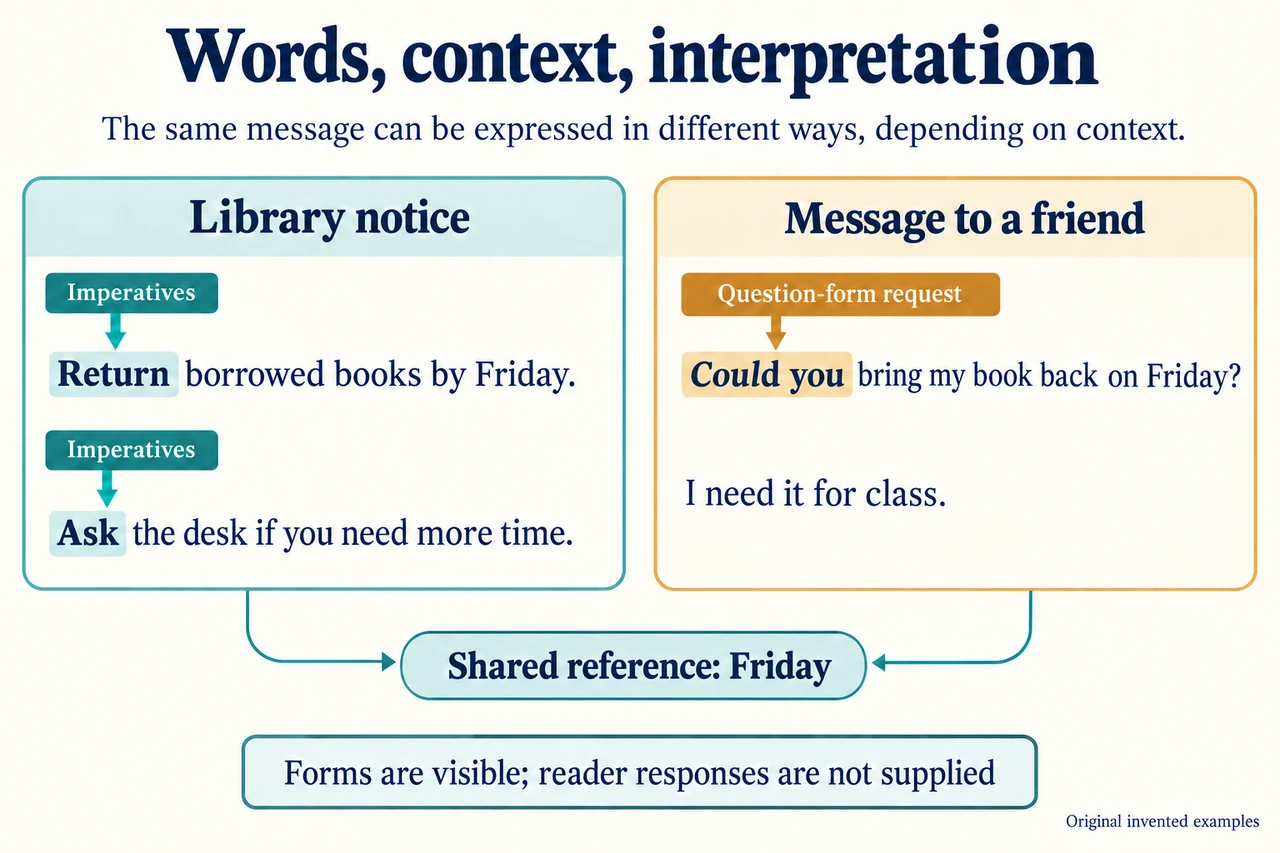
myAudience original rendered educational illustration. Image: illustration, not a documentary photograph. · Original generated educational concept plate; retained generation provenance; no third-party text or logos.
Context, register and warranted interpretation
Language analysis explains how a particular text makes meaning in a particular situation. Start by distinguishing supplied information from your interpretation. If a task identifies a library notice, that institutional setting is given. If you say its writer is angry, you have added an inference that needs evidence. Audience, purpose, genre and mode offer useful questions, but they are not four labels to attach and forget: their relationships help explain choices across the whole text.
Genre concerns recognisable kinds of communication, such as notices or personal messages. Register concerns patterns associated with situations and uses; neither gives every text a single inflexible identity. A notice can both inform and direct, while a personal message can explain and request. Written language may also be conversational. Avoid assuming that all speech is informal or that all electronic communication is identical. Identify the actual resources available and the supplied relationship between participants.
Consider two original invented examples. Library notice: ‘Return borrowed books by Friday. Ask the desk if you need more time.’ Message to a friend: ‘Could you bring my book back on Friday? I need it for class.’ Both concern returning a book and Friday, but they establish different relationships. The notice addresses borrowers as a category; the message supplies a personal need. These are teaching examples, not collected library evidence or an examination source.
The notice begins with two imperative clauses, ‘Return’ and ‘Ask’. The subject you is understood rather than written explicitly. That form can perform an instruction, invitation or request according to context; grammatical form alone does not settle its social effect. Here the second instruction offers a route to discuss extra time. Analyse that provision alongside the deadline instead of isolating one command and declaring the whole notice hostile.
The personal message uses an interrogative construction, ‘Could you’, to make a request. It is not naturally limited to asking whether the friend has the physical ability to transport a book. ‘My’ identifies ownership in relation to the speaker, and the following reason locates the request within a class need. Such choices can make a request negotiable, but we have no reply, audio or participant history. Their actual reception remains unobserved.
A strong analytical paragraph connects exact evidence with a warranted explanation. ‘The notice is bossy because it uses imperatives’ substitutes a judgment for reasoning. A better account identifies the institutional borrowing relationship, explains how the deadline directs an action, and recognises that the extension instruction complicates a purely punitive reading. Terminology supports this argument; listing five devices without explaining their relationship to meaning would not improve it.
Context also sets limits on interpretation. If the same words are spoken privately by a librarian to a colleague, the audience and interaction change even though the clause forms do not. We would need to know what activity they are coordinating. Compare plausible alternatives and specify the evidence that would distinguish them. Do not invent the colleague’s emotions, assume their agreement or treat the institution’s stated purpose as proof of effectiveness.
The illustration highlights the two imperative verbs and the question-form request, then brings the shared Friday reference together. Its lower caption deliberately separates visible forms from missing reader responses. Read it with the complete examples, not as a ranking of rude and polite people. The methodological lesson transfers beyond these short texts: make a claim, locate the evidence, explain the contextual connection, consider an alternative, and conclude at the strength the evidence permits. Image: illustration, not a documentary photograph.
Worked example: Compare the two invented book-return texts without inventing a reader response.
Both invented texts seek a book’s return in relation to Friday, yet their wording organises that request around different social relationships. The library notice treats its audience as borrowers within an institutional arrangement, whereas the personal message presents an individual’s need to a friend. This contextual contrast is more useful than deciding that one text is simply formal and the other informal.
In the notice, ‘Return’ introduces an imperative with an understood second-person subject. It directs the relevant audience towards an action and deadline. However, the next imperative, ‘Ask’, does not merely repeat a prohibition: it tells borrowers where they can discuss needing more time. The conditional clause ‘if you need more time’ makes that possibility explicit. Consequently, the text combines a borrowing requirement with a route for negotiation. Calling all its imperatives hostile would overlook how their functions differ.
The friend’s ‘Could you bring my book back on Friday?’ has interrogative form but functions as a request in the supplied context. The possessive ‘my’ identifies the book through the speaker’s ownership, unlike the notice’s more general category ‘borrowed books’. The following declarative, ‘I need it for class’, gives an individual reason. That reason can support the request by explaining its relevance, although it does not prove that the addressee finds it persuasive.
The shared Friday reference links the examples without making them identical. ‘By Friday’ specifies a latest return point in the notice; ‘on Friday’ identifies the day proposed in the personal request. That distinction may matter when coordinating an actual return. The institutional desk also supplies a contact point that the friend’s message does not need to name. Both are concise, so length alone would provide little basis for a meaningful comparison.
A plausible alternative reading is that the notice feels more accommodating because it explicitly offers extra time, while the friend’s class need feels urgent. We cannot rank those impressions as actual reactions without replies or further context. The strongest conclusion is therefore about how the wording makes different relationships and possibilities available. It explains the forms in context while leaving intention, uptake and effectiveness appropriately open.
Answer: The library notice foregrounds institutional procedure through imperatives and an extension route; the friend message gives a personal reason through a question-form request. Friday is shared, but by Friday permits an earlier return whereas on Friday locates it on that day. Supplied context supports these contrasts without proving intention, politeness or reader response.
Check your understanding: The exact library wording is now spoken privately by a librarian to a colleague. Which observations remain defensible, and which contextual claims need reconsidering?
Answer: The two imperative forms, the Friday deadline and the conditional route for extra time remain visible in the words. The public notice genre and general borrower audience no longer follow from the new setting. A colleague might be helping organise returns, borrowing personally or rehearsing a notice; the task does not choose among these. Reanalyse the interaction using the supplied roles and activity, and ask for missing information where necessary. An imperative does not establish anger, hierarchy or resistance by itself. The change illustrates why an accurate grammatical description can survive while an explanation of its social function needs revision.
Why: A justified answer keeps the supplied linguistic forms and evidence exact, explains alternatives and limits, and does not invent speaker intentions, research outcomes or assessed completion.