Clause structure, voice and represented responsibility
By UK A Level English Language · independent study · myAudience
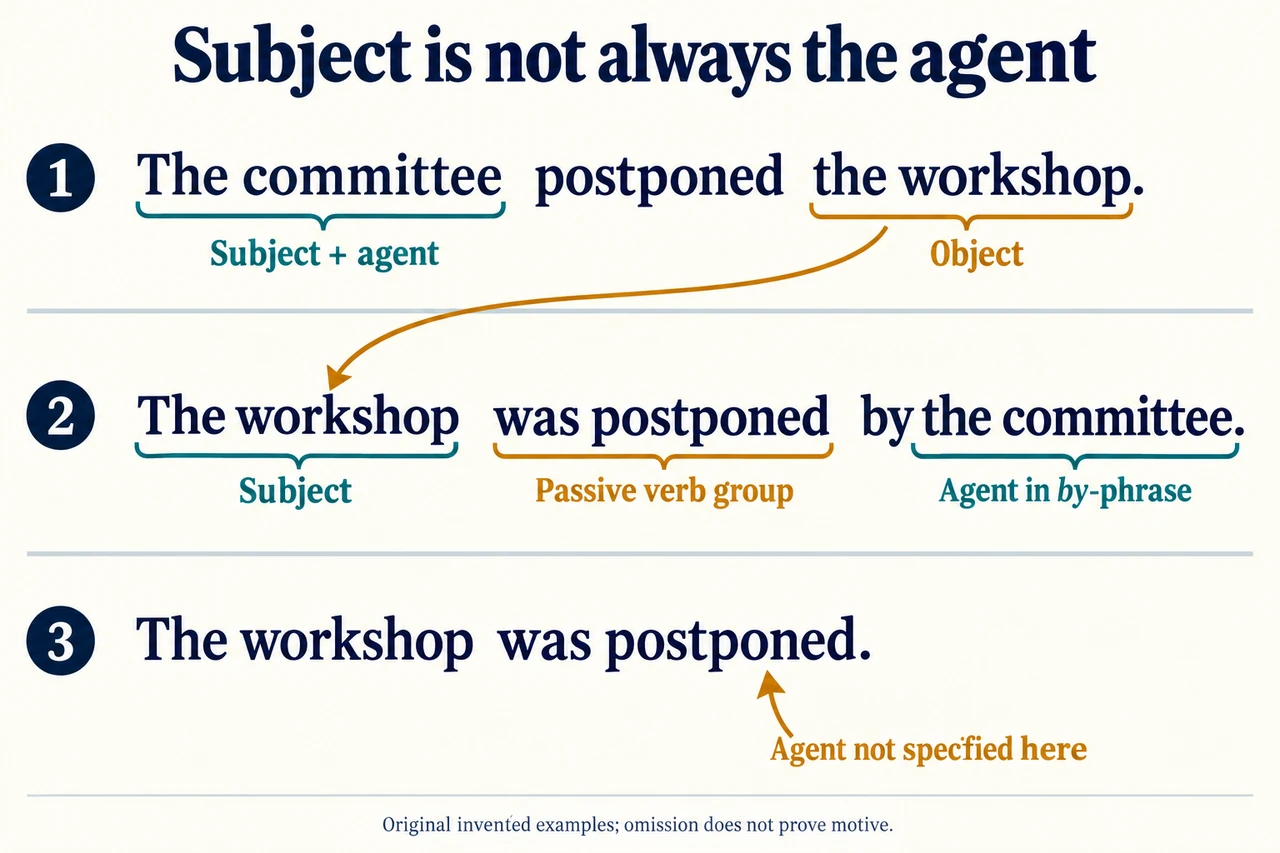
myAudience original rendered educational illustration. Image: illustration, not a documentary photograph. · Original generated educational concept plate; retained generation provenance; no third-party text or logos.
Clause structure, voice and represented responsibility
Grammar allows you to describe relationships inside a sentence rather than attaching impressions to its surface. A word class, such as noun or verb, differs from a grammatical function, such as subject or object. A noun phrase can perform either function. Begin with a specific clause and test how its parts relate. Do not define subject as ‘the person doing the action’ universally: passive clauses and clauses about states show why that shortcut fails.
Our original active clause is ‘The committee postponed the workshop after the inspection.’ ‘The committee’ is the subject noun phrase; ‘postponed’ is the past-tense lexical verb; ‘the workshop’ is the direct object noun phrase. The prepositional phrase ‘after the inspection’ supplies a temporal adjunct. Here the committee is also the agent, the participant responsible for postponing. Subject and agent coincide in this example, but they name different kinds of relationship.
Compare ‘The workshop was postponed by the committee after the inspection.’ The workshop becomes the grammatical subject. ‘Was postponed’ is a passive verb group containing past-tense be and a past participle. The by-phrase identifies the committee as agent. The event can be described while attention starts with the workshop, perhaps because the reader already knows which event is being discussed. In the passive clause, calling the workshop the object would confuse its role with the active version.
Now remove the by-phrase: ‘The workshop was postponed after the inspection.’ The agent is no longer specified within this sentence. It might be known from the surrounding document, unknown to the writer, irrelevant to the immediate purpose, or deliberately omitted. The sentence alone does not discriminate between those explanations. An analytical account should identify the omission before arguing for a motive, and use contextual evidence rather than treating every passive as evasive.
‘The postponement followed the inspection’ packages the event into the noun ‘postponement’. This is nominalisation: a process is expressed as a noun, enabling it to occupy a noun-phrase role in a new clause. The new wording is not a simple word-for-word voice transformation; ‘followed’ describes a chronological relationship. It suppresses who postponed and does not state why. The inspection occurring first cannot, on its own, establish that it caused the postponement.
Information packaging matters at the text level. Repeating ‘the workshop’ as a subject may maintain an established topic, while an active clause may foreground the committee’s decision. Ask what the surrounding text makes salient and what the reader needs. An explicit passive agent can be clearer than an active clause using vague ‘they’. Therefore, grammatical labels identify resources; they do not constitute a universal checklist for honest or dishonest communication.
Try an error analysis: ‘The workshop is the agent because it comes first.’ The conclusion mistakes grammatical position for semantic responsibility. Another error, ‘The inspection caused the postponement because after proves causation’, adds a relationship not asserted by the temporal phrase. Correct both by distinguishing sentence structure, event participants and the evidence required for cause. A demanding analysis explains why an interpretation fails, not merely what the right label is.
The plate carries the workshop from active object to passive subject and labels the retained by-phrase agent separately. Its third row shows only that the agent is unspecified there. This is a schematic comparison of original sentences, not a verdict on a real committee. Read each label against its exact row and use the worked analysis to evaluate possible functions. The wider course still requires more complex clause patterns, morphology and authentic contextual evidence. Image: illustration, not a documentary photograph.
Worked example: Analyse responsibility and information focus in the active, explicit passive and nominalised alternatives.
The three original alternatives organise information differently, but they do not justify a simple ranking from honest active to dishonest passive. Their most defensible contrast concerns grammatical structure, the specification of the agent and the relationships explicitly asserted. Any claim about the committee’s motives would require more context.
In ‘The committee postponed the workshop after the inspection’, the committee is both the grammatical subject and the semantic agent of postponing. ‘The workshop’ is the direct object, while the temporal phrase locates the postponement after another event. This wording identifies responsibility for the action, but it does not say that the inspection caused it. The distinction matters because a chronological sequence is compatible with several causal explanations.
In ‘The workshop was postponed by the committee after the inspection’, the workshop is now the subject. The passive verb group ‘was postponed’ consists of past-tense be and a past participle, and the by-phrase still specifies the committee as agent. Responsibility is therefore not hidden. Starting with the workshop could maintain a topic already established in preceding sentences, allowing the explanation to follow the reader’s existing concern. That is a plausible contextual function, not a proven account of the writer’s intention.
If ‘by the committee’ is removed, the agent becomes unspecified in that sentence. The omission creates a relevant analytical question, but it does not answer it. A preceding sentence may already name the decision-maker; a short timetable notice may prioritise the changed event; alternatively, the omission may reduce accountability. The surrounding document and its purpose would help discriminate between these possibilities.
‘The postponement followed the inspection’ nominalises the action and then describes its sequence through ‘followed’. It lacks an explicit postponing agent and differs from the original voice alternatives: it makes chronology the main clause relationship. Its compactness may be useful in a summary, but a reader seeking responsibility would need additional evidence.
Finally, compare an active ‘They postponed the workshop’ with the explicit passive. Without a supplied referent for ‘they’, the active wording identifies responsibility less precisely than ‘by the committee’. The justified conclusion is that clarity depends on the whole wording and context, not voice alone. An accurate analysis keeps grammatical subject, agent and causal inference distinct.
Answer: The active committee is both grammatical subject and agent; in the passive, workshop is subject while the committee remains agent in the by-phrase. Omitting the agent does not prove concealment, and after the inspection expresses sequence rather than establishing cause. A specific passive by-phrase can identify responsibility more clearly than a vague active they.
Check your understanding: An active report says “They postponed the workshop.” A passive report says “The workshop was postponed by the committee.” With no earlier referent for they, which identifies responsibility more precisely, and what follows about passive voice?
Answer: The explicit passive identifies the committee as the agent more precisely than an active clause with an unresolved ‘they’. The workshop is the passive subject, not the postponing agent. Passive voice can change information focus while retaining responsibility in a by-phrase. This comparison rejects the rule that every passive hides an actor or that every active necessarily clarifies one. It does not prove which writer is more truthful or why either chose that wording. Further context might resolve the pronoun and alter the comparison, so the conclusion is conditional on the specified absence of a referent.
Why: A justified answer keeps the supplied linguistic forms and evidence exact, explains alternatives and limits, and does not invent speaker intentions, research outcomes or assessed completion.