Lexis, semantic framing and modality
By UK A Level English Language · independent study · myAudience
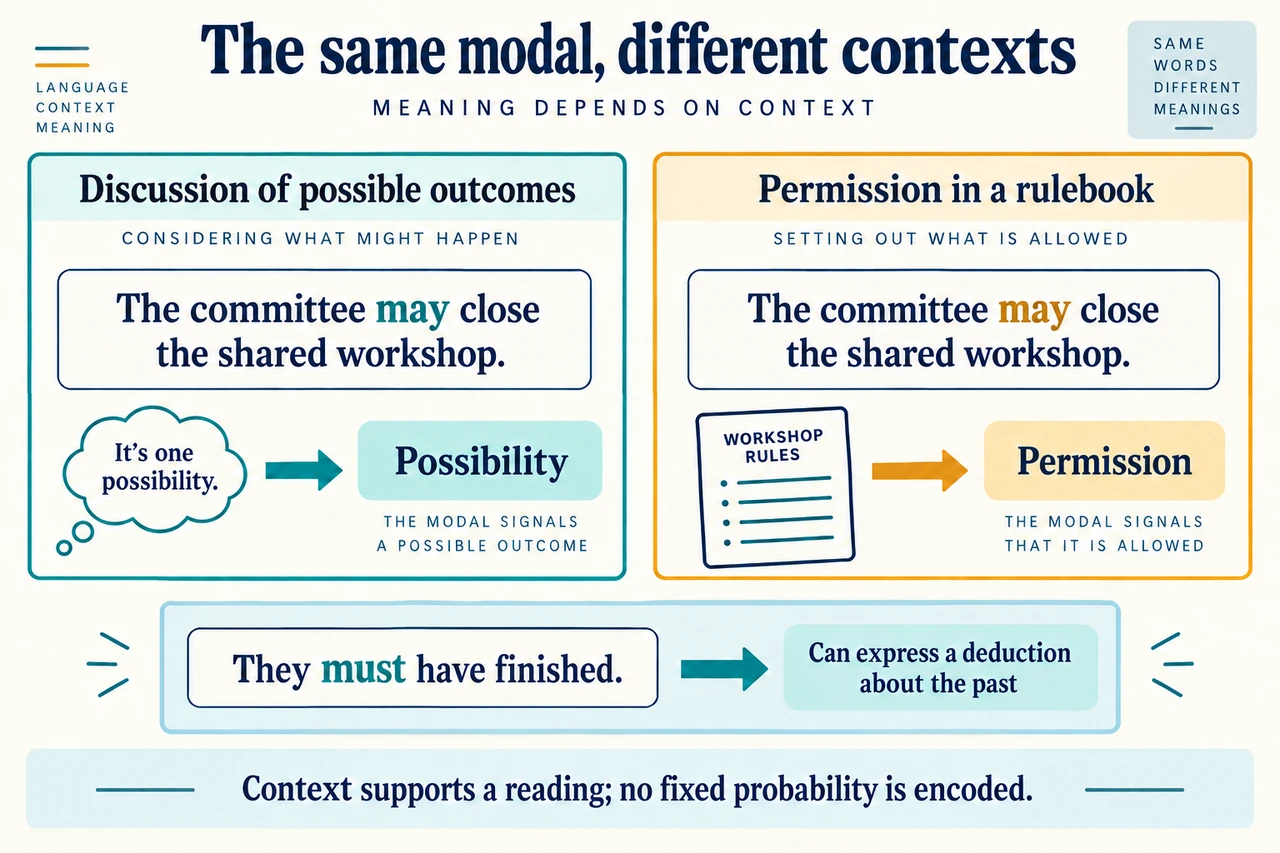
myAudience original rendered educational illustration. Image: illustration, not a documentary photograph. · Original generated educational concept plate; retained generation provenance; no third-party text or logos.
Lexis, semantic framing and modality
Lexical choices and grammatical choices work together in representation. Denotation concerns what an expression conventionally refers to; connotation concerns associations that may accompany its use. Neither makes meaning independent of context. Calling a room a ‘shared workshop’ foregrounds collective use, while ‘the committee’s premises’ foregrounds a different relationship. Those descriptions might refer to the same location, yet their wording selects different aspects for attention.
A semantic field is a set of words associated with an area of meaning, such as permission or repair. Identify patterns with precise textual evidence rather than claiming that one isolated word establishes a whole field. Collocation concerns recurring combinations in usage; an apparent combination in one invented sentence is not proof of an empirical frequency pattern. A corpus or other appropriate collection can test recurrence, provided its scope and sampling are understood.
Modality qualifies how a proposition or action is presented. Epistemic readings concern possibilities or conclusions about what is the case; deontic readings concern permission or obligation. ‘The committee may close the shared workshop’ can present closure as a possible outcome in discussion, or grant permission in a rulebook. The modal form is the same. The surrounding situation and wording support the interpretation rather than a universal may-equals-permission rule.
‘The committee must close the shared workshop’ may impose an obligation under a supplied policy. In another context, must can express a deduction, as in ‘They must have finished’ when the speaker reasons from a completed task. Distinguish the speaker’s degree of commitment from whether the conclusion is actually true. Modal wording does not encode a fixed numerical probability, and it does not compensate for weak evidence about an event.
Form also constrains your analysis. In ‘may close’, may is a modal auxiliary followed by the plain verb close; in ‘must have finished’, have introduces a perfect construction and finished is a past participle. A past-event deduction differs from a simple command to finish. Read the whole verb group and its time context before assigning a meaning. A single keyword search for must would miss those relationships.
Representation includes who can act, who grants permission and whose needs are named. A rulebook may make committee authority explicit while leaving workshop users’ perspectives absent. That is an observation about the selected example, not proof of the writer’s hostility or the committee’s actual power. Ask whether surrounding clauses identify consultation, conditions or alternatives. An interpretation grows stronger when it accounts for qualifying evidence rather than removing it.
Evaluate contrasting versions rather than assuming that cautious wording is always better. Changing must to may can alter an obligation into a permission or possibility and therefore misrepresent a genuine rule. Conversely, turning a possible outcome into a categorical statement can overstate the available evidence. The relevant standard is whether the wording matches the intended communicative task and the supplied knowledge, not whether it contains more hedging.
The plate keeps the sentence with may constant while changing the stated context, then supplies a separate must-have example of possible deduction. Its arrows illustrate warranted readings, not an automatic interpretation engine. No probability scale is shown because neither modal supplies a numerical likelihood. These original examples provide controlled practice; they do not establish how all dialects, audiences or institutions use modals, or complete the course’s lexical and semantic breadth. Image: illustration, not a documentary photograph.
Worked example: Explain why the same may sentence has different warranted readings in a discussion and a rulebook.
The repeated sentence ‘The committee may close the shared workshop’ shows that identifying a modal auxiliary is only the start of analysis. Its interpretation depends on what the text is doing. In a discussion of possible outcomes, may supports an epistemic reading: closure is presented as possible rather than certain. In a rulebook that grants authority, the same form can have a deontic permission reading. Neither interpretation follows from the word may alone.
The grammatical structure is stable in both versions. ‘The committee’ is the subject noun phrase, may is a modal auxiliary, and close is the plain form of the lexical verb. ‘The shared workshop’ is the direct object. Consequently, the contextual contrast does not require inventing a different sentence structure. It concerns the relationship between a proposition, the producer’s knowledge and a rule-making situation.
In the discussion context, calling closure possible does not tell us its numerical probability or whether it will happen. Other clauses might identify alternatives, evidence or uncertainty. In the rulebook context, granting permission does not assert that the committee will exercise it. Conditions elsewhere in the rules could also restrict that authority. An analysis that converts either version into ‘the workshop is definitely closing’ would erase a significant distinction.
The adjective ‘shared’ foregrounds collective use, which might make users’ interests relevant to the discussion. However, one adjective does not prove that the committee consulted them or that the writer supports closure. We would need the surrounding argument and evidence of actual participation to make those stronger claims. This is where lexical representation and modality interact without establishing a hidden motive.
A useful contrast is ‘They must have finished’ in a context where a speaker reasons from the completed arrangement of a room. Here must can express a deduction about a prior event. Its certainty is the speaker’s stance, not independent confirmation of what occurred. A deadline instruction using a perfect construction could require a different reading, so time and situation remain essential.
The justified conclusion is that the repeated may sentence makes different relationships available in the two supplied contexts. Describe the form precisely, explain the contextual warrant, and preserve the difference between permission, possibility and actuality. This method produces a stronger account than assigning one fixed meaning or probability to each modal.
Answer: In a discussion of possible outcomes, may close supports a possibility reading; in a permissions context the same form can permit closure. Must can express obligation, while must have finished can support deduction in a retrospective context. Interpret the whole clause and supplied situation rather than assigning a universal function or fixed numerical probability.
Check your understanding: At nine, a speaker sees the equipment packed and says “The volunteers must have finished before eight.” Does must necessarily impose an obligation? Evaluate the reading and its limits.
Answer: No. In the supplied retrospective context, must have finished can express the speaker’s deduction about a prior event. The packed equipment supplies a reason for that inference, but it does not independently establish the precise finishing time: someone might have packed it later, or some work might remain. A different prospective instruction, given before a deadline, could use a similar perfect construction to require completion by a time. Analyse the complete verb group and time context rather than treating must as invariably deontic. The speaker’s strong commitment is not a numerical probability or proof that the conclusion is true.
Why: A justified answer keeps the supplied linguistic forms and evidence exact, explains alternatives and limits, and does not invent speaker intentions, research outcomes or assessed completion.