Pragmatics, discourse and transcription limits
By UK A Level English Language · independent study · myAudience
myAudience original rendered educational illustration. Image: illustration, not a documentary photograph. · Original generated educational concept plate; retained generation provenance; no third-party text or logos.
Pragmatics, discourse and transcription limits
Pragmatics examines language in use: how a listener can make sense of an utterance in relation to a situation. Discourse analysis also examines connections across stretches of communication rather than treating each sentence as isolated. Before analysing a conversation, state what evidence the record contains. A script with words and turn order does not supply audio, timing, gesture or participants’ private thoughts. Those omissions limit what you can claim.
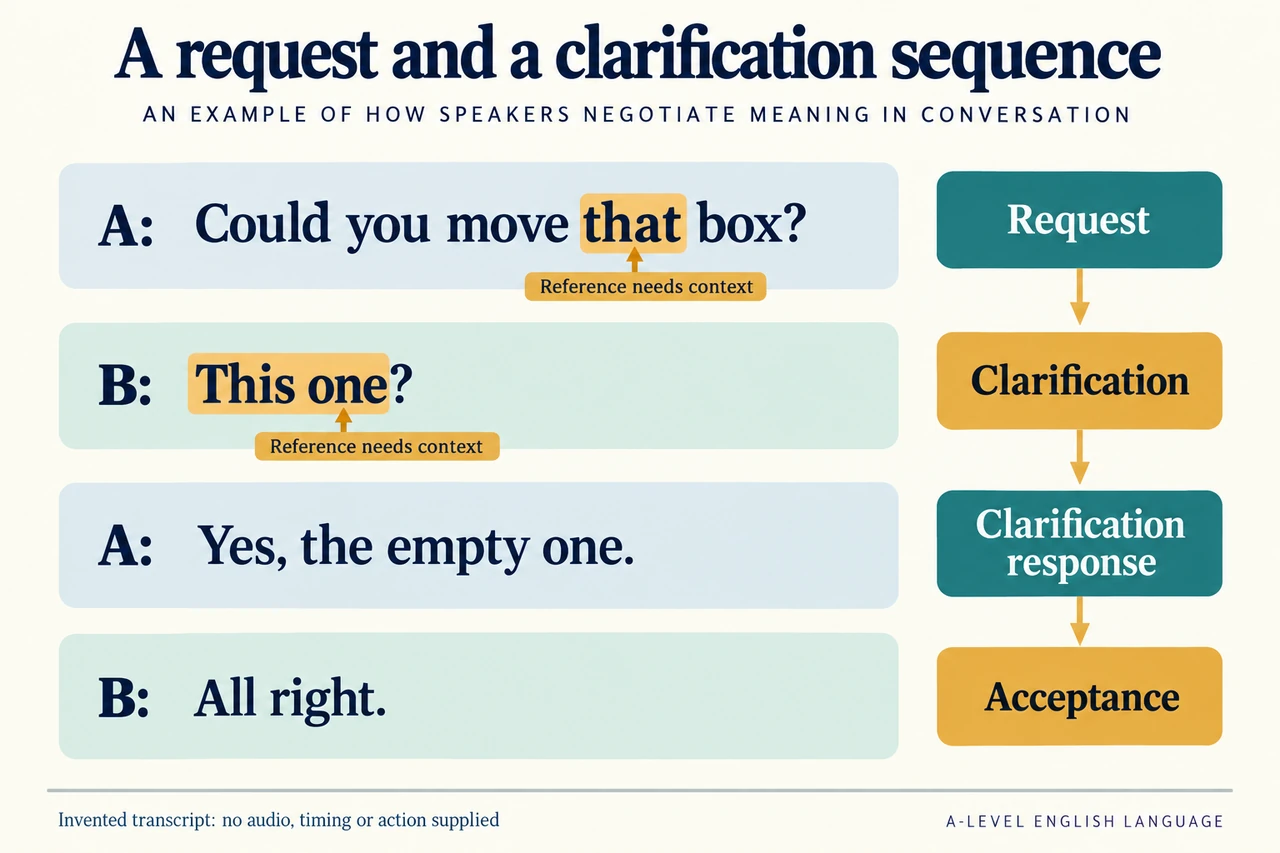
Read our original invented four-turn script: A: ‘Could you move that box?’ B: ‘This one?’ A: ‘Yes, the empty one.’ B: ‘All right.’ The speaker labels identify turn order only; they do not establish age, gender, occupation or status. No pause, overlap or intonation is marked. Treat this as a controlled example for reasoning, not a recording, a representative sample or a finding about a social group.
The first turn has interrogative form, but in a practical box-moving situation it can function as a request. A reply that merely describes physical ability could fail to address that request. Yet the function depends on context: in an ability assessment, the same words might have a more literal use. Separate the clause form from the action it plausibly performs, and explain why the supplied situation supports your interpretation.
‘That box’ and ‘This one’ require a referent available in context. The script does not locate the boxes. B’s second turn asks for clarification rather than completing the requested action, and A’s third turn supplies the distinguishing property ‘empty’. We can describe that clarification sequence without claiming that B was deliberately obstructive. Resolving a reference can be necessary for successful coordination.
The final ‘All right’ is compatible with acceptance of the request. It does not show the physical action occurring. Someone can agree and later be interrupted or fail to move the object. Track the difference between an interactional response and an observed outcome. That distinction prevents an analysis of words from being presented as proof of task completion or relationship quality.
A transcript needs a transparent convention when it represents actual speech. Speaker labels, pause lengths, overlapping talk and emphasis should correspond to documented evidence, and uncertain or inaudible portions should be marked rather than guessed. Here there is no audio to transcribe, so adding a long hesitation or a sarcastic tone would manufacture data. Accuracy sometimes requires keeping an attractive interpretation out of the record.
If the final turn becomes ‘I am carrying the equipment’, the sequence becomes more ambiguous. The statement may explain why B cannot move the box immediately, indirectly decline, or propose that A should do it. A subsequent action or reply could help distinguish those readings. Consider plausible alternatives in the actual activity instead of labelling the speaker unhelpful or assigning emotion from one line.
The plate shows the request, clarification, clarification response and acceptance in order, with references highlighted. Its arrows trace the supplied turn sequence, not a measured causal effect. The footer identifies missing audio, timing and action; all four words-only cards are synthetic. Practising this bounded analysis prepares you to ask better questions of real interactional data, while authentic transcription, prosodic analysis and broader discourse research remain to be learned and independently assessed. Image: illustration, not a documentary photograph.
Worked example: Analyse the four-turn invented exchange, keeping interactional evidence distinct from unobserved actions.
The invented exchange shows how a request can be clarified before it receives an acceptance. Its most secure evidence is the wording and the sequence of turns. There is no audio, gesture or timing record, so claims about sarcasm, interruption or either participant’s emotional state would exceed what is supplied.
A’s ‘Could you move that box?’ uses an interrogative construction to request an action in the practical situation. The modal could contributes to the request form; the utterance is not naturally limited to seeking a report of B’s physical ability. Nevertheless, that interpretation depends on context. In a mobility assessment, a similar question might seek information about capability rather than ask for immediate action. Recognising this alternative makes the contextual explanation more precise.
The phrase ‘that box’ assumes an identifiable referent. B’s ‘This one?’ shows that identification needs to be checked. Rather than completing the request, this turn inserts a clarification. A’s ‘Yes, the empty one’ confirms and elaborates the reference by adding a property that can distinguish the object. The sequence supports an account of practical coordination without proving that B is resisting, confused generally or deliberately delaying.
‘All right’ can then be understood as acceptance in relation to the preceding request and clarification. That response differs from evidence that the box actually moved. We have no action description after the fourth turn; claiming successful completion would mistake an agreement for its eventual outcome. Even acceptance itself could be qualified by further context not present in this short script.
The interaction does not identify who holds authority. A is the requester and B the addressee, but those local roles are not equivalent to permanent social rank. A concise clarification could occur among friends, colleagues or strangers sharing a task. A strong analysis therefore explains the relationships enacted in these turns without inventing biographies.
The illustration makes the sequence easy to trace, but it cannot fill the evidential gaps. The justified conclusion is that the script contains a question-form request, a reference clarification, a confirmation and a compatible acceptance. To evaluate how the request was received in a real encounter, we would need appropriately collected surrounding talk, relevant actions and, where necessary, audio. Those additional sources should test the interpretation rather than merely decorate it.
Answer: The question-form request is followed by a clarification about the referent, a clarification response and expressed acceptance. That and this one depend on context; All right does not show that the box was moved. Without audio, timings or actions, the script supplies neither measured hesitation nor proof of speaker motive.
Check your understanding: Replace B’s final “All right” with “I am carrying the equipment.” Is this necessarily a refusal? Explain at least two plausible readings and the evidence that would distinguish them.
Answer: It is not necessarily a refusal. The statement could explain a temporary difficulty and postpone compliance, or indirectly decline by presenting a competing task. It might also invite A to choose another helper. The wording itself does not settle which action B intends. The subsequent response, relevant physical activity and fuller conversation could discriminate among these readings: B might finish carrying and then move the box, suggest another arrangement, or explicitly decline. Do not invent those events as if they were recorded. Preserve the request-and-clarification analysis already supported by the earlier turns, but revise the claim of acceptance because the new final turn supplies different evidence.
Why: A justified answer keeps the supplied linguistic forms and evidence exact, explains alternatives and limits, and does not invent speaker intentions, research outcomes or assessed completion.